Imagine paying for a room full of GPUs, then watching them wait for a file to arrive. That is the awkward arithmetic behind much of modern AI: the expensive machine is ready, the durable storage is doing its job, and the route between them is congested. Alluxio has spent more than a decade trying to make that route shorter. Its software forms a distributed cache between applications and storage, placing frequently used data near the machines that need it. The name may sound like a mineral; the product is closer to a well-run loading dock.
The short version
- Alluxio sits between compute and persistent storage, caching hot data close to the workload.
- Its roots are in UC Berkeley’s Tachyon research; today it sells enterprise editions for AI and analytics.
- Fireworks AI says the cache cut large-model loading from 20-plus minutes to 2–3 minutes in a demanding deployment.
- The strongest case is repeated or bursty data access. A compute-bound job has little to gain.
A thesis with excellent timing
Founder Haoyuan Li began the work as Tachyon, a Ph.D. research project at UC Berkeley’s AMPLab. The immediate problem was data sharing around Apache Spark. In a distributed system, one program finishes work and another needs the results; making each handoff travel through slow storage can turn an elegant computation into a procession of delays. Tachyon offered a memory-first, shared data layer. Alluxio, founded in 2015 with co-founder Amelia Wong, carried that idea out of the lab.

The original attraction was broad: one access layer could connect applications such as Spark and Presto with stores such as HDFS, S3, and Google Cloud Storage. Data could be presented through a common namespace and cached in memory or on faster local disks. Teams could choose where compute ran without first rebuilding every application or copying an entire lake. The same separation of compute and storage that made cloud systems flexible also made distance, network bandwidth, and object-store latency newly visible.
That is the company’s position in the market today. Alluxio does not sell a replacement for durable object storage. It sells the middle layer that makes that storage feel nearby to data-hungry software. Its free community edition remains an open-source route into analytics workloads. Its paid Enterprise Data product targets query performance and unified access; Enterprise AI is built for model training, distribution, inference, and checkpoint operations. The commercial package adds scale, enterprise controls, support, and services. Public list pricing is unavailable, so the bill depends on a sales conversation and the hardware used for the cache.
The pipeline that ran out of road
Fireworks AI provides the clearest public account of the mechanics. Its inference platform deploys large models across multiple GPU clouds. Model weights can be 70 GB to more than 1 TB, and a rollout can send 100 or more replicas after the same files at once. Before Alluxio, Fireworks used a custom pipeline: download from primary object storage, copy into regional stores, then rely on simple caching on each GPU server. It worked at smaller scale. As deployments became larger and more synchronized, the inbound network and object-store rate limits became the choke points. Model loads that should have taken minutes could stretch beyond an hour.
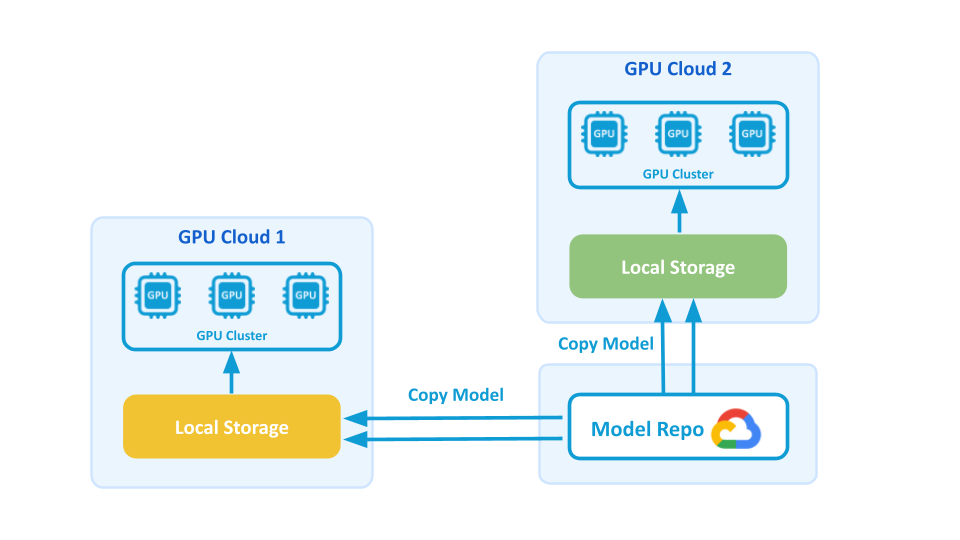
Fireworks placed Alluxio’s distributed cache directly on GPU hosts, using their local NVMe drives as pooled capacity. When a file is absent, the cache fetches it from the repository. Later reads can come from the nearby pool. Kubernetes manages the deployment across clusters. Fireworks kept the durable model repository in GCS and S3-compatible storage; the cache became a temporary acceleration layer, not a second permanent truth. That distinction matters because a second truth requires its own synchronization rituals, and rituals are where infrastructure teams lose Fridays.
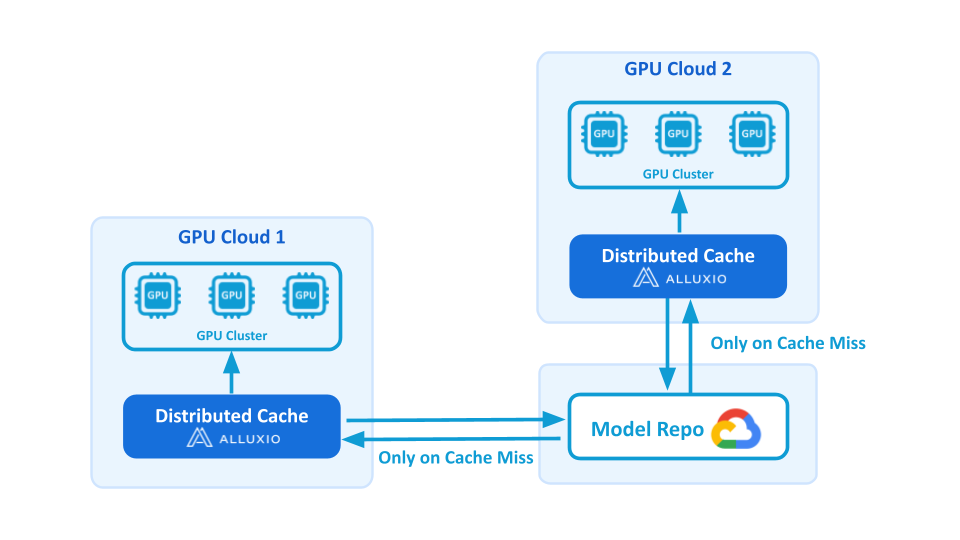
Those are Fireworks’ reported results, not a universal service-level promise. Its case study gives useful conditions: a fleet with more than 100 replicas loading huge models, high internal bandwidth, local NVMe, and repeated access that can produce 90% to 100% cache hit ratios. The company says 800 GB-plus models now load in about 2–3 minutes per replica under that pattern, compared with 20-plus minutes before. It also reports aggregate throughput of 800 GB/s to more than 1 TB/s and halved egress costs after removing staging tiers.
“What used to take hours now takes minutes.”Akram Bawayah, Fireworks AI software engineer
The first cache miss is a clue
There is a revealing footnote in the Fireworks story. Preloading very large model files was slower than expected even when raw bandwidth appeared sufficient. Alluxio and Fireworks traced part of the trouble to load jobs splitting each file into many small 8 MB partitions, an approach suited to data-lake work rather than giant model artifacts. They changed the warmup path. In other words, the cache needed tuning to the shape of the workload. “Add a cache” is easy to say. Deciding what to preload, how to partition it, and how cold reads behave during a synchronized rollout is the actual engineering.
The same principle appears in a different costume at Dyna Robotics. Its training system produces multi-camera video and telemetry from real robot interactions, then reads large collections of HDF5 trajectory files on H100 clusters. Alluxio describes pooling SSDs across GPU nodes while GCS remains the system of record. The researchers keep a POSIX-style access path; the platform team gets near-compute caching and the option to fall back to direct object storage. In August 2025, Alluxio named Dyna alongside Salesforce and Geely as new customers in the first half of that year.
Alluxio’s product roadmap follows the operational objections that arrive after a speed demo. Enterprise AI 3.7, released in 2025, added a sub-millisecond time-to-first-byte capability for cached cloud data, faster parallel preloading, and role-based access control for S3 access. A June 2026 announcement paired the software with Oracle Cloud Infrastructure for AI workloads. These releases suggest a company narrowing its pitch: less abstract “data orchestration,” more concrete GPU utilization, startup time, and access control. Its older analytics business remains part of the product line.
Where the middle layer earns its rent
The alternative is often familiar rather than exotic: direct reads from S3, a homegrown regional copy pipeline, or a parallel file system. Alluxio’s appeal is strongest when applications revisit data, when many workers request the same artifact, or when compute shifts between clouds and regions. A software cache can use existing object storage for durability while buying speed with local SSD capacity. It also adds something to operate: cache sizing, warmup, eviction, consistency expectations, and security policy all become real decisions. A cold cache still has to go to the origin.
Alluxio’s own open-source FAQ gives a welcome boundary: if a job is mainly limited by computation rather than I/O, faster data access may do little. The same is true when storage is already local and the operating system serves the data efficiently from its cache. That is the test a buyer can copy. Measure GPU idle time and storage waits first. Inspect whether the same bytes are requested repeatedly. Then compare cold and warm runs, count cache misses, and include the cost of NVMe capacity and operations in the calculation. A lower benchmark latency alone will not pay the invoice.
The company raised a $50 million Series C in 2021 to expand product development and global operations. The sum bought time to pursue a market that has since become rather more impatient. Alluxio now sits in the unglamorous but lucrative space between the durable place where data lives and the expensive place where it is used. The insight has not changed much since Tachyon: make the next byte travel less. What changed is the price of making a processor wait for it.
Performance figures above describe published customer deployments and benchmarks. Results depend on model size, cache warmth, network design, storage behavior, and workload mix.