Dealfront made a living from an awkward truth: plenty of interested buyers visit a B2B website and leave without introducing themselves. A pricing page gets opened, a case study gets read, perhaps somebody returns on Tuesday. Analytics records the motion. The sales team sees nobody. Dealfront tried to put a company name beside that motion, add context, and send the useful bits where a rep might act on them.
That makes the platform most useful to a particular crowd. You sell to businesses, your site receives enough traffic to produce a signal, you know which kinds of accounts matter, and somebody owns follow-up. Marketing teams can inspect whether campaigns attract suitable companies. SDRs can prioritize warm accounts instead of opening another cold spreadsheet. RevOps can route activity into a CRM. Agencies can separate a client's real audience from an impressive but commercially empty traffic chart.
There is one timely complication. Dealfront no longer exists as the customer-facing brand. On March 24, 2026, the company renamed the whole platform Leadfeeder. Existing subscriptions, product access, saved lists, pricing, contracts and integrations stayed put, according to its migration FAQ. Dealfront.com now redirects to Leadfeeder. This guide uses Dealfront for the product people bought and Leadfeeder for its current checkout counter.
The dashboard's valuable moment is not “a company visited.” It is “a suitable company came back, and the right person heard about it.”YesPress verdict
The two-company origin story
Dealfront was assembled rather than invented from scratch. Echobot began in Karlsruhe in 2011, building European company and contact intelligence. Leadfeeder followed in Helsinki in 2012, concentrating on the businesses hidden inside website traffic. In June 2022, the pair merged with a €180 million investment from Great Hill Partners and another €50 million reserved for acquisitions. The combined operation reported about 8,500 paying customers at the time.
The fit was pleasingly literal. Echobot knew a great deal about European companies; Leadfeeder knew when one of those companies appeared on your website. Their adviser introduced them after discovering that each had plans to build pieces the other already owned. In April 2023, the joined platform got the Dealfront name and a pitch built around winning European markets.
Growth continued. A €30 million financing in late 2024 supported expansion and acquisitions. In March 2025 Dealfront bought WiredMinds, a Stuttgart company that had worked on website visitor intelligence for more than two decades. Two months later it released Dealfront AI globally, adding plain-language activity summaries, company research and natural-language contact search. Then came the reverse rebrand. Leadfeeder, once a module inside Dealfront, became the name above every module.
What the machine actually does
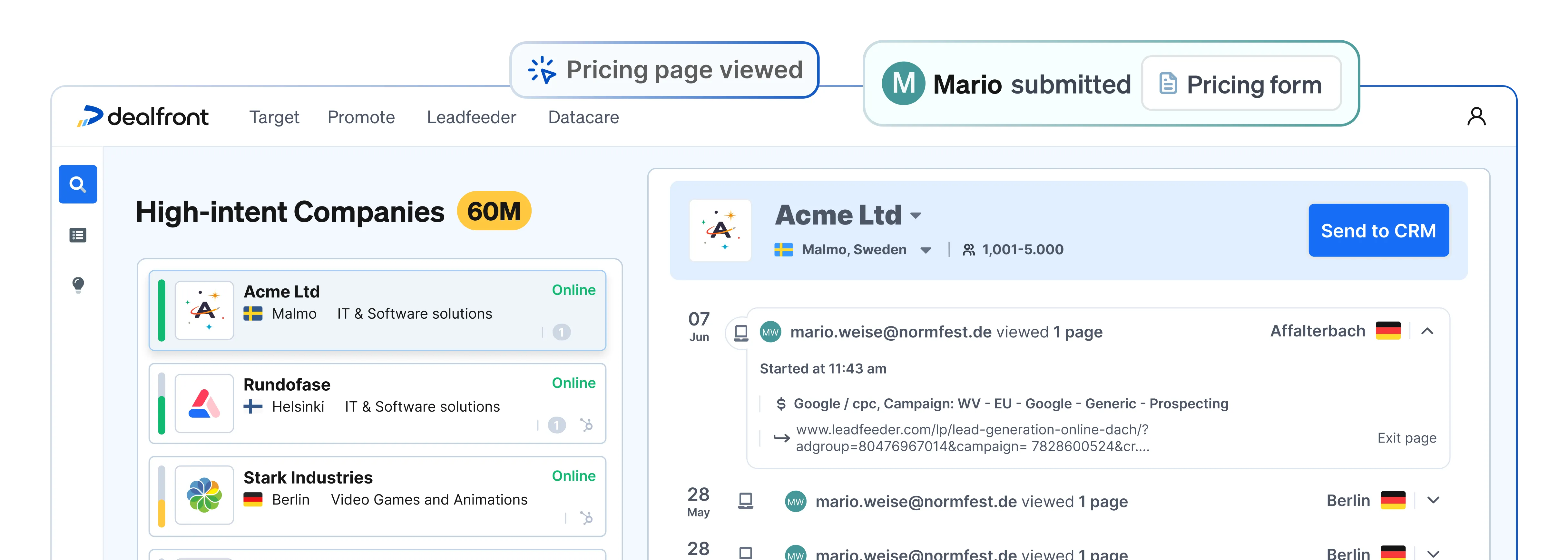
Install the tracking script and the visitor product attempts to resolve business traffic through Dealfront's proprietary IP-to-company data. It shows the company, sessions, pages viewed, acquisition source and recency. Filters remove bots, service providers and irrelevant traffic. Teams can create feeds for target accounts, regions or behaviors, then trigger alerts when the pattern becomes interesting.
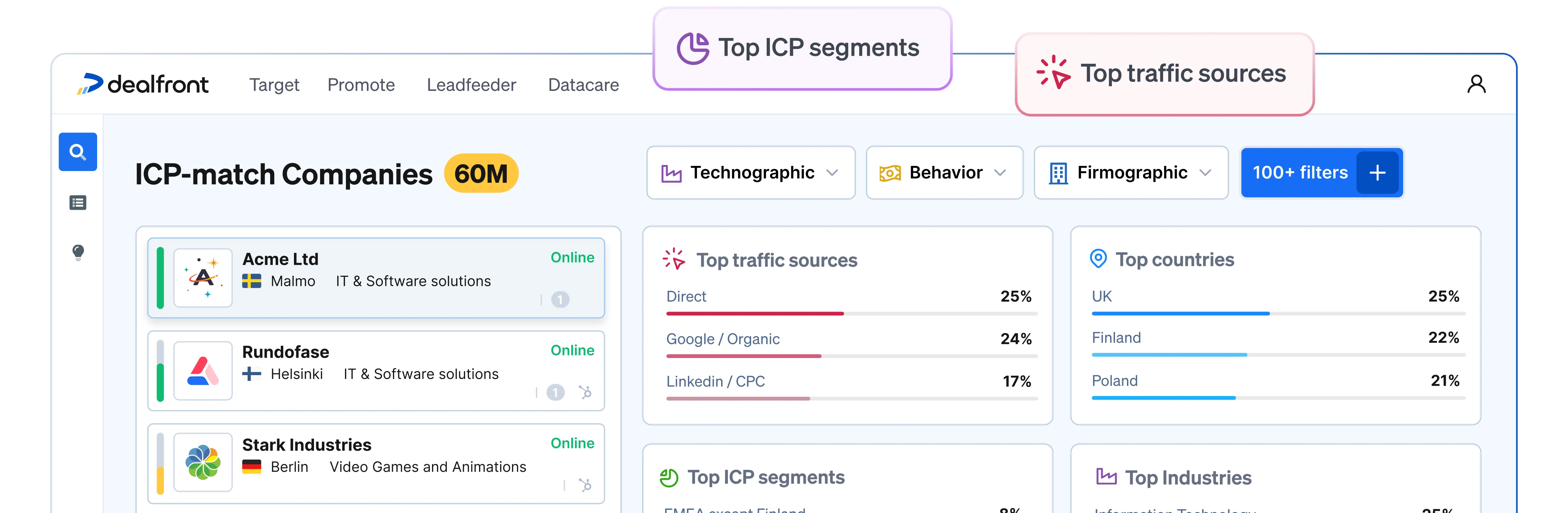
The old Target module expands the hunt beyond current visitors. Users search companies with more than 100 filters spanning location, industry, size, technology and behavior. Company profiles add firmographics, news, financial detail and sales triggers. Contact search suggests people at those organizations. Lists can move into HubSpot, Salesforce, Pipedrive, Microsoft Dynamics 365 or Zoho, with Zapier covering additional routes. Promote, renamed Campaigns in 2026, applies selected company audiences to display advertising.
The AI layer sits across this sequence. Activity Summary translates a visit trail into prose. Company Insights answers research questions such as whom a firm sells to or which technology it uses. AI Contacts accepts a natural-language description of the person you need, useful when job titles refuse to behave. These tools can reduce research time, though their answers still deserve the same source-checking and human judgment as any generated summary.
The privacy promise, with its useful limit
Dealfront's European posture is central to the purchase. The company says its business data draws on public sources including national trade registers and chambers of commerce, enriched with firmographic and financial information. Its compliance materials list European hosting and processing, GDPR controls, source transparency, plus ISO 27001 and ISO 27701 certifications. The history on a company profile matters in markets where local registries, languages and corporate structures are easy for a US-first database to flatten.
The boundary is equally important: visitor identification generally names the company, not the human being at the keyboard. A list of likely contacts is context, not proof that Klaus from procurement read the pricing page at 11:43. Treat it as an account signal. Outreach should refer to a relevant business problem or timely event, never pretend to have watched an individual browse. That restraint is both more credible and less creepy.
Reviews praise the window, question the bill
Public reviews tell a coherent story. TrustRadius summarizes praise for visitor tracking, prospect identification, an approachable interface and CRM connections. A verified marketing director described using it to measure the share of ideal-customer traffic and understand journeys through the site. Other users value account assignment, tagging and the ability to relate campaigns to visits.
The friction is practical. G2's review summary records complaints about expense, credits, missing data and filters, plus a learning curve around automation. Capterra's published breakdown places ease of use above value for money. A critical January 2026 review objected to data quality and an automatic contract renewal. An older TrustRadius reviewer reported unresolved Microsoft Dynamics integration problems. Those experiences do not predict every deployment, but they suggest a good buying checklist: test your countries, your CRM and your renewal language with real records before signing.
| Choose this route | When it fits | Watch closely |
|---|---|---|
| Dealfront / Leadfeeder | European B2B data, website intent and CRM activation in one workflow | Credits, regional coverage, contract terms |
| Cognism or ZoomInfo | Contact-led prospecting and large sales-data programs | Regional depth, compliance model, cost |
| 6sense | Enterprise ABM orchestration and multi-source intent | Implementation weight and budget |
| Snitcher, Albacross or Lead Forensics | A narrower visitor-identification brief | Data enrichment and workflow breadth |
| Apollo.io | Outbound contact data and sequencing at a more accessible entry point | European register depth and visitor intelligence |
Pricing: test the signal before buying the system
Current Leadfeeder pricing offers an unusually sensible starting point. Lite costs €0, supports unlimited users, and shows the last 100 identified companies with seven days of history. Discover starts at €79 a month when billed annually, Activate at €369, and Scale at €599 with annual commitment. Monthly options cost more where offered. Identified-company allowances and credits are tiered; credits pay for enrichment, exports and activation rather than the basic act of identifying a visitor.
That structure can become expensive as traffic and workflow ambitions rise. It also creates a clean experiment. Run Lite on a representative site. Agree on an ICP before looking at results. Create one alert for a high-intent action, assign one owner, and log what happened. Count qualified meetings and pipeline, not revealed logos. If the trial produces a handsome mosaic of companies that nobody contacts, the subscription will only buy a larger mosaic.
Give the test enough time to catch repeat visits, and compare identified accounts with the opportunities already in your CRM. Ask sales whether the alerts arrived with enough context to write a credible message. Ask marketing whether the channel data changed a spending decision. Finally, sample companies that the product failed to resolve. A modest hit rate on valuable traffic may beat a crowded feed of weak matches, but only your own domain, geography and audience can settle that arithmetic.
Who should buy it?
Good fit: B2B teams selling into Europe, especially DACH and the Nordics, with useful web traffic, defined accounts and disciplined CRM follow-up.
Weak fit: B2C sellers, tiny sites, teams seeking the exact identity of every visitor, or global contact-volume buyers whose priority is thousands of inexpensive verified emails.
The verdict
Dealfront's name has become historical, but the underlying idea remains sound. A company browsing your site can be a better starting point than a stranger selected from a generic database. European source depth makes the proposition more specific than a reverse-IP novelty. The broader suite can carry that signal through research, audience building, advertising and CRM action.
Success depends on operational habits the software cannot supply. Somebody must define fit, suppress noise, respect the line between a company and a person, and follow up while the interest is fresh. Buyers should also pressure-test data in their actual territories and read the commercial terms without the demo glow. Do that, and the free tier offers a fair audition. Dealfront may have lost its badge, but its best clue still points in the right direction.