A promising prospect opens the pricing page at 10:07, reads the enterprise copy, disappears and leaves the sales team none the wiser. RB2B is built for that small, expensive silence. Add its pixel to a website and a portion of those visits reappear as people or companies, complete with enough professional context to decide whether anyone should care. The alert can land in Slack, Microsoft Teams, a CRM or an outbound workflow while the visit is still fresh.
That is the product’s whole argument, and it is a good one. Conventional analytics tells you what a crowd did after the crowd has gone home. RB2B tries to tell you who just walked through the room. The useful outcome is not a giant lead list. It is a small number of well-timed clues for teams that already know their ideal customer.
Who is this actually for?
RB2B makes sense for a lean B2B company with meaningful U.S. website traffic, a crisp ideal-customer profile and somebody ready to follow up. Founder-led sales teams can use it as a tap on the shoulder. Demand-gen teams can learn whether campaigns attract the right accounts. SDRs can prioritize a person who has already shown intent instead of working another cold list from the top. Revenue operations teams can route visits into systems they already maintain.
There is no published traffic minimum, but economics still applies. A quiet site with little U.S. traffic will produce few person-level matches. A busy consumer site will produce noise. A B2B site whose pricing, demo and competitor pages attract recognizable buyers is the sweet spot. The product becomes more valuable when the team can describe a qualified visitor before the first alert arrives.
How the trick works
Installation starts with a JavaScript snippet in the site header. RB2B says its matching process uses first- and third-party cookies, device identifiers and IP-address analysis, then enriches a successful match with professional data. The company says the script collects an IP address, user agent, hashed identifiers, current and referring URLs, and a timestamp. Demandbase reverse-IP data supplies the company-level layer.
Profiles can include name, title, LinkedIn URL, business email, company, industry, employee count, estimated revenue, location, referring page and visit history. No match is guaranteed, and not every field appears every time. Cookies, geography, consent state and the underlying identity network all affect the result.
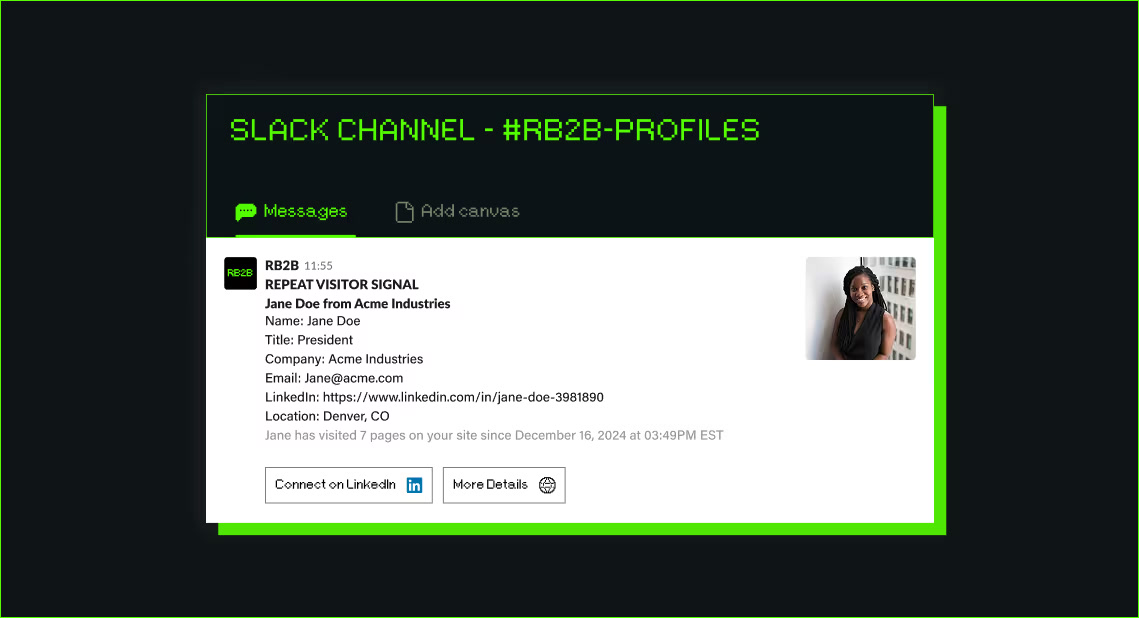
The feature that keeps the room quiet
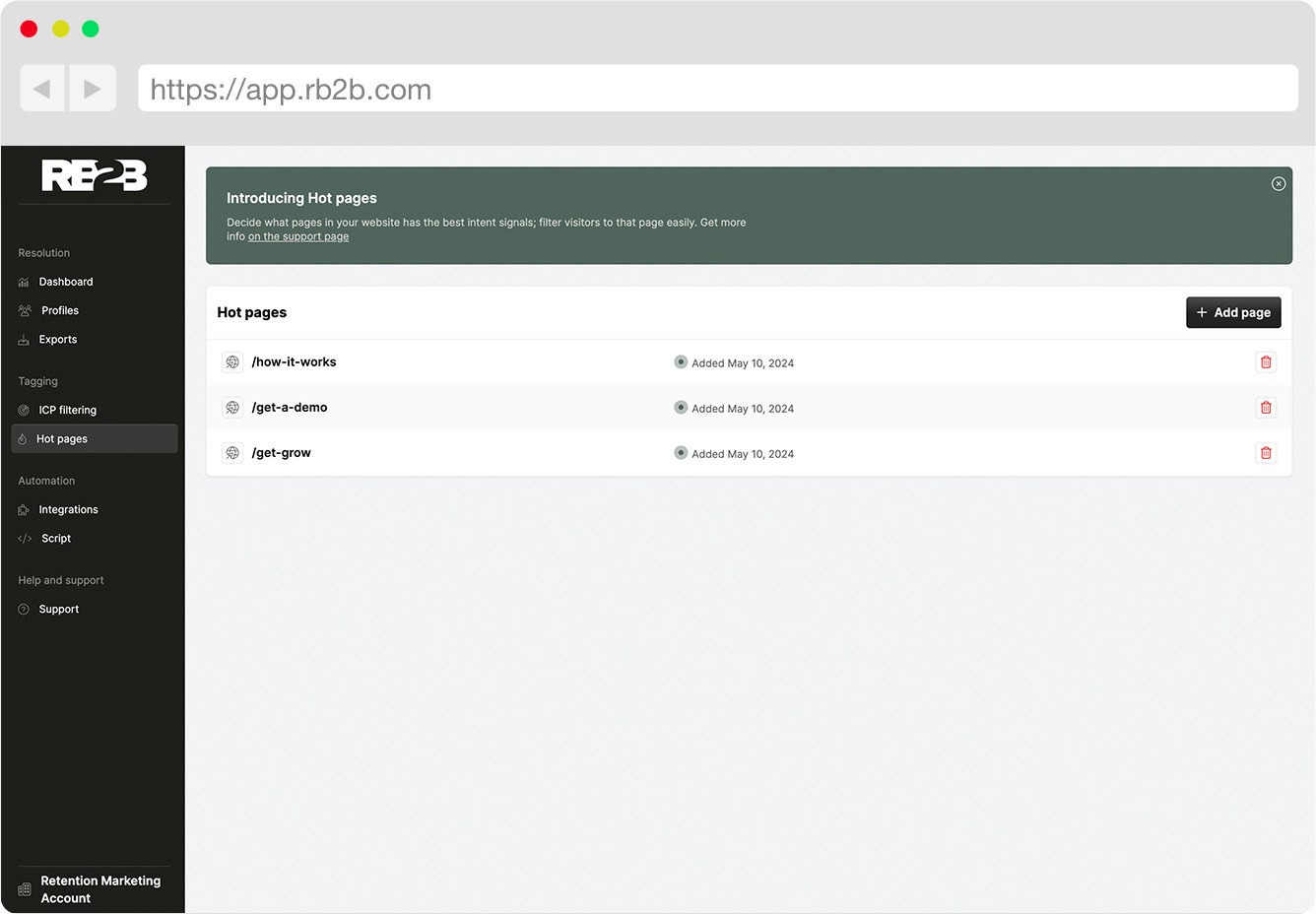
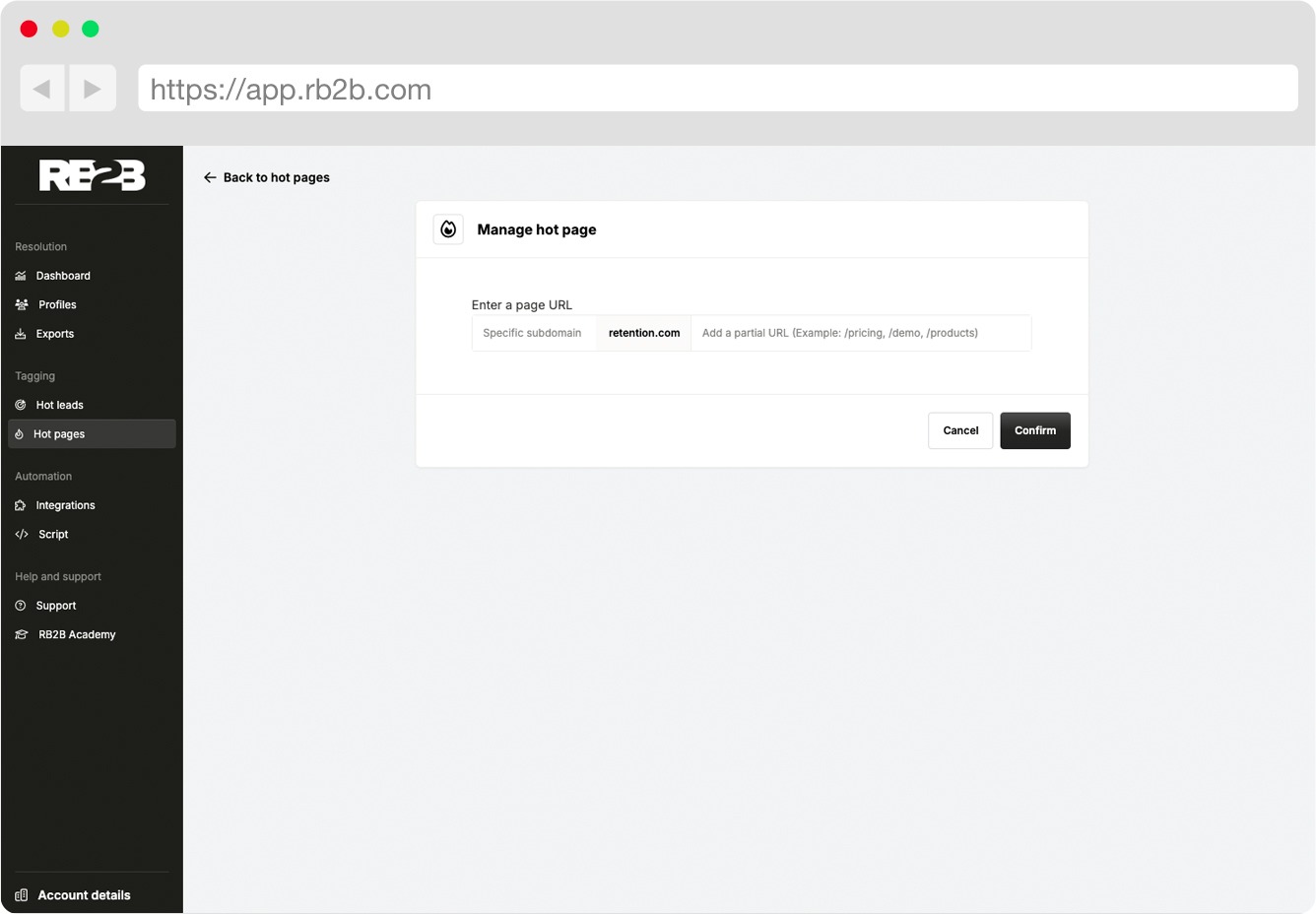
Raw identity alerts become annoying quickly. RB2B’s more important controls are Hot Pages, Hot Leads and suppression. Hot Pages tag visits to URLs that signal intent, such as pricing, demo or comparison pages. Hot Leads filters by company size, revenue, industry, geography, seniority and department. Suppression removes careers pages, customer logins, broad editorial traffic or domains your team never wants to chase.
Those controls turn a clever demo into a workable habit. A head of growth visiting the pricing page can go to an account executive. An existing customer visiting documentation can stay out of the prospect channel. An investor visiting a company page can ping the founder. Different filters can feed different integrations, which is far saner than putting every recognizable visitor in one noisy Slack channel.
Coverage needs two numbers
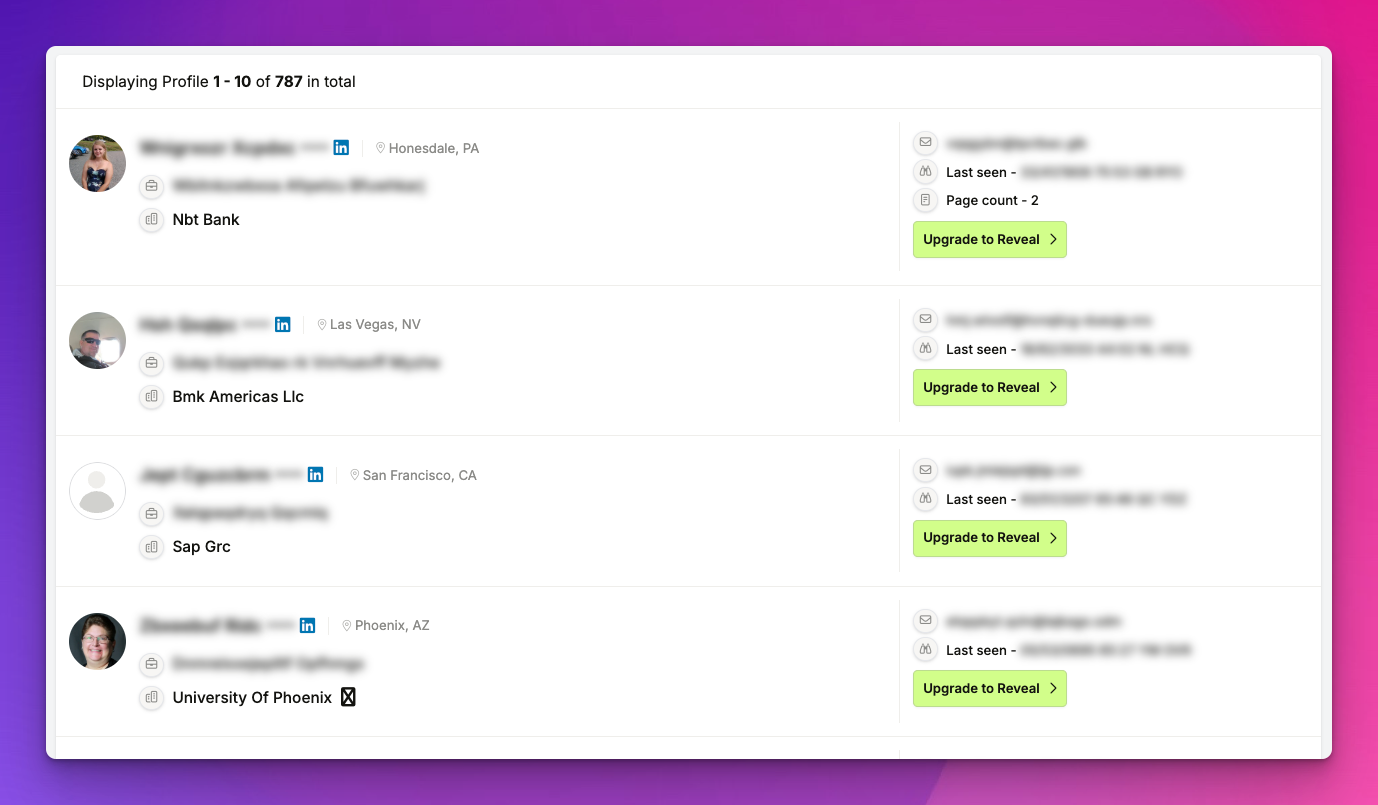
RB2B’s home page advertises identification of 70 to 80 percent of traffic, but buyers should unpack that figure. The current plan table separates contact-level and company-level coverage. Starter lists roughly 15 to 20 percent contact coverage, while Pro and Pro+ list roughly 35 to 45 percent. Company-level matching adds another layer, including global accounts through Demandbase. The combined headline number is useful for describing total signal, not a promise that eight of ten visitors will arrive with a name and email.
Users notice the gap. One April 2026 G2 reviewer wrote, “The percentage identified is low,” while adding that privacy standards make this a category-wide problem. Another solo founder liked the insight but called the paid versions expensive and the interface “lo-fi.” That is a fair summary of the trade: fast, unusually specific signals, delivered with partial coverage and a deliberately plain workbench.
Plans without the fog machine
Every new account gets a seven-day full-featured trial. After that, Free keeps 150 monthly company-level resolutions but masks person details. Starter costs $79 per month for 300 resolutions and sends person-level LinkedIn URLs to Slack or Teams, without email addresses or the broader integration catalog. Pro begins at $149 per month and adds business email plus integrations. Pro+ begins at $199 and uses premium resolution. Paid overages are listed at 45 cents per resolution on Starter and 25 cents on Pro and Pro+.
| Plan | Starts at | What you get | Our read |
|---|---|---|---|
| Free | $0/mo | 150 company-level resolutions | Validate whether useful companies visit at all |
| Starter | $79/mo | 300 resolutions, person profiles to Slack/Teams, no email | Manual LinkedIn follow-up for small teams |
| Pro | $149/mo | Business email and wider integrations | CRM and outbound workflows |
| Pro+ | $199/mo | Premium resolution and integrations | Teams buying more match coverage |
The right evaluation metric is qualified opportunities created per resolution, not profiles collected. During the trial, tag two or three high-intent pages, define the roles and company sizes worth seeing, and keep a simple scorecard. Count matches that fit the ICP, alerts a rep acted on, conversations started and opportunities influenced. If the team merely admires the feed, the paid plan has become expensive office television.
The privacy meeting is part of setup
Person-level identification is restricted to U.S. traffic. RB2B says its database contains profiles matched to U.S. home addresses and uses IP ringfencing. It describes itself as CCPA and CPRA compliant, offers consumer opt-out routes and announced SOC 2 Type II compliance with parent Retention.com. Global company identification is different: RB2B says customers must use a consent-management tool when deploying it where GDPR applies.
That should prompt practical work before launch. Let counsel review the intended use. Update the privacy notice. Decide whether the pixel belongs behind consent in each region. Document who receives alerts, how long records remain, what outreach is acceptable and how opt-outs flow through connected systems. A match can be lawful and still produce clumsy outreach. “I saw you on our pricing page” is rarely the opening line anyone wants.
Run the trial if all four are true
- Your website attracts a steady stream of U.S.-based B2B buyers.
- Your ICP is specific enough to write as filter rules.
- A rep can respond thoughtfully while intent is fresh.
- Your privacy and data-handling review is ready to include another identity vendor.
From tiny Slack bot to routing layer
Adam Robinson launched RB2B through Retention.com in March 2024 and narrated much of the build in public. The opening offer was memorable: identify individual visitors and push LinkedIn profiles to Slack for free. Robinson reported 3,000 users in the first month, 5,043 company sign-ups in 60 days and $1 million in annual recurring revenue in about six weeks. He later reported $4 million ARR at the end of 2024, $5 million 13 months after launch and $6.3 million by September 2025.
The product has widened without losing that first useful moment. HubSpot and Salesforce integrations matured. Demandbase added global company identity. Microsoft Teams arrived in January 2026. An OEM program lets partners manage domains through an API and receive profiles by webhook. Recent releases added standalone shareable profiles, an installation debugger, longer CSV export windows, a Clay agency plan, AutoCRM and Reachfast integrations. The company page still lists a team size of 2 to 10, which fits the public story of a small group using automation heavily.
What to compare before buying
Warmly competes on visitor identification plus orchestration. Lead Forensics, Leadfeeder, Snitcher and Albacross are familiar company-level alternatives. Clearbit’s data and reveal products often live inside broader marketing stacks. Koala and 6sense aim at larger intent and account-prioritization jobs. The deciding questions are concrete: Do you need a person or only an account? Which regions matter? Where should the signal land? How much control do you need over enrichment and sequencing? What evidence will your legal team request?
RB2B’s advantage is legibility. The setup is small, the core result is easy to explain and the free tier can test traffic quality before a contract. Its weakness is the temptation to confuse identification with demand. A name does not create intent, and an alert does not write a tactful message. Used with clear filters and patient salespeople, RB2B can reveal a warm trail your analytics buried. Used as permission to chase every visitor, it turns a useful signal into static.
Questions buyers ask
Does RB2B identify every visitor?
No. Match rates vary with plan, geography, cookies and available identity signals. The company currently lists lower person-level coverage than its combined person-plus-company marketing figure.
Does it work outside the United States?
Person-level identification is U.S.-only. Company-level identification works globally through Demandbase, with consent capture required where applicable.
Can it send leads into our existing stack?
Yes. Paid plans support direct and webhook-based connections including Slack, Teams, HubSpot, Salesforce, Clay, Apollo, Zapier and Make. RB2B says it has nearly three dozen direct integrations.
What should we do during the trial?
Install the pixel, mark a few high-intent pages, define a narrow ICP, route alerts to one owner and measure qualified actions rather than total profiles.
Is the free plan enough?
It is enough to test company-level signal on up to 150 monthly resolutions. Names, emails and nearly all integrations require a paid tier.