CrewAI is for people who look at one chat window and think, “This meeting needs more attendees.” Give one agent the researcher badge, another the analyst badge, a third the writer badge, then ask the group to produce something useful. The Python framework makes that setup disarmingly quick. The hosted platform is for what comes next: the awkward morning when the demo must touch a CRM, survive a failed API call, explain its bill, and satisfy the person from security.
That makes the audience broader than the name suggests. A Python developer can use the open-source package to prototype a research pipeline or support triage crew. An operations lead can sketch a workflow in Studio. An enterprise platform team can put access rules, tracing, approvals, and deployment controls around it. If your job is a single deterministic transformation, ordinary code is still cheaper and calmer. CrewAI earns its keep when work contains judgment, multiple tools, handoffs, or enough exceptions to make a brittle script miserable.
Why the crew metaphor worked
Founder João Moura did not begin with a procurement deck. While leading AI engineering at Clearbit, he built agents to turn short personal notes into LinkedIn posts. The experiment exposed a tedious amount of copied boilerplate, so he packaged the pattern as an open-source library. CrewAI first appeared on PyPI in December 2023. Moura has said Oracle was the first big company to pull him aside and ask for help using it. That was the clue that a weekend-friendly framework might support a company.
The metaphor helped. An Agent has a role, goal, backstory, model, and tools. A Task has instructions and an expected output. A Crew assigns the work and chooses a process. People already understand the difference between a researcher, reviewer, and editor, so the abstraction turns an intimidating system into an org chart you can hold in your head. It is opinionated, readable, and friendly to the first hour.
“If you’re looking to get started quickly, CrewAI is probably the easiest.”A developer comparing agent frameworks on Reddit
That ease has limits. The underlying workers are language models, not colleagues with health insurance and a fear of quarterly reviews. They can loop, call the wrong tool, repeat each other, or spend tokens resolving a dispute nobody needed. A separate Reddit tester complained that overlapping agent responsibilities made routing difficult. Both observations can be true: CrewAI shortens the path to a convincing prototype, while production reliability still demands narrow roles, explicit outputs, timeouts, evaluation, and cost limits.
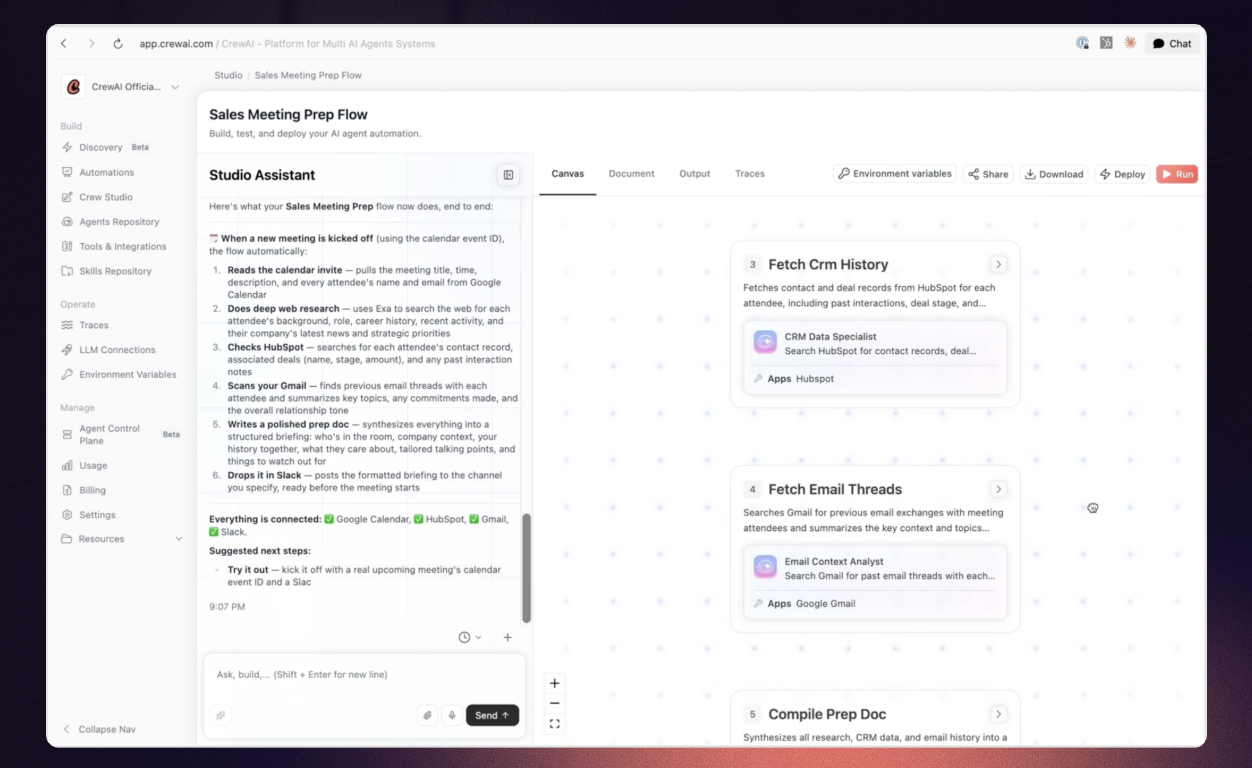
Crews improvise. Flows carry the clipboard.
The most important product distinction is between Crews and Flows. Crews optimize for autonomy: agents can collaborate and delegate inside a task. Flows optimize for control: event-driven steps start, listen, route, persist state, and resume. A Flow may call one model directly or place an entire Crew inside a bounded node. This is the sensible architecture for serious work. Put judgment where judgment helps; keep permissions, sequence, retries, and state in ordinary machinery.
An agent workflow that knows its lane
Crew Studio, refreshed in July 2026, brings this architecture to a canvas. Describe a workflow in plain language and its assistant proposes the steps, agents, tools, and routes. There are three node types: a focused single agent, a collaborative Crew, and a conditional Router. The resulting Flow can be run, traced, deployed, or downloaded as Python. That last option matters. A visual tool is less frightening when engineers can review its output in a pull request and run it elsewhere.
Studio also claims more than 1,000 connectors across messaging, email, CRM, support, data, productivity, and developer tools. Agents can be published to an organization repository and reused. The promise is a low floor for the person who understands the business process and a high ceiling for the engineer who must harden it. Whether the generated code stays pleasant after six months of changes will depend on the team, but exportability is the right starting posture.
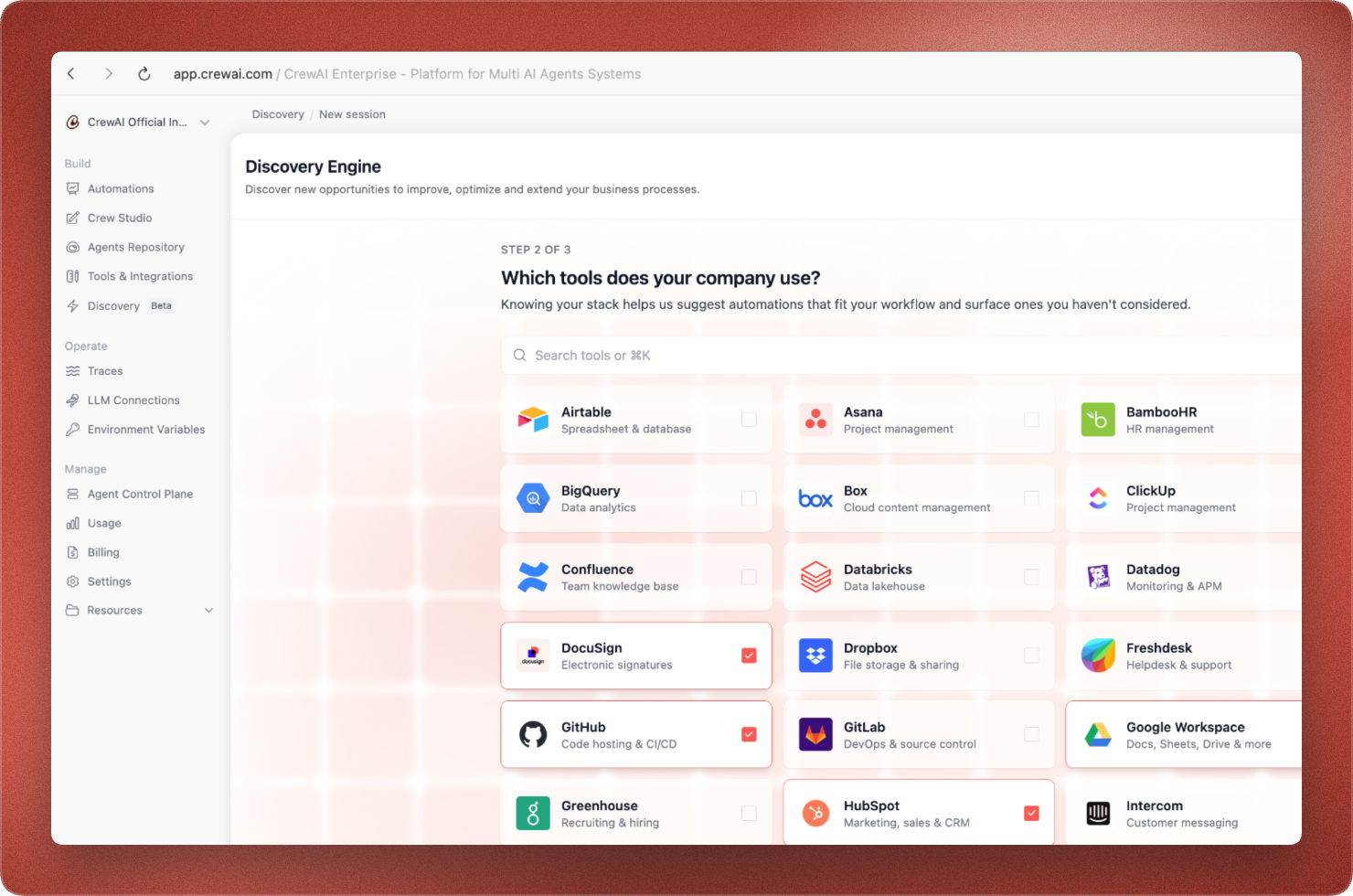
The new front door is “what should we automate?”
Discovery is CrewAI’s attempt to solve a problem one step earlier. It examines tickets, chats, apps, and workflows, then ranks automation candidates by effort, value, and readiness. CrewAI says its suggestions draw on patterns observed across billions of agent runs. Instead of funding the loudest department’s pet chatbot, a company can start with a list of recurring work and an argument for why each item belongs with agents.
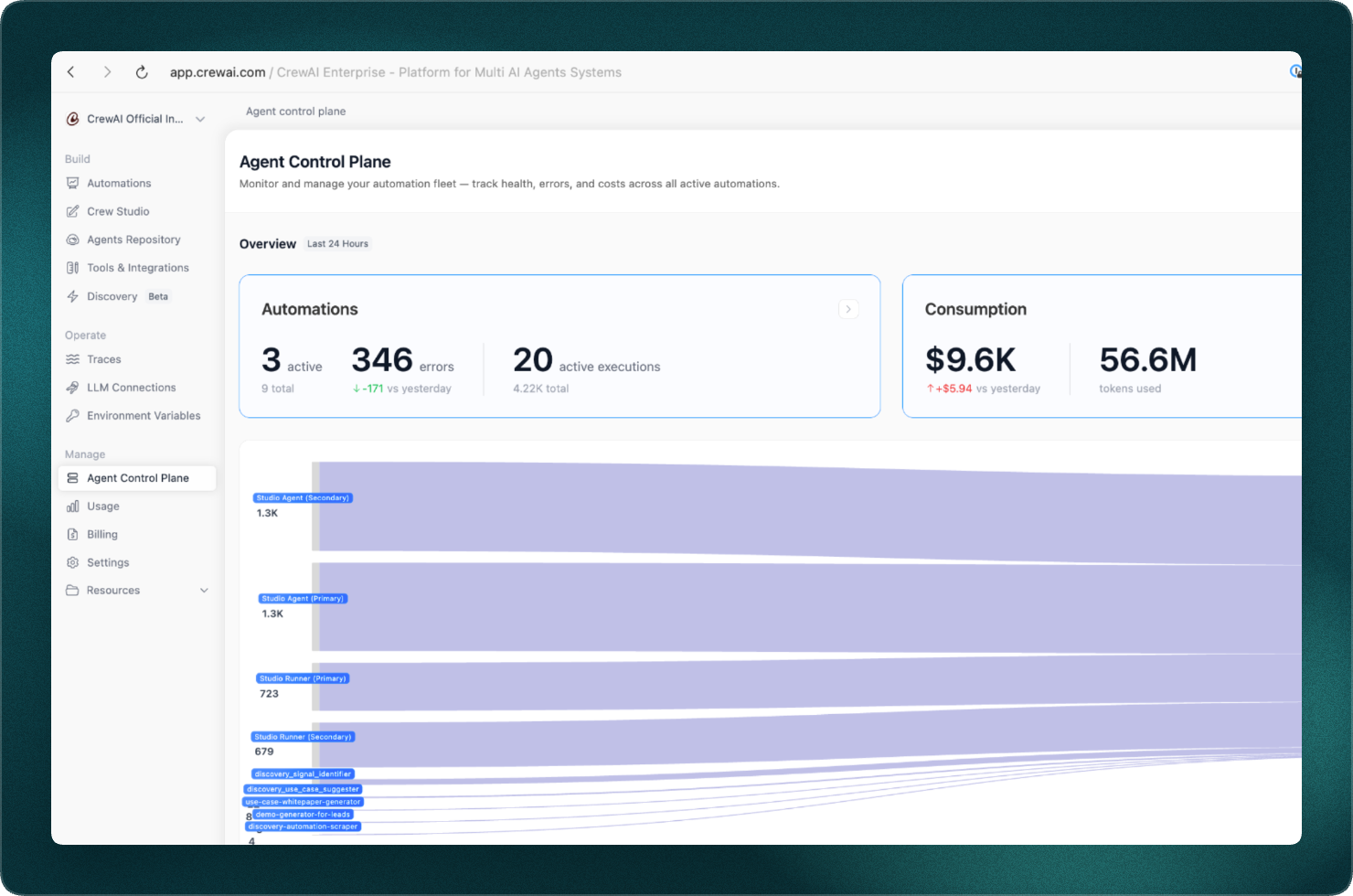
This is also where the product has moved furthest from its open-source roots. The original charm was a few Python objects and a playful team metaphor. The commercial pitch now spans discovery, building, deployment, governance, and optimization. The Control Plane traces model calls, tools, memory reads, tokens, errors, and costs. Enterprise controls include SSO, RBAC, audit trails, workload identity, PII redaction, policy hooks, and human approval gates. Deployment can live in CrewAI’s cloud, a dedicated VPC, or customer infrastructure.
What it costs, including the part on another invoice
The Python framework is MIT-licensed. The hosted Basic plan is free, with Studio, an AI copilot, GitHub integration, two automations, and 50 workflow executions per month. Enterprise pricing is custom. It adds enterprise connectors, governance, flexible capacity, onboarding, support, and more deployment choices. That is straightforward enough, but it is not the whole budget.
Every model call, search request, database query, and third-party tool can carry its own cost. Multi-agent designs multiply opportunities to spend. A researcher asks a model, a reviewer reads the answer, a manager retries it, and suddenly a task that looked like one prompt has become a tiny committee with a catering bill. Prototype with a representative workload, record tokens and tool calls, cap iterations, and compare the result against one well-instructed agent. Sometimes the crew wins. Sometimes it is four bots passing the same stapler.
| Option | Best fit | Control style | Friction to expect |
|---|---|---|---|
| CrewAI | Role-based collaboration plus a path from code or canvas to governed deployment | Autonomous Crews inside deterministic Flows | Overlapping roles, loops, and model cost require discipline |
| LangGraph | Complex, stateful systems where engineers want the graph made explicit | Graph-first, granular state and routing | More concepts and setup before the first useful run |
| Microsoft AutoGen | Conversational multi-agent research and code-oriented experiments | Messages and agent conversations | Conversation paths can be harder to predict and constrain |
| OpenAI Agents SDK | Lean agent handoffs, tools, and tracing in an OpenAI-centered stack | Code-first agents and handoffs | Tighter platform affinity than model-neutral frameworks |
The customer guide: start with one mildly annoying job
CrewAI’s own founder has argued that a first agent should do one thing badly. The phrasing is cheeky; the method is sound. Choose a low-risk process with a clear before-and-after: enrich ten leads, summarize closed support tickets, assemble a meeting brief, classify documents, or draft a report for human review. Define the expected output before inventing agent personalities. Give each worker a distinct responsibility and only the tools it needs.
Then test the boring edges. What happens when the CRM is down? Can the workflow resume? Who approves an email? Can you reconstruct the evidence behind a classification? Does memory improve the task, or preserve a mistake? Run a single-agent baseline. Measure accuracy, latency, tool failures, human corrections, and total cost per completed job. A multi-agent framework should earn its complexity in those numbers.
CrewAI is a good first framework for Python teams that think naturally in roles and tasks, and an increasingly credible platform for organizations that want business builders and engineers in the same workflow. Choose it for approachable orchestration, model flexibility, and the Crews-within-Flows pattern. Look harder at LangGraph when explicit state-machine control is the main event, and keep plain code in the running whenever the work is predictable.
The company has momentum: more than 58,000 GitHub stars as of September 2026, $18 million raised across seed and Series A rounds, and partnerships or integrations involving NVIDIA, IBM, and PwC. CrewAI says more than 100,000 developers have completed its community courses and that its technology is used by 65% of the Fortune 500. Those are scale signals, not a substitute for a proof of concept on your data.
What makes CrewAI interesting in 2026 is its change of emphasis. The cartoon version is a table full of agents debating the assignment. The useful version is quieter: one agent making a bounded judgment inside a Flow, a router choosing the next step, a person approving the risky branch, and a trace showing exactly where the money went. The crew still gets top billing. The clipboard is the product.