The applicant arrives when the recruiter has gone home. In a consumer-sector shared-services center described by Beecker, 70% of candidates contacted the business outside office hours. An eight-to-five hiring operation had become a peculiar sort of shop: the customers came chiefly when it was closed. The problem was a mismatch between two clocks.
- Beecker builds and operates automation for enterprise back offices.
- Its business is shifting from individual projects toward recurring managed services.
- The useful test is completed work, with exceptions and human approvals included.
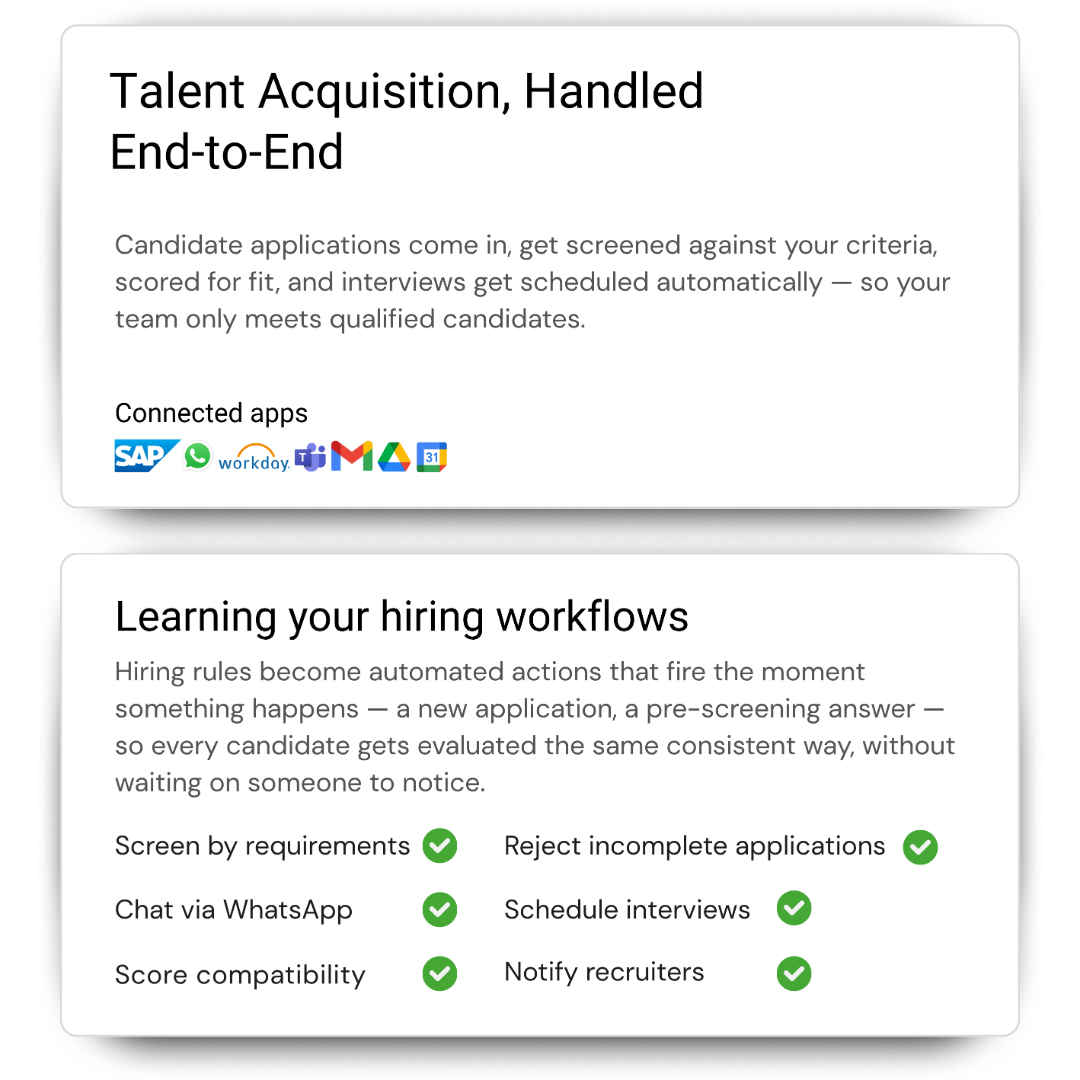
Beecker’s answer was Lucas, a conversational recruitment agent that screens applicants and schedules interviews. Around Lucas sits a less photogenic apparatus: integrations, monitoring, escalation rules and people. That apparatus explains the company better than the character’s friendly name. Making software respond at midnight is useful. Making the whole hiring process function at midnight is a different assignment.
A bot sold once. A process kept running.
Beecker began with process consulting and developed an RPA practice. Robotic process automation uses software to perform repetitive tasks across business applications. In late 2022, Felipe Corcuera and Antonio Elosua acquired the business through a search fund. Corcuera later put the enterprise value at $8.5 million, against roughly $5.5 million in revenue and $1.4 million in EBITDA.
The old model mixed specialist staffing, bot projects and software-license resale. Management pushed toward recurring Robots as a Service contracts. Smaller initial payments meant cash arrived more slowly; Corcuera described the strain while also investing in an AI lab. ChatGPT’s arrival around the acquisition added another reason to rethink the offering. The owners had bought an automation company just as automation’s possibilities were changing.
“We never know when we’re gonna get crushed by someone.”Felipe Corcuera · Acquiring Minds · September 2025
The worry is understandable. A recurring contract ties the vendor to what happens after delivery. The next month brings another obligation to keep the process useful. That is Beecker’s commercial wager: customers will pay for continued operation.
A cast of digital coworkers
The product roster reads like an office seating plan. Lucas handles candidate selection. Olivia handles purchase orders. Daniel processes invoices. Diana plans loads. Beecker groups agents around familiar sequences: procure-to-pay, hire-to-retire and order-to-cash. The names are memorable; the sequences tell buyers where the work belongs.
These offerings sit alongside consulting, custom implementation and specialist staffing. A customer can start with process discovery and an ROI model, then commission integrations and ongoing management. Beecker advertises subscription automation and has described transaction-based AI services. The commercial proposition depends on scope: the workflow, its volume, the systems involved and the supervision it needs.
Beecker’s dashboard is the companion product: activity tracking, timestamped audit logs, conversations with agents and approvals for critical actions. This matters because a digital worker needs more than instructions. Someone must see what it did, decide when it can proceed and notice when it stops.
- 01Map the process
- 02Connect the systems
- 03Run and monitor
- 04Resolve exceptions
The night shift, and the month-end close
The Lucas deployment published in June 2026 connects intake, eligibility screening, interview calendars and background-investigation workflows. Beecker reports 1,862 conversations and 221 scheduled interviews. It also reports a 60% reduction in cost per hire and 84 hours of manual work saved monthly. These are results from one unnamed customer, rather than a forecast for every recruitment team.
Its Robotic Operations Center handles cases outside the defined rules, including unusual eligibility situations and system errors. The case is instructive because the starting problem was concrete: applicants were waiting for an office to reopen. The automation changed the hours of access and joined up the steps that followed.
Finance supplies another example. An automotive company was reconciling 22 bank accounts, with three complex accounts consuming a week of work. Beecker connected an agent to 11 banking portals and Microsoft Dynamics NAV, automating statement extraction, data transformation and reconciliation checks. After three months of implementation, its June 2025 case study reported monthly reconciliation time falling from 80 hours to 28.
Unreconciled items still get reported, and supervisors approve adjustments. The useful detail is the path from banking portal to accounting system to review. A faster calculation alone would leave much of the original job untouched.
For a buyer, that distinction changes the demonstration worth requesting. Show a statement arriving in an awkward format. Show an unmatched payment. Show the queue where someone reviews it. A process earns its keep across those ordinary complications. The polished example on the first slide tells only part of the story.
The people behind the automation
Beecker’s background gives that integration work context. HFS named BeeckerCo a Hot Vendor in 2020 and documented relationships with 12 technical universities in Mexico, including embedded work placements. The company describes a bilingual delivery team spanning engineering, mathematics, business strategy and enterprise technology. Its public materials report more than 200 certified professionals.

Historical customer materials name businesses including Nestlé and PepsiCo. Such enterprises bring existing platforms and established approval routines. Beecker works across automation technologies including UiPath and Automation Anywhere. Its position is between the software platform and the internal operations team: selecting tools, connecting systems and supporting the resulting workflow. Buyers can also build internally or hire a larger integrator; Beecker competes on that practical middle ground.
Before the demo, count the work
Beecker’s recent writing offers a useful buying discipline. Its July 2026 discussion suggests roughly 1,000 to 10,000 monthly transactions as a promising range for a scoped back-office project. Volume needs repeatability: inconsistent inputs and undocumented exceptions can overwhelm the economics. A process that runs rarely may save too little to justify dedicated implementation.
The transferable lesson is to choose a process with an owner, establish its baseline and count the exceptions. Then ask who maintains it after launch. Beecker’s outcome-based buying advice adds a contractual question: what happens if the agreed metric is missed? Even an elegant dashboard needs an answer. For a reader considering automation, that question may prove more valuable than meeting another charmingly named agent.
A sensible pilot therefore has a finish line smaller than “transform the company.” Pick a queue, document its inputs and compare the time needed to finish the same work. Include the reviewer’s hours. If the process improves, repeat it elsewhere; if exceptions multiply, revise the workflow before expanding. That is a method an operations team can copy without buying a new vocabulary.