Sixteen price mismatches sat inside a single purchase order. Together, they amounted to €3,022. For a manufacturer with $40 billion in annual revenue, that is barely a rounding error. For the person trying to check millions of items, it is a clue: the company’s carefully negotiated prices were getting lost on their way to the factory.
- Magentic’s AI workers check purchases, contracts and invoices for overlooked savings.
- They work across existing systems, with evidence and human review.
- The practical starting point: one neglected category, one measurable result.
Magentic’s case study describes the familiar split between headquarters and the plant. Category managers negotiated centrally; people at individual sites bought the parts. Outdated documents, different part numbers and manual processes opened gaps between those two activities. Its AI worker matched items, checked prices and generated a recovery workflow. During the pilot, it identified leakage equivalent to approximately 4% of maintenance, repair and operations spending.
€3,022 in discrepancies.
A small document with an expensive memory.
These are company-reported findings, and identified leakage is not the same as money recovered after fees. Still, the example explains the business better than a procession of AI adjectives. Manufacturers can win a negotiation and lose the saving afterward. Magentic has built a company around checking that second half.
The consultant and the researcher
Robin Van Aeken and Odhran O’Donoghue met while winning hackathons at Oxford, according to Sequoia. Their subsequent careers gave them different views of the same difficulty. Van Aeken worked on supply chains at McKinsey. O’Donoghue worked in AI research at OpenAI. One understood the industrial paperwork; the other understood increasingly capable machines.

Sequoia records the company’s founding in 2024 and its participation in that year’s Arc programme. Public launch followed in July 2025. On its own origin page, Magentic says medication shortages helped prompt its creation. That background gives its commercial focus a wider logic: purchasing failures affect what factories can make, as well as what they pay.
Three chances to keep the saving
The product’s digital workers are called Mages. Sam, the recovery teammate in early case studies, has a less theatrical name and a useful occupation: checking whether a supplier’s obligations survived contact with actual transactions. Magentic combines contracts, invoices, ERP records, emails and spreadsheets so the same supplier or component can be recognised across fragmented information.
Find buying opportunities.
Route the purchase.
Recover missed value.
Before buying, a Mage can compare equivalent materials and aggregate demand. During buying, it can flag an approved supplier or agreed price before an order goes out. After buying, it can detect overpayments and missed rebates. The offer extends beyond producing an answer: workers prepare communications and carry workflows forward, bringing people in at review points.
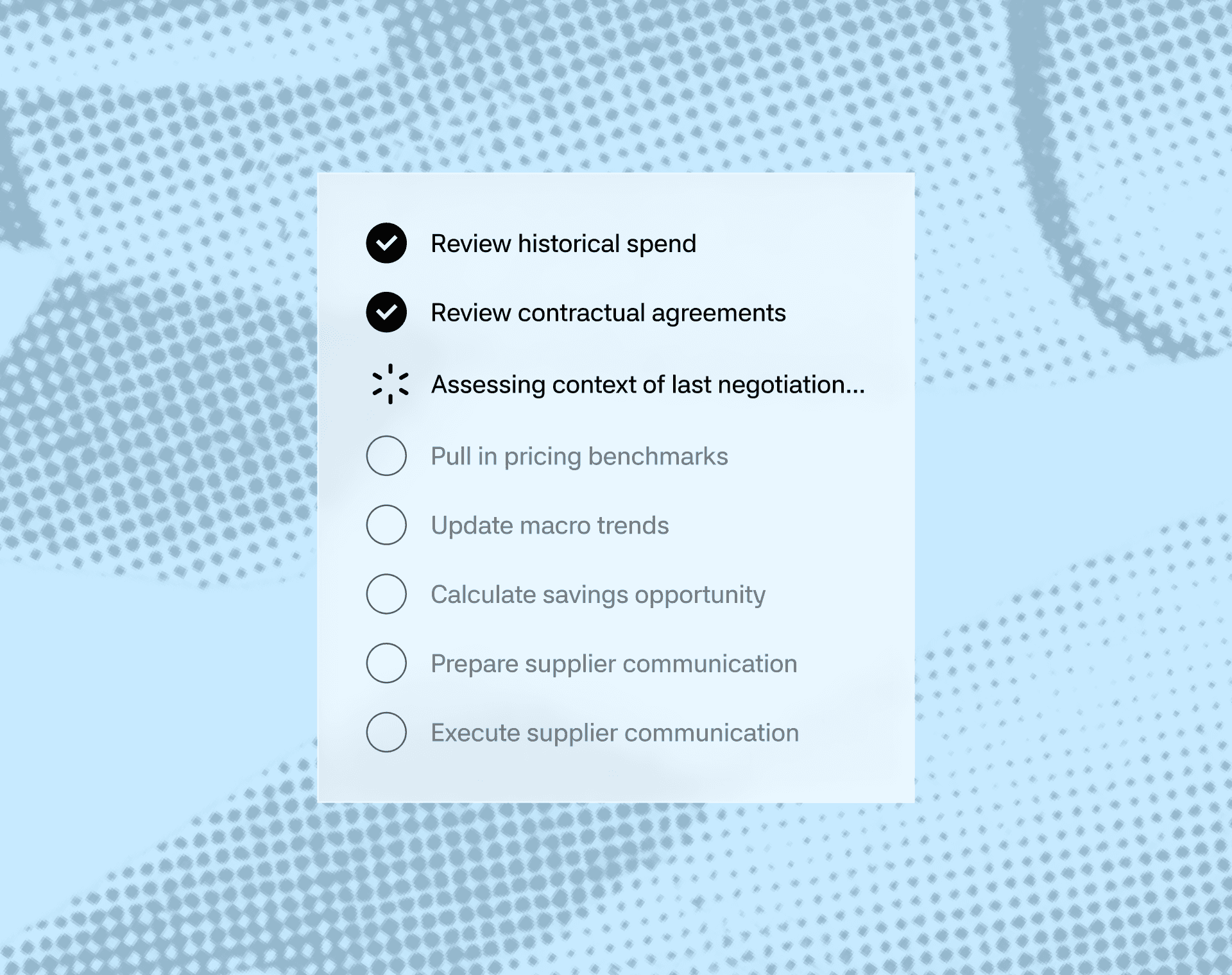
There is a substantial market around this work. Pactum also offers digital workers for procurement, sourcing and negotiation. SAP Ariba and Coupa are established parts of purchasing infrastructure, and appear in Magentic’s customer environments. Magentic’s distinctive emphasis is connecting scattered evidence to action across the buying cycle. A buyer should test that proposition against a real contract and order, rather than the elegance of a demo.
A separate case involved a Fortune 500 manufacturer with more than $50 billion in revenue. Months of manual review had still missed problems in supplier paperwork. Magentic says roughly a quarter of the agreements and transactional documents it analysed contained issues affecting profit: inconsistent payment terms, missed rebates, inflation adjustments and missing compliance clauses. The failure began with fragmented records. Even a diligent reviewer had to reconstruct the relationship between an agreement, an order and a bill.
The spreadsheet has a point
One of Magentic’s most useful accounts concerns a category manager tracking volume obligations in a spreadsheet. The formal system did not flag them. An embedded engineer found the calculations and mapped them into the platform. Only then could the AI reliably identify the missing discounts.
That story explains why a system can be installed and remain optional. Employees may know that the official database omits something important. Magentic’s Forward Deployed Engineers work inside customer operations to learn the exceptions, shared-drive contracts and local interpretations that software records miss. Earning trust requires understanding why the old workaround existed.
The company describes human review, visible evidence and controlled access to systems of record. Its security page states ISO 27001 and SOC 2 Type II certification. Those controls matter when the software can act on a purchasing decision. A confident recommendation without the relevant records leaves the reviewer doing the investigation again.
That customer-facing work also appears in Magentic’s employment offer. Its careers page describes three or four days a week at the London headquarters or on customer sites, alongside monthly socials and an annual retreat. The office welcomes pets. These are ordinary startup details, but the site visits are revealing: industrial AI still needs people who will leave the laptop demonstration and ask how a plant actually buys things.
Capital meets the purchase order
Magentic announced a $5.5 million seed round in July 2025, led by Sequoia, with The Westly Group and First Momentum Ventures participating. An $18 million Series A followed on September 17, 2026, led by Felicis alongside Sequoia and Westly. Total announced funding reached $23.5 million.
By then, Magentic said one customer was running more than a million orders annually through its agents. It also reported customers including three of the world’s ten largest beverage companies. Those claims describe the intended scale: enterprise operations with enough transactions to make neglected details consequential.
Its sales process starts with an enterprise conversation and demo. Sequoia’s investment thesis favours selling outcomes and potentially sharing in savings. For a buyer, the sensible calculation includes deployment costs, review time and realised recovery. A percentage of leakage identified cannot settle that calculation alone.
A pilot worth copying
A beverage manufacturer’s published deployment began with a two-month pilot covering office equipment, administration and IT hardware. Mages analysed existing systems and attached evidence to proposed cases. Category managers validated the findings, while the team began extending coverage into more complex areas.
“Previously, we only had the capacity to pay attention to the big spend.”IT procurement leader, beverage manufacturer
The transferable lesson is modest: begin where attention is scarce, make the evidence inspectable, and let the people doing the work correct the system. The economics become less attractive where transaction volumes are small or records cannot support a claim. Adoption suffers when nobody owns review. Magentic’s wager is that large manufacturers have plenty of overlooked work, and that checking it can pay better than another dashboard.