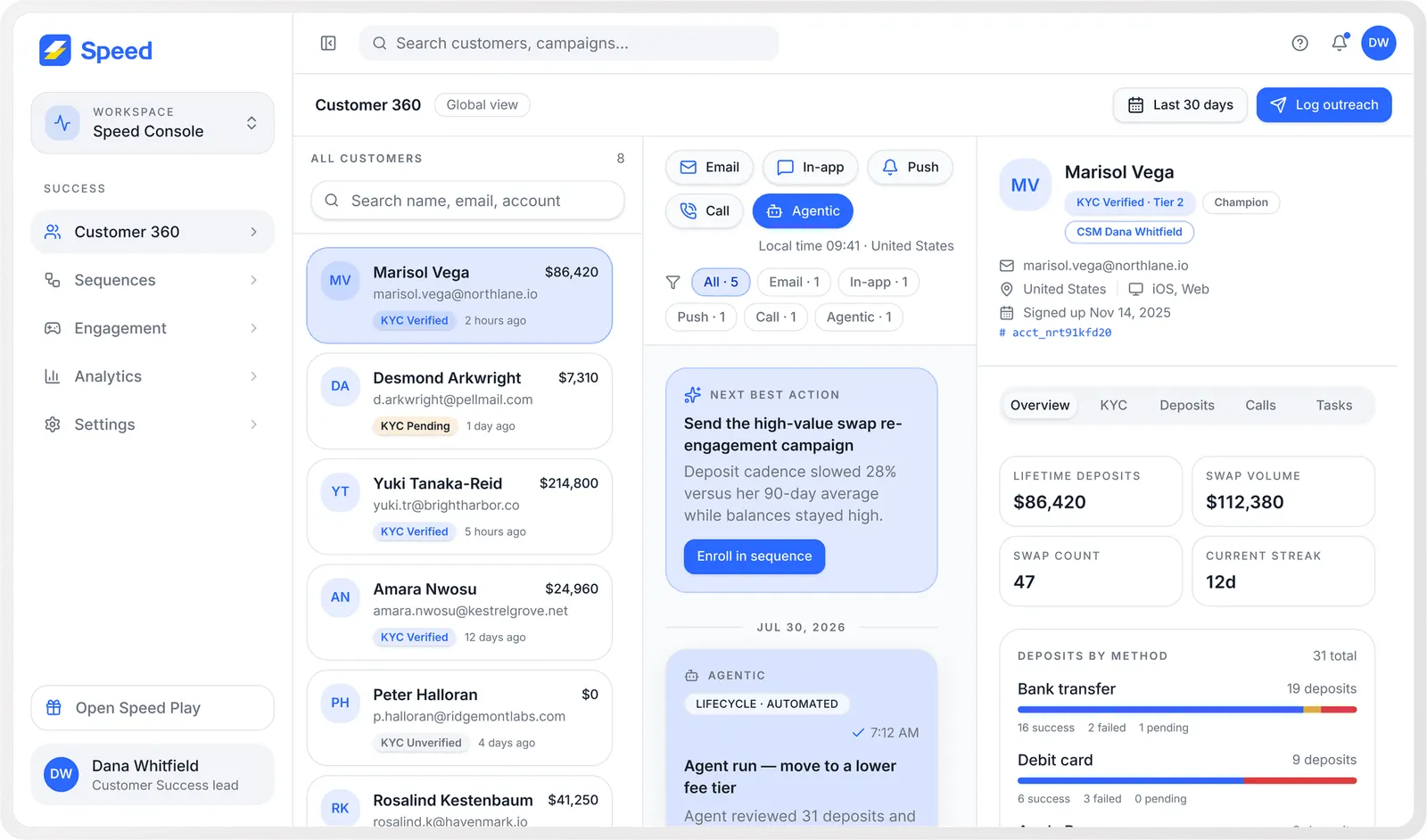
At Speed, the customer existed in several places at once. A conversation lived in Intercom. An email lived in Gmail. Something important lived in a spreadsheet. Another answer required SQL. According to Openxcell’s account of the project, customer-success staff had to assemble the person before they could help the person. The tools worked. The handoffs consumed the afternoon.
- Openxcell builds business applications around existing software.
- Its AI work includes assistants, document processing and workflow automation.
- The interesting engineering is often in permissions, calculations and handovers.
That is an unusually concrete entrance into a company described on LinkedIn as “Next-Gen AI Services.” The phrase suggests models and chat windows. The work suggests something more familiar: a capable employee carrying information between systems that have never properly met. Openxcell makes a business of shortening that trip.
A customer in four places
For Speed, Openxcell describes building a customer-success console that brings account checks, deposits, outreach and tasks into one view. Its published case study says campaign setup moved from days to minutes. Those are the builder’s reported results. The underlying intervention is easy to understand: give staff somewhere to finish the job.
Then comes the enjoyable complication. The project includes wallet games: spin a wheel, scratch a card, pop a balloon, receive a small bitcoin reward. A forwarded prize link could become an expensive party invitation. The implementation therefore checks the wallet account’s eligibility on each opening and routes reward actions through the backend. The animation attracts attention; the permission check decides whether money moves.
This makes the company’s market position clearer. It serves businesses whose existing software covers much of the operation but leaves a troublesome gap. A custom console, portal or workflow can occupy that gap. The buyer is purchasing engineering work shaped around a process, rather than choosing a feature from a universal product menu.
An older argument in new clothes
Openxcell’s history begins in 2009. Founder and CEO Jayneel Patel built a company associated with mobile applications and offshore software development. Its present emphasis on production software has an ancestor. In a 2013 company announcement, Patel argued that “just building a great UI/UX” was insufficient. Testing and reaching the right users mattered too.
The same announcement discussed Orderhive, an inventory-management product developed inside the business. Cin7 subsequently confirmed acquiring Orderhive in 2021. That history gives Openxcell a product-building chapter alongside its services work. It also supplies a useful continuity: the company has repeatedly widened its brief around what happens after code starts running.

Today its leadership page emphasizes senior engineers backed by designers, testers, cloud specialists and security staff. Its stated values include transparency and continued learning. A team celebration cannot establish a workplace culture, but it does interrupt the impression that software companies consist entirely of diagrams and extremely serious profile pictures.
Let the code count
The most revealing AI example is Daily Recon, built for Speed’s finance and treasury work. The daily question was simple: did the money across wallets, exchanges and other holdings still match the obligations? The answer had depended on spreadsheets, changing exchange rates and explanations scattered through conversations.
Openxcell describes a system that reads native asset balances, recalculates dollar values using current rates and marks unusual changes. An AI analyst asks questions about unexplained movements. Crucially, server-side logic computes and validates the figures the model discusses. Staff explanations stay attached to the day’s record. This is a deliberate division of labor: calculation, interpretation, accountability.
Let the machine ask why.
Keep the arithmetic on a leash.Our reading of the Daily Recon design
Another project, Bank Deposit Guardian, collects deposit information from multiple providers. Here the first weakness was visibility: analysts were reconciling exports while suspicious deposits could wait hours or days for attention. Openxcell reports that weekly reconciliation fell from 15-20 hours per analyst to approximately 1.5 hours. The system retains original provider messages and applies alert rules on the server. Much of the value comes from dependable data handling.
Weekly reconciliation per analyst. Openxcell’s case-study figures; bar scale uses the 20-hour upper bound.
A build, a handover, a bill
Openxcell’s AI services cover knowledge assistants, document extraction, reply drafting and agents that act across business tools. Its broader engineering offer includes mobile and web applications, integrations and product development. The common thread is implementation: connect the data, establish permissions, test behavior and put the result where employees can use it.
Its current delivery pitch embeds a senior engineer with the client, using AI coding tools and application builders where appropriate. Clients receive the code in their own repositories and accounts. Ongoing work can continue on retainer. The commercial starting point is a scoped, fixed-price quote. A buyer should budget for the surrounding operation too: hosting, model usage, third-party services and maintenance.
That handover also puts security into the buying decision. Openxcell’s security page lists ISO 27001:2022 certification, CMMI Level 3 appraisal and AWS consulting-partner status. These are company-reported credentials. Its stated operating practices include access controls, backups and deployment inside client cloud accounts. For the buyer, a useful follow-up is specific: who can read the underlying records, who can change them, and what survives if the supplier relationship ends?
There is a small but consequential distinction between an assistant suggesting a reply and a system sending it. The company describes human approval as the starting point for its AI automation, with autonomy expanded as confidence grows. That gives a client a sequence to evaluate: observe the draft, inspect the evidence, approve the action, then consider delegating the next one. It turns a broad promise about intelligence into decisions an operations manager can actually make.
The alternatives are practical: an internal developer, a contractor, another agency or configuring a low-code tool yourself. Openxcell’s case rests on combining business-process discovery with the build. That combination needs access to the people doing the work and someone empowered to decide what the workflow should become.
The lesson a reader can copy is modest. Find one repeated handoff. Count the effort. Decide who approves an action and where its explanation belongs. Custom development makes less sense when an existing product already fits, the task rarely repeats, or nobody will maintain the result. Openxcell’s interesting proposition begins with the employee still joining the dots. Give that person a shorter route.