At the Hilton Marco Island Beach Resort & Spa, the batteries in door locks used to be replaced every nine months. This was a reasonable precaution. Nobody wants a guest discovering the maintenance schedule has been optimistic. Yet engineering director Lonnie Hoschar reported an awkward detail: batteries coming out of those locks could still have around 70% usable power remaining.
That is an interesting kind of waste. The hotel was buying certainty. Without an efficient way to see battery condition, replacing early was a defense against replacing too late. Procell, Duracell’s professional battery brand, has made that dilemma a business.
- The cells: alkaline and lithium batteries for professional devices.
- The service: engineering support for equipment makers, plus InSite device monitoring.
- The pitch: judge the maintenance bill alongside the battery price.
01 / THE HIDDEN LINE ITEMA battery with a payroll attached
A home remote control makes batteries seem like a small purchase. A building full of locks, dispensers and sensors changes the arithmetic. Someone must find the device, get access, open it, replace the cells and record the work. Procurement sees the carton. Engineering sees the corridor.
Procell sells into that gap. Its customers include facilities teams in hospitality, healthcare, industry, infrastructure and security, alongside original equipment manufacturers. The company says millions of professional end-users use its batteries worldwide. This is the commercial maintenance market, where an ordinary cell can carry a surprisingly large service obligation.
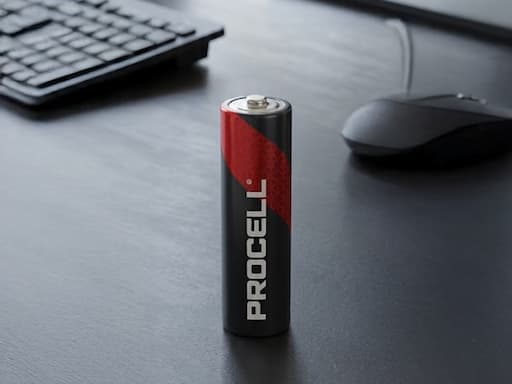
The current US catalog includes alkaline AA, AAA, C, D and 9V batteries; high-power lithium CR123 and CR2 cells; and lithium coin sizes 2016, 2025 and 2032. Procell now promotes one simplified US alkaline portfolio. Older descriptions emphasize separate Constant Power and Intense Power ranges; some regional catalogs still do. Buyers need the local specification, not a remembered product story.
Distribution spans professional suppliers and direct larger-volume orders, with small US purchases also routed through Amazon or local stockists. The positioning is professional; the purchasing door is not reserved for giant companies. Energizer Industrial offers a direct alternative. The meaningful comparison is performance in the intended device and the resulting replacement workload.
02 / SELLING THE VISITMeet the battery changer
That argument took some explaining. Agency VML describes buyers treating Procell as overpriced, while earlier attempts struggled to communicate its specialist proposition. The eventual advertising answer was delightfully literal: invent the people whose labor a cheap battery keeps purchasing.
The Battery Changers campaign introduced comic maintenance characters and even mailed little figurines to decision-makers. The reframing moved attention from the cost of buying to the cost of replacing. VML reports a 12% revenue increase associated with the campaign. That is an agency case-study result, rather than a measure of every customer’s savings. The useful lesson is narrower: show buyers the expense their usual comparison leaves out.
03 / REPLACING THE CALENDARThe clock was the wrong instrument
A longer-lasting battery addresses only part of the problem. If the hotel keeps removing it on the same schedule, extra life may still go into the waste stream. Procell InSite adds wireless monitoring to supported existing devices, bringing battery status and device health into an online platform with maintenance alerts.
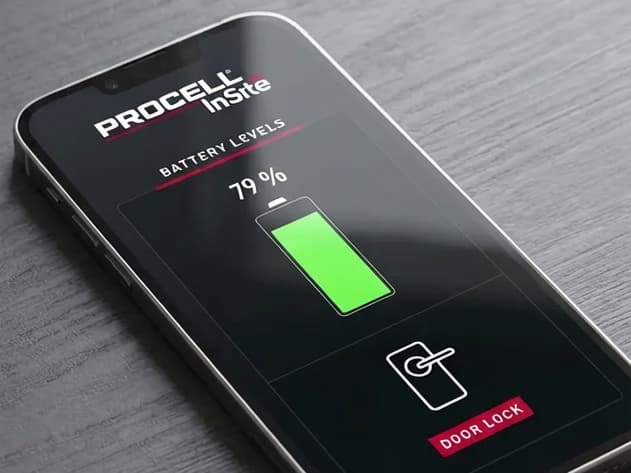
The Hilton case study reports usable power remaining at replacement fell from about 70% to 10%. Its lesson is the change in the decision rule: attend to the device when its condition warrants attention.
“Waste of money, time and bad for the environment.”Lonnie Hoschar · Engineering director, Hilton Marco Island
On discarding usable battery power, in Procell’s case study
A newer example appears in an October 2026 Procell-sponsored Hotel Management white paper. At Charleston’s 179-room Hotel Bennett, engineers review a dashboard daily and have moved away from mass annual changeouts. The hotel reports no guest tickets for dead-battery lockouts after implementation. The publication does not specify the measurement window, so the result belongs to that property and report.
04 / TRY THE ARITHMETICPut a price on the visit
The economics need ordinary inputs. Suppose a replacement visit takes ten minutes and labor costs $30 an hour. Avoiding 100 visits releases $500 worth of staff time. That is an illustrative calculation, not a Procell price or savings forecast. Adjust the assumptions below; the result changes with them.
What is a visit worth?
Visits × minutes ÷ 60 × hourly cost$500
USD. Excludes batteries, installation, hardware and software fees. Time released is not automatically a cash saving. Visits avoided is an assumption you must validate.
Procell advertises estimated InSite returns above tenfold within a year, accompanied by qualifications about devices, habits, facility size, wages and schedules. Treat that as a scenario to examine. The useful test compares avoided work and consumables with the complete deployment bill. A nearby device changed during an existing inspection offers different economics from a special trip down a long corridor.
There is a second, quieter business here. Procell’s OEM services advise on power-source selection and battery-cavity design, give manufacturers access to Duracell testing expertise, and support qualification and post-launch problems. Choosing a cell and designing the compartment are connected engineering decisions.
The technical detail matters because a battery’s performance belongs to an application. Procell describes environmental testing and access to accredited laboratories; its published specifications attach conditions to performance figures. A purchasing team can copy that discipline: name the device, define how it is used, and compare the candidate cells under that workload. A familiar size on the carton is only the beginning of the specification.
05 / BEYOND THE CORRIDORA door lock goes to sea
The hospitality pitch has reached ships. A May 2025 announcement described an Azamara partnership to introduce InSite onboard. An August Procell release described a pilot installed aboard Villa Vie’s Odyssey in Seattle. The latter was explicitly a test of door-lock monitoring and a way to gather evidence for possible wider deployment. An installed pilot and a proven fleet-wide return are different milestones.
The practical move for another operator is straightforward: inventory the devices, record replacement labor, and establish a baseline for failures. Then test a supported group. Teams must check alerts and act on them; a dashboard nobody opens cannot change maintenance. Where devices already report their condition, extra monitoring must earn its place.
Procell’s proposition becomes useful at the point where a buyer stops treating the battery as the entire purchase. Count the trips. Watch the failures. Then decide what the cell is worth.