There are people in finance who choose the investment, people who price it, and people who explain why it deserves a place in somebody else’s portfolio. Priya Kaftan has worked on both sides of that last sentence. She began amid leveraged loans and high-yield transactions, where every assumption eventually meets a number. She now leads investor relations and product strategy at Heard Capital, where every number eventually meets a person.
The distance between those jobs is smaller than it sounds. Both require a feel for structure: what holds, what strains, what another party needs to know before agreeing to proceed. A financing has covenants. An institutional relationship has expectations. Neglect either and the paperwork may remain immaculate while the arrangement quietly fails.
Kaftan’s particular territory is the connective tissue. At Heard, she oversees client relations, client communications, business development and product strategy. The nouns are corporate; the work is human. An investment idea has to survive contact with committee calendars, risk questions, changing mandates and the plain fact that professional trust is earned slowly.
First, learn how the machinery carries weight
Her training began at JPMorgan in the Syndicated and Leveraged Finance group. As an analyst, associate and later vice president, she structured leveraged-loan and high-yield transactions for companies in energy, metals, mining, packaging and chemicals. This was finance with steel-toed boots: capital attached to plants, commodities, debt loads and businesses that had to keep operating after the deal dinner ended.
At Boston University, Kaftan earned a business administration degree and graduated magna cum laude. From 2006 to 2008, while her career was already underway, she completed Columbia Business School’s Executive MBA program. The sequence matters. Classroom frameworks arrived alongside the live texture of markets, clients and transactions. Theory had a daily appointment with consequence.
Leveraged loans, high-yield transactions and a progression from analyst to vice president.
Eleven years spanning institutional relationships, communications, research and new-product work.
Investor relations and product strategy at a Chicago asset manager investing across six global sectors.
Conference chair, convening women-led managers and the institutions that allocate capital.
In 2008 she moved to Silver Point Capital, the credit and special-situations hedge fund. She stayed for 11 years. Her remit there combined existing and prospective investor relationships with communications, reporting, credit-market research and new-product development. It was an education in duration. Markets pitch and roll; a serious institution must communicate through more than the agreeable quarters.
A smaller firm, a wider brief
In July 2019, Kaftan left Silver Point for Heard Capital. The Chicago firm invests globally across technology, media, telecommunications, financials, industrials and energy. William Heard described the hire as part of the foundation for scale. Kaftan’s assignment was broad enough to make that phrase concrete: serve investors well, communicate the strategy, understand evolving needs and help decide how products should develop.
There is a tidy temptation to call this “relationship management,” as though relationships were houseplants assigned to a conscientious colleague. In practice, the job sits much closer to translation under pressure. Portfolio teams speak in exposures, catalysts and asymmetric outcomes. Institutions ask about process, liquidity, concentration, operations and what happens when the thesis goes wrong. The translator cannot decorate. She has to preserve the meaning.
Kaftan’s public comments suggest an appetite for the argument beneath the consensus. After a Chicago economic luncheon, she wondered what new risks might emerge as investors crowd into supposedly non-consensus trades, and how anyone remains focused on the long term when markets twitch at policy headlines. These are not predictions dressed for television. They are better questions about what behavior does to an opportunity once everyone has noticed it.
Her 2025 appearance at SEO’s Alternative Investments Conference placed her in a discussion about market inefficiencies, risk management, macroeconomic trends and the role of hedge-fund strategies. It was familiar ground approached from a useful angle. Kaftan was not presented as the person naming a single winning security. Her value on the panel came from seeing how a strategy reads across the table - how an allocator may test it, where an explanation may buckle and which risks sound different outside the walls of the firm that owns them.
The allocation problem needs more than applause
The same discipline appears in Kaftan’s volunteer work. Through 100 Women in Finance, she chaired Global FundWomen Week from 2023 through 2025. The initiative connects women-led investment managers with institutional allocators and consultants. Its premise is not that another ballroom full of encouraging speeches will alter capital flows. Its premise is that a well-designed encounter might.
The 2023 in-person conference brought more than 300 delegates to New York. It paired over 60 women fund managers with more than 120 institutional allocators and arranged over 500 one-to-one meetings. Roundtables and speakers supplied context, but the meeting count tells the sharper story. A network earns its keep when people can sit across from one another, ask precise questions and decide whether the conversation deserves a second calendar invitation.
“We won’t be fighting over our 0.7% slice of the institutional allocation pie. We’ll be fighting for all 100% of it.”Priya Kaftan · Global FundWomen Week, 2023
Her formulation is revealing. She did not ask for a nicer slice. She challenged the boundary drawn around the opportunity set. That argument avoids charity. Allocators are supposed to search widely for skill; fund managers are supposed to compete for mandates; the market is supposed to benefit from more complete information. If talented managers remain unseen, everyone is working with a distorted map.
Kaftan has carried that work into panels and classrooms. She has discussed hedge-fund strategies and evolving investment opportunities at the SEO Alternative Investments Conference. She has joined conversations about women-led financial managers and helped host early-career networking in Chicago, inviting interns and experienced professionals into small-group exchanges. Her volunteer record also includes the 100 Women in Finance Chicago Leadership Committee, Women Investment Professionals and the board of Ten Thousand Villages Oak Park.
The Chicago sessions reveal her preferred scale. Early-career participants rotate through small groups with senior professionals and hear candid accounts of career decisions. No stagecraft is required. The format gives a student or intern permission to ask the question that would vanish in a crowded reception, while mentors can offer more than a slogan before the next rotation begins. For Kaftan, access appears most useful when it has a timetable, a chair and enough quiet for a real answer.
The room works better when it can laugh
Institutional finance can make ordinary conversation sound like a prospectus. Kaftan leaves small apertures for personality. After playing in the 2025 RTX United Way Golf Tournament with Heard colleague Tyler Williams-Sinclair, she offered a forensic explanation for the result: “Someone clearly tampered with our putters or we would have had the W!” It is a minor joke, which is exactly its charm. The market opened the next morning. No committee was harmed.
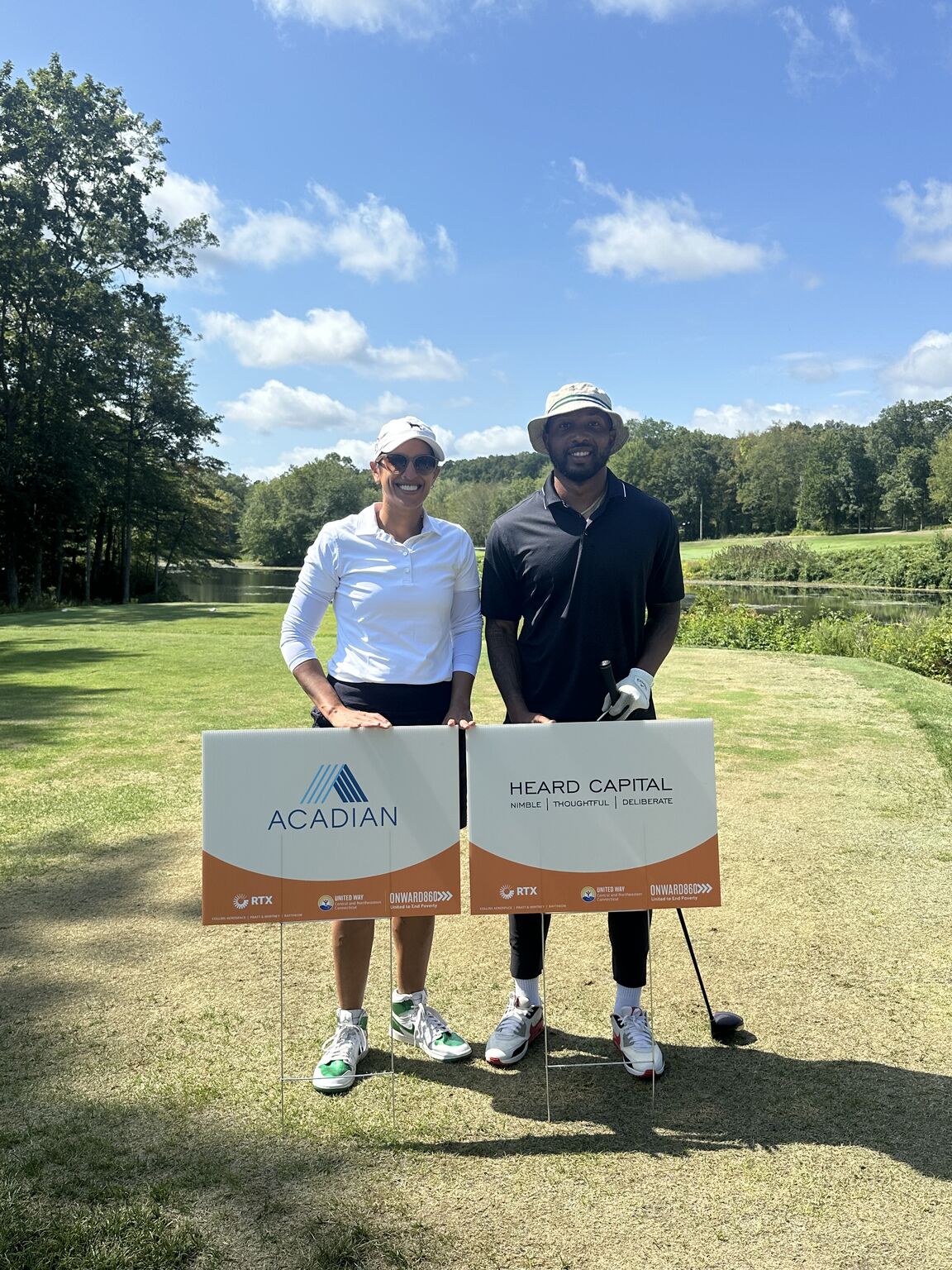
Her acknowledgments are often longer than her jokes. Public updates name organizers, volunteers, hosts and mentors one by one. At the close of her FundWomen chairmanship, she credited the people who had done the work and welcomed fresh leadership for 2026. This is more than good manners. Convening is an operating craft, and people return to rooms where their labor was noticed.
A more private anecdote makes the same point at family scale. Kaftan asked a filmmaker to record her parents telling their life stories so that her children could know the full story of their grandparents’ lives. When her parents approached their 50th anniversary, part of that recording became a celebration film with messages from family members. She called it a cherished memory. The investor-relations executive, it turns out, also understands another kind of long-duration asset: a story preserved before anyone thinks to ask for it.
What remains after the introduction
By 2025, FundWomen’s faces had appeared on the Nasdaq tower. Kaftan called the moment surreal, then turned quickly to the hundreds of members expected at the conference. The light show made a fine photograph. The real work waited indoors.
That instinct links the chapters of her career. A leveraged-finance deal cannot live on a pitch. A hedge-fund relationship cannot live on one quarter. A conference cannot live on a group photograph. Each needs structure after the excitement: reporting, follow-up, candor and an answer to the unglamorous question of what happens next.
Kaftan has made a profession of that next step. She knows how capital is assembled, how investment products are explained and how a room can be designed so overlooked managers meet people with the authority to act. None of this guarantees an allocation, nor should it. It improves the contest by widening who gets heard.
Finance enjoys grand metaphors about opening doors. Kaftan’s record is more practical. She arranges the meeting, sharpens the question, thanks the people who set up the chairs and stays long enough to see whether anyone comes back. Conviction may begin with an idea. Capital usually arrives through a relationship sturdy enough to carry it.