In 2019, Covercy looked at the money passing through its payments business and found an unexpected landlord. The company says 65% of its payment volume was tied to real estate investment: capital calls, distributions, and payments to investors. Its customers had quietly written a new product brief. The firm that knew how to move their money could also help them manage the awkward machinery around it.
- Covercy began in 2015 as a regulated cross-border payments company.
- Its real estate customers pulled it into investor management, then embedded banking.
- Covercy One now joins fundraising, capital calls, distributions, reporting, and fund administration.
- The company says 300 firms and 30,000 investors use its services.
That is an unusually sensible way to discover a market. A software vendor might begin with the screen a manager sees. Covercy began with the thing that has to happen after the screen says “approved.” A real estate sponsor can calculate an investor’s share perfectly and still spend an afternoon entering bank details, chasing a wire, updating a spreadsheet, and explaining the result to a limited partner. Covercy’s proposition is that those acts belong to the same transaction.
The clue was in the ledger

Doron Cohen founded Covercy as a cross-border payments business. Its UK and Israeli regulatory footing came before its investment management software. The company says it saw a concentration of real estate activity in its 2019 data, visited the firms behind those payments, and found fund managers working across spreadsheets, banking portals, and separate investor systems. In 2020, it launched investor portals, capital-call tools, distributions, and a customer relationship manager for that audience. US banking followed inside the platform in 2022.
There is a lesson in the order. A payments company already had to understand identity checks, currency, settlement, and the difference between a promised transfer and a completed one. Extending that knowledge to the records around a fund was a plausible adjacency. Starting with money movement also gave Covercy a question to ask of every feature: does this make the payment easier to calculate, execute, record, or explain?
A distribution is a small opera
For a general partner, sending money back to investors starts long before anyone presses “send.” The team must determine each investor’s entitlement, account for preferred returns or a promote, tell investors what is coming, move the cash, and reconcile the result against capital accounts. When those steps live in separate tools, the human being becomes the integration layer. They are also where errors can hide.
Covercy One puts that sequence alongside fundraising, a CRM, fund and asset records, investor communications, and an LP portal. Sponsors can issue capital calls, collect contributions, calculate distributions, and publish reports. Investors can see holdings, documents, and payment history. The actual US banking services come from Thread Bank, a regulated partner; Covercy is a financial technology company. That distinction matters when a software interface begins to look like a bank.
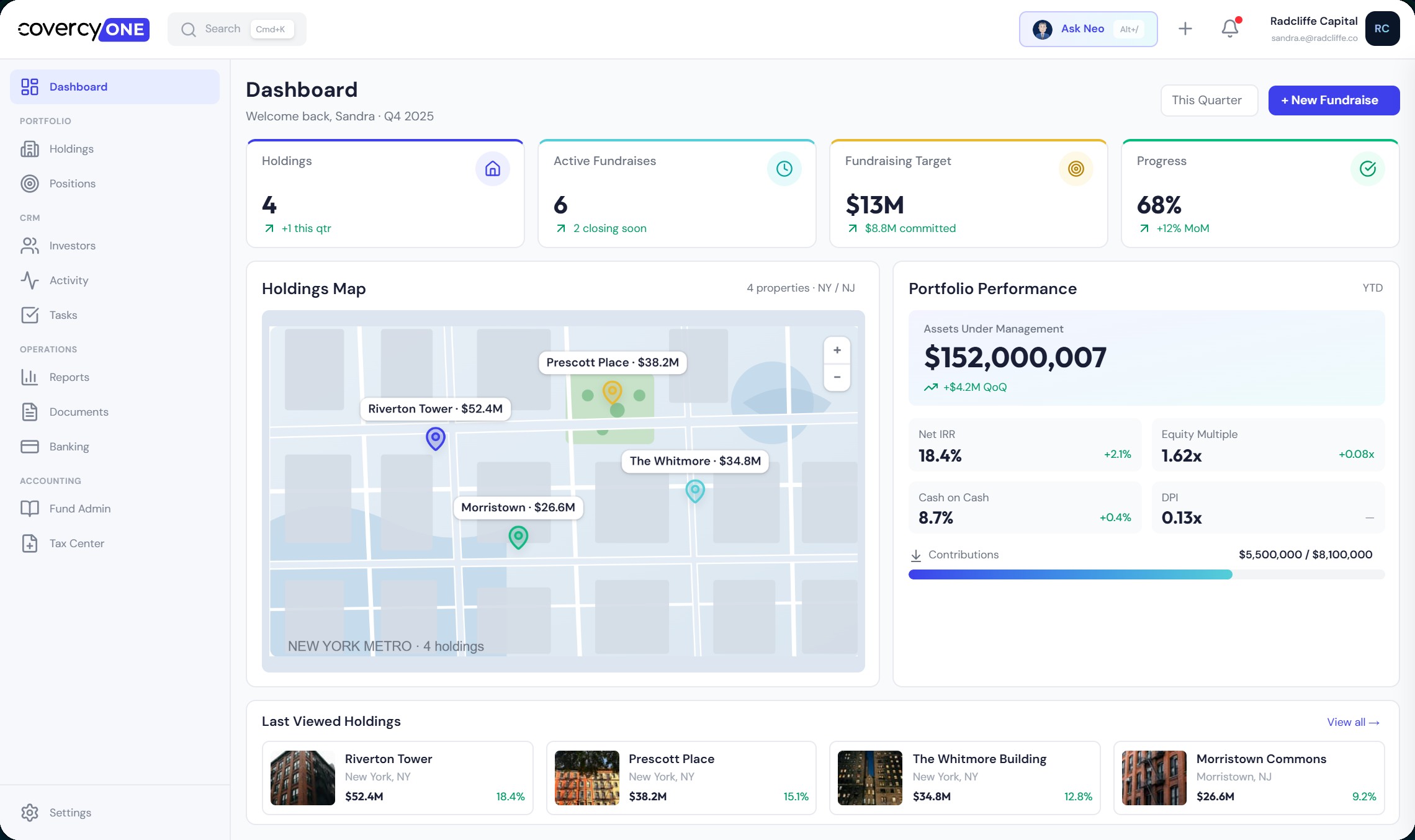
Its rivals include investor management products such as Juniper Square and AppFolio Investment Management. The more persistent competitor may be a familiar stack: a bank account here, a property system there, a fund administrator in another window, and a spreadsheet that knows everyone’s secret. Covercy’s distinguishing move is the direct link between an investor position and the payment and reconciliation that follow. Property tools such as Rent Manager and accounting software can still connect to it; “one platform” does not mean one company performs every specialized job.
The rebuild, and the person at the gate
In April 2026, Covercy launched Covercy One, a rebuilt platform with a shared data model and an assistant named Neo. The company says Neo can answer questions across a portfolio, draft investor updates, and help prepare reports from the records already in the system. There is an obvious attraction here: an assistant that knows the fund’s actual positions is more useful than one asked to guess from a pasted table.
“Bolting AI onto legacy architecture is like putting a navigation system in a horse-drawn carriage.”Doron Cohen, on the Covercy One rebuild
The quote is theatrical, but the engineering choice is concrete. Covercy says it rebuilt rather than adding an AI widget to its old platform. Its stated rule is that humans approve critical actions. That matters in a business where a cheerful error can send very real money to the wrong place. Neo may draft the note; a manager is meant to own the decision.
Covercy also extended beyond software through a December 2025 partnership with NAV Fund Services. NAV supplies fund-administration expertise behind the platform, while Covercy fronts the relationship and data workflow. That arrangement says something about the company’s ambition: to be the desk a GP works from, even when a specialist does the accounting behind it. Covercy Prime, a separate product for UAE off-plan property sellers, shows how far its payment-plan instincts can travel from the original CRE fund use case.
The bill for fewer tabs
The commercial terms are unusually visible for this kind of software. Covercy prices investment management by legal entity. Its public two-entity example lists Fundraising Starter at $498 a month, or $249 per entity; Standard at $566; and Professional at $812. Fund administration is quoted separately. Banking has its own tiers, including a no-monthly-fee Smart Payments tier and paid tiers at $79, $239, and $799 a month, with charges for some additional accounts and transactions. Cross-border transfer fees and exchange rates deserve their own inspection.
Fundraising Starter at $249 per legal entity per month. Banking, transfer charges, and fund administration can add to the bill; pricing can change.
For a manager comparing products, the useful arithmetic is not just subscription versus subscription. Count the hours spent calculating waterfalls, entering payments, reconciling books, answering investor requests, and maintaining separate systems. Then ask which of those steps Covercy actually removes for the firm’s fund structure. A simple vehicle with few investors may feel little pain. A manager with many entities, frequent distributions, and investors across borders has more to gain from the connected workflow - and more configuration to get right.
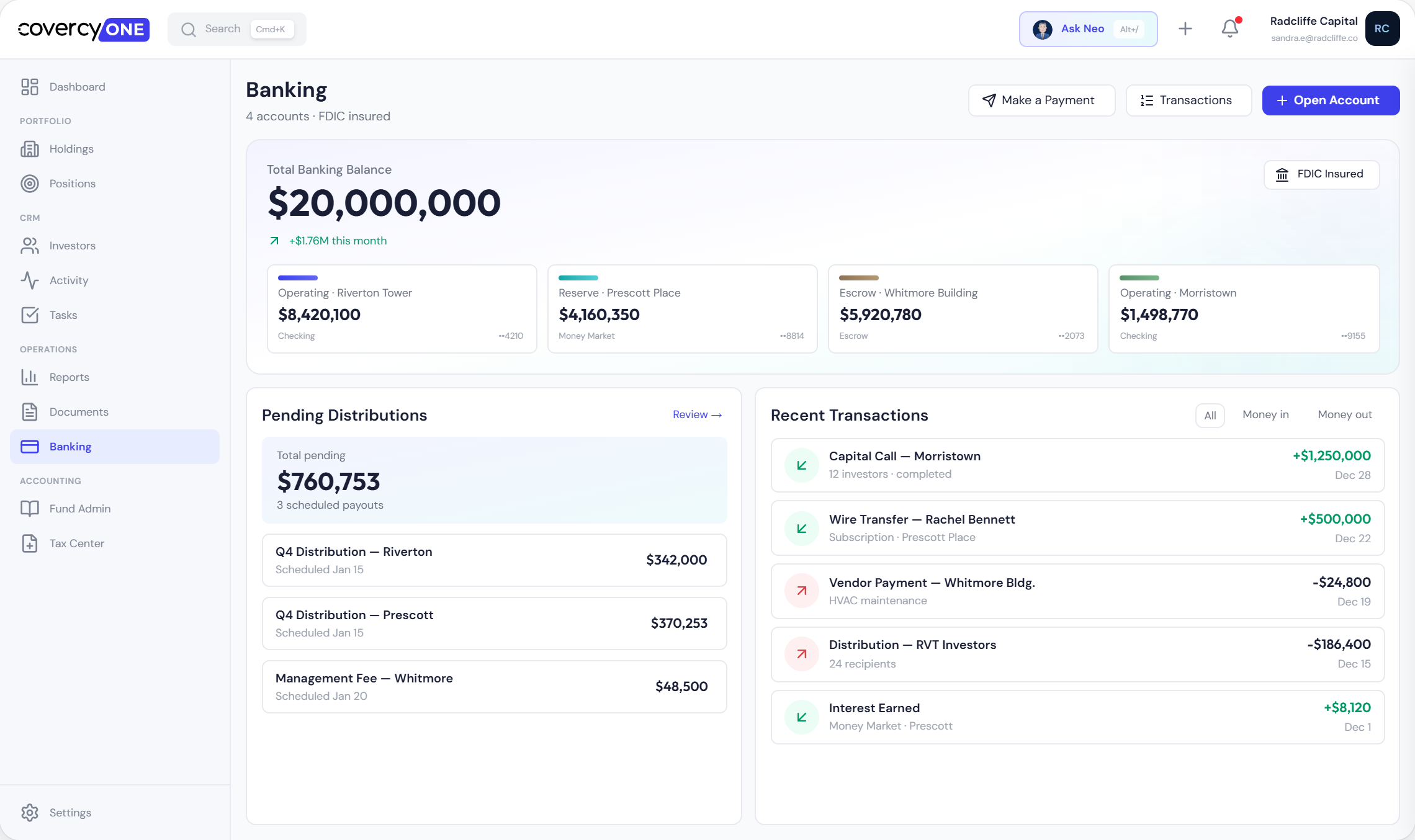
Covercy says it now serves 300 investment firms and 30,000 investors, and processes about $2 billion a year. Those are company figures, useful for scale but not proof that every customer has retired every spreadsheet. The more durable observation is smaller. In this corner of finance, a payment is never merely a payment. It is a promise made to an investor, a calculation reviewed by a manager, a transfer executed by a bank, and a record that must still be right next quarter. Covercy built its business by following that chain from the money backward.