Private markets have a paperwork problem dressed as a software problem. A deal team records a promising company in one system. Investor relations keeps the fundraising history in another. Accountants calculate waterfalls elsewhere. Quarterly reports arrive as PDFs, portfolio-company metrics come in whatever spreadsheet happened to be nearby, and an investment committee still wants the whole story before lunch. Dynamo Software has spent nearly three decades trying to make those records behave like one connected memory.
The Watertown, Massachusetts company began in 1998 with a narrow observation from founder Krassen Draganov: general partners and limited partners needed relationship software that understood investments, not a generic sales pipeline wearing a finance tie. From that CRM root, Dynamo expanded into deal management, fundraising, investor portals, research, portfolio monitoring, valuation, fund accounting, data automation, ESG reporting and, most recently, embedded AI. The result is an unusually broad operating platform for alternative investments.
Dynamo says more than 1,000 clients managing over $10 trillion in assets now use its products. They range from private equity, venture capital, private credit, real estate and hedge funds to pensions, endowments, family offices, funds of funds and the service providers around them. Named users include Boston University, Carthona Capital, HPE Growth Capital, BAE Systems Pension Fund Investment Management and iGlobe Partners. The pitch is simple enough: stop rebuilding the same investment story every time it crosses a department.
The product is the handoff
Most enterprise software is described as a collection of nouns. Dynamo makes more sense as a sequence of verbs. Find a deal. Record the relationships around it. Run diligence. Convert the opportunity into a portfolio company. Collect operating data. Update the valuation. Feed the result into accounting. Prepare an investor report. Answer the LP who asks why a number moved. Each handoff is where context normally leaks and labor multiplies.
For a general partner, Dynamo can track sourcing, contacts, fundraising, subscriptions, capital calls, distributions, portfolio metrics and financial statements. For a limited partner, it can organize manager research, exposures, cash-flow forecasts, documents and performance. HoldingsInsight adds a human-assisted data service: analysts extract and normalize holdings buried in fund statements, then deliver the cleaned information into portfolio management. Fund Administration adds outsourced back-office work on top of the accounting engine. This is software with services deliberately tucked into the difficult corners.
The accounting side is a useful example of the company's pragmatism. Dynamo offers general-ledger fund accounting, partnership allocations, IRR calculations, waterfalls and standard financial statements. Yet it keeps Excel close, allowing finance teams to inspect formulas and adjust reporting. The spreadsheet is not treated as a moral failure. It is treated as an interface investment professionals already trust, with controls and connected data wrapped around it.
What failed first was not the math
Breadth creates its own tax. By the time a platform can serve a deal professional, an investor-relations lead, a portfolio analyst, a fund accountant and an allocator, its menus risk becoming an archaeological site. Dynamo's product team has been candid about the pressure. Vice President of Product Josh Martin called the system “very feature rich” while identifying usability as something the company had long wanted to improve.
“We’ve gotten a lot of gap analysis that we didn’t have internally.”Josh Martin, VP of Product, on feedback from v3.0 early adopters
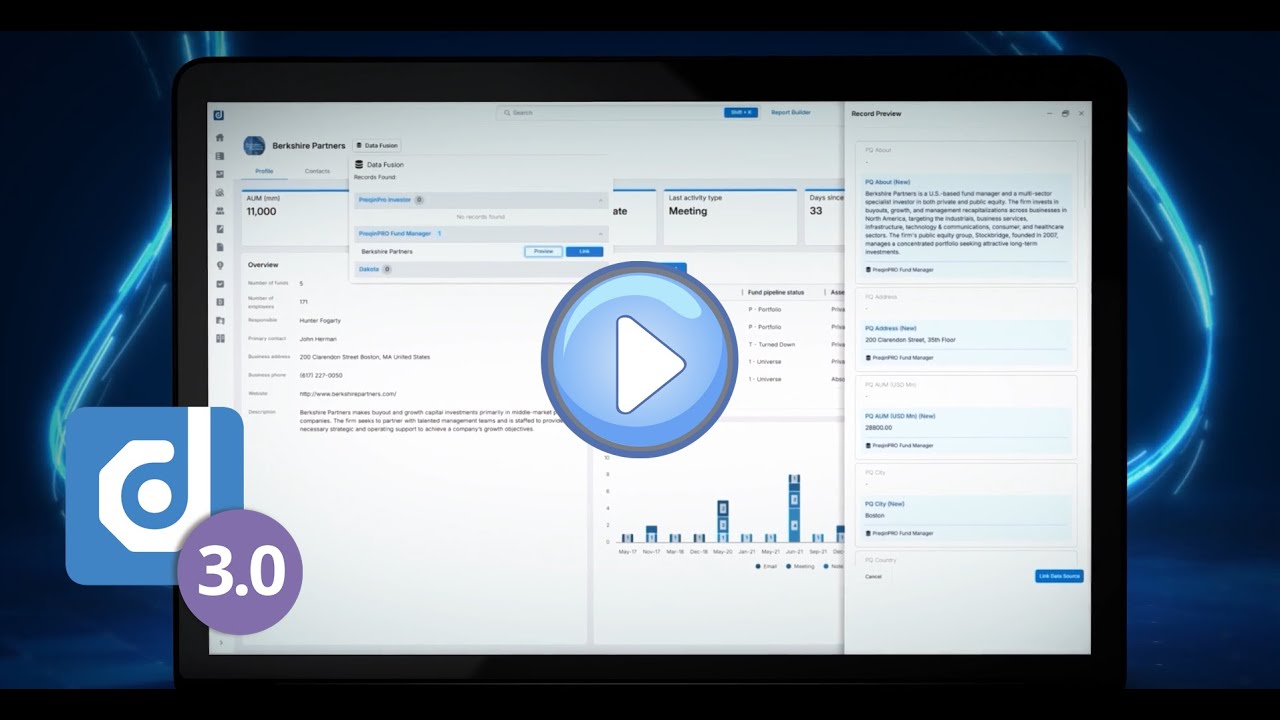
That is the tension behind Dynamo v3.0, launched in October 2025 and rolled out in phases beginning in 2026. Rather than forcing every role through the same interface, v3.0 organizes work into Hubs. Deal teams get pipeline and diligence views. Investor-relations staff see the investor lifecycle. Portfolio and valuation teams get grids and comparisons. Accountants move through reconciliation and reporting. LPs see exposure and oversight rather than a recycled GP screen.
The change of mind was subtle but important. Internal testing could prove that a feature worked. Early adopters exposed whether it worked inside an actual day. Their gap analysis pushed Dynamo toward workflow configuration instead of sprawling custom work, prebuilt industry workspaces instead of a blank canvas, and role-centered design instead of one universal cockpit. Version 3.0 is therefore not a repudiation of the company's breadth. It is an attempt to make breadth stop announcing itself.
AI with paperwork under its fingernails
DynamoAI sits across the platform rather than living as a detached chatbot. Its Document Hub can extract information, tag files and summarize notes. The broader system can use context from CRM, deals, fundraising, portfolio monitoring, valuations and accounting. That positioning matters because private-market AI is only as useful as its access to proprietary records and the controls around them. A clever answer with no provenance is a liability when the subject is an investor statement.
The immediate jobs are intentionally ordinary: reduce rekeying, find a clause, normalize a metric, prepare an update and surface the relationship history attached to a deal. Dynamo's edge is not that it invented language models. It is that the model sits next to years of structured investment context. The limitation follows from the same fact: fragmented, poorly governed source data will still produce a disappointing result. AI does not excuse a firm from cleaning house.
The acquisition map is the strategy
Dynamo assembled much of its range by buying specialists. HoldingsInsight brought data capture and normalization in 2017. Q-Biz Solutions and PEView added partnership accounting and outsourced administration in 2018. Preqin Solutions expanded portfolio monitoring and valuation in 2019, while Communica deepened European hedge-fund CRM and compliance. Imagineer added hedge-fund relationship software and investor portals in 2020. Smonik strengthened data automation in 2022.
In May 2026, Dynamo acquired Paris-based InvestHub. Its modules digitize subscriptions, investor onboarding, compliance, capital calls, distributions and portals. Terms were not disclosed, as with Dynamo's 2017 majority investment from Francisco Partners and the 2021 strategic growth investment from Blackstone Growth. The company's software pricing is also quote-based. Prospects request a demo and can ask for ballpark pricing, which signals a consultative enterprise sale rather than a swipe-card subscription.
There is a clean logic to the buying spree. Each acquisition closes a break in the investment lifecycle, brings expertise from a specific operating niche, or expands the platform into a customer segment. It also increases integration risk. A platform assembled across products only earns the all-in-one label when identity, data and workflows truly cross the seams. Version 3.0 is partly a public test of whether Dynamo can turn that portfolio into a coherent experience.
What another builder can copy
- Start with one expensive workflow whose users share a precise professional language.
- Expand at the handoffs, where customers re-enter data or lose context.
- Standardize the repeatable 80 percent and configure the distinctive 20 percent.
- Use expert services where software alone cannot reliably clean messy inputs.
- Let early adopters expose workflow gaps that feature testing will never reveal.
Where Dynamo wins - and where it does not
Dynamo competes with several markets at once. DealCloud and Affinity pursue deal and relationship work. Allvue, eFront, SS&C and FundCount cover operations and accounting. Juniper Square and newer investor-operations tools focus on the LP experience. Chronograph and iLEVEL specialize in portfolio monitoring. Salesforce, Excel, data warehouses and fund administrators remain the build-it-yourself alternative. Dynamo's difference is the ambition to connect GP and LP workflows across one industry-specific data model.
That can be persuasive when a firm has multiple funds, asset classes, geographies or teams and feels the cost of fragmented information every quarter. It is less convincing for a small manager with a single acute need, limited implementation capacity, or perfectly adequate administrator workflows. A broad platform requires governance, process ownership and patient change management. Configuration is not magic; someone still has to decide what the process should be.
It fits when…
Several teams touch the same investment data, reporting is recurrent, controls matter, and growth is making handoffs expensive.
It strains when…
The need is narrow, the team lacks an implementation owner, or replacing a simple point tool creates more process than it removes.
The company now has the familiar trappings of scaled vertical SaaS: global offices, a partner ecosystem, private-equity backing, managed services and a product taxonomy long enough to require a diagram. Yet its durable insight remains the one Draganov started with. Investment firms do not merely need software that stores contacts or calculates returns. They need software that understands why a contact, a document, a valuation and a capital call belong to the same story.
Dynamo's next act depends on making that understanding visible without making the machinery exhausting. The company has already built the everything machine. The more interesting job is teaching it when to get out of the way.
Keep exploring