Nav Gupta began with a problem that would have struggled to hold its own at a cocktail party: hedge funds needed better accounting. The investment decisions might be exciting. Recording them accurately, reconciling them, and explaining the results demanded a different kind of attention. In 1991, he and his wife, Sudha, began serving their first client. They had set out to build a technology platform that would make fund accounting more accurate and efficient. It was a modest-sounding ambition with a remarkably long working life.
Thirty-five years later, Gupta remains chief executive of NAV Fund Services. Sudha remains its chief technology officer. Their business has followed alternative investments into new markets, new jurisdictions, and new kinds of assets. Its latest developments include connections to banking systems and a way for AI assistants to retrieve fund data. Somewhere beneath each new interface sits the obligation that gave the company its beginning: someone must be able to explain the numbers.
That makes Gupta an interesting figure in a part of finance that seldom gets the starring role. A fund manager can describe a strategy in a few arresting sentences. The administrator has to help turn its activity into usable records. There is less room for mystery here. Mystery is delightful in a novel and considerably less welcome on an investor statement.
A business built by two accountants
Gupta’s professional background fits the problem he chose. He is a Certified Public Accountant and holds a master’s degree in management from Texas Christian University. His current responsibilities include formulating NAV’s framework and enterprise standards. Accounting systems and administration controls feature prominently in his working history. The founder is still involved in deciding how the institution should operate.
Sudha’s place in this story deserves equal attention. As co-founder and CTO, she directs the technology platform, including software engineering, cybersecurity, and disaster recovery teams. Her work also includes interconnected data centers. Both founders brought accounting credentials to a business that would depend heavily on software. Their division of responsibilities makes the original partnership visible in the present company: standards need systems that can carry them out.
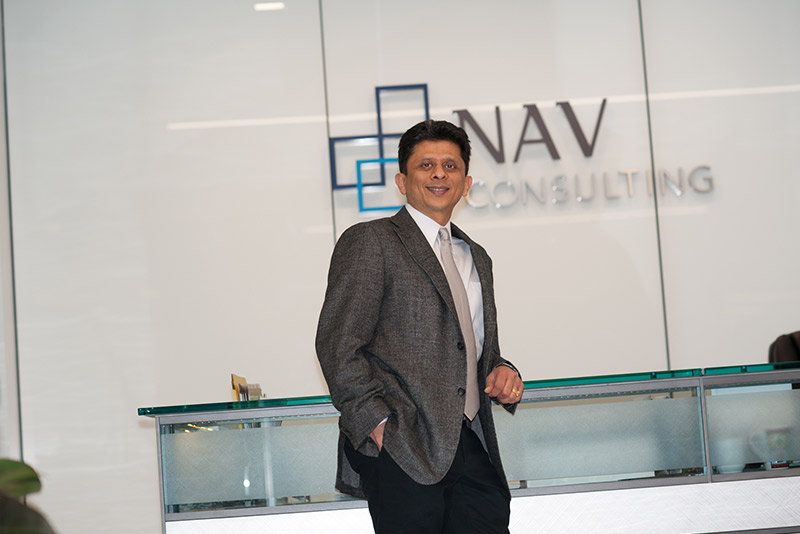
There is an appealing lack of theatrical machinery in that origin. Two people recognized a work problem and began trying to solve it. A first customer made the proposal real. Every subsequent customer would bring another version of the task: different reporting needs, different transactions, different expectations. The useful question for a service business is how much of that variation its systems can handle without losing the detail that matters to the individual client.
Keeping the machinery close
In 2016, Gupta described a company that owned its technology, invested internally, and depended on client and industry referrals. “We do not have a sales team,” he said. That was his account of the business at that time. His argument for proprietary systems was practical: they offered flexibility in reporting, responsiveness to changing requirements, and freedom from large outside licensing fees.
The attraction of that approach is easy to understand. If a report needs changing, owning the underlying technology gives the operator a direct route to the people who can change it. It also leaves the operator responsible for maintaining the machinery. Control comes with a repair bill. For a founder whose work involves administration standards, that exchange connects a commercial decision to the daily quality of the service.
Gupta also described a commitment to independence and lasting client relationships. Those statements reveal the priorities he was prepared to put on record. His public working language concerns operations, technology, and continuity. The story offers plenty of evidence about the business he wanted to build. Its most useful character details are the choices he was willing to explain.
“My wife and I started NAV 25 years ago.”
Nav Gupta, 2016
Thirty-five years, with the work still changing
By October 2026, NAV’s website reports more than 3,300 professionals, over 2,750 clients, and more than $540 billion in assets under administration. These are figures for the company Gupta leads. Assets under administration describe the funds serviced; they are neither his personal fortune nor money he personally manages. Keeping that distinction clear is particularly appropriate in a story about an accountant.
The sequence of changes is more revealing than a large number on its own. NAV opened its Jaipur operations center in 2001. It began administering digital asset funds in 2017. Its Irish business obtained authorization in 2024. In 2025, it introduced services supporting tokenized funds. Each step placed the organization in a different setting while leaving it responsible for the records and relationships its service requires.
- 1991Nav and Sudha start NAV in Chicago.
- 2001The Jaipur operations center opens.
- 2017Digital asset fund administration begins.
- 2024Ireland authorization adds an EU base.
- 2026Banking APIs and AI data access extend the platform.
For Gupta, longevity has meant leading through changes in what a fund can hold and how information can travel. A founder can preserve an original purpose while replacing much of the equipment used to pursue it. The dates make that possibility concrete. The first client arrived years before the Jaipur center; the digital asset practice arrived sixteen years after it. This business has accumulated its capabilities over time.
Dublin adds another conversation
In May 2024, NAV announced its Irish business had been authorized by the Central Bank of Ireland to provide fund administration, including fund accounting and transfer agency. Gupta described Ireland as a strategic opportunity to establish a presence in the European Union. Ray Murphy, an executive with experience across Ireland, the Cayman Islands, and the United States, headed the local business.
That September, Nav and Sudha visited the Dublin office to engage with the team and deepen regional partnerships. It is a small, specific episode in a career mostly told through systems and company milestones. The co-founders went to meet people doing the work in a new location. Expansion acquires a more human scale when it includes a visit to colleagues, rather than simply another place name on a corporate map.
The same year, NAV added an 80,000-square-foot facility in Kanakpura, Jaipur, designed for 750 employees. Its design included solar power and rainwater harvesting. Those details give a physical shape to a service often encountered through screens and statements. An administration platform also consists of rooms, desks, and people. Its footprint grows because the work needs somewhere to happen.
Sunlight, with an estimated output
Gupta’s public comments have also connected technology with the company’s environmental decisions. In December 2018, NAV announced solar panels for its Jaipur offices, with estimated generation of 375,000 kilowatt-hours a year. The announcement described measures to reduce paper waste and electricity use and conserve water. Gupta framed clean energy as part of the organization’s approach to technology and sustainability.
There is something pleasingly accountant-like about giving sunlight an estimated annual output. The figure was a projection, rather than a report of electricity subsequently generated. That distinction matters. It also makes the episode a useful glimpse of how a technological preference can reach beyond software into the buildings where a business operates. The 2024 Jaipur facility continued that practical attention to infrastructure.
When the bank stops waiting for a file
On August 4, 2026, Northern Trust and NAV announced a banking API collaboration. NAV was the first client to put the new capability into production. The integration brought real-time banking information into its platform, covering transaction and balance reporting alongside other banking functions. The two technology teams tested a range of transaction types and fund administration scenarios.
Ravi Gupta, NAV’s chief strategic solutions officer, described the effort involved in bringing that information into fund administration. His place in the leadership team broadens the account beyond the two founders. A company that began with a couple now depends on specialists translating a shared operational problem into working connections between institutions.
For the administrator, the attraction is immediate: information can arrive through a direct connection instead of waiting for batch processing and file delivery. The business significance lies in the interval between an event and a usable record of it. Shortening that interval changes how quickly someone can understand what happened. It is a recognizable continuation of the accuracy-and-efficiency problem the founders began with.
The new interface still needs the old books
On October 5, 2026, NAV announced an MCP server connecting fund data to compatible AI assistants. The connector uses existing access permissions and can retrieve accounting and investor capital information. It is read-only. Figures are identified as official or estimated, and portal reports and investor statements remain the authoritative record. Position and security-level detail belongs to the future development roadmap.
Official and estimated figures retain their labels.
The details are more interesting than the mere presence of AI. A convenient answer still needs an identifiable record behind it. An estimate still needs to be called an estimate. NAV’s account teams remain available to explain the fund data. The interface changes where a client asks the question, while the business retains responsibility for the information it supplies.
That is where Gupta’s career becomes useful to think with. The first accounting platform, the growing operating network, the banking integration, and the new connector all address versions of the same practical difficulty: financial activity creates information that other people need to understand. Each additional capability also creates something else to maintain, check, and explain. Thirty-five years has given the original problem more places to turn up.
Nav and Sudha started with one client. They now lead an organization whose work reaches across markets and technologies that were far from that first engagement. Gupta’s continuing role in its standards gives the story its through line. An accounting business earns its place in the next chapter by making the current chapter intelligible. For all the new machinery, the numbers must still arrive with an explanation.