A company remembers its customers in fragments. There is an address in one system, a payment record in another, an old export that somebody needed on a Tuesday. As the business grows, the fragments multiply. Eventually, remembering where everything went becomes a job in itself. Prithvi Rai spent much of his career working around this problem. Then he founded Borneo to help other companies do something about it.
It is an unglamorous starting point for a technology business. Nobody opens a new app hoping to admire its data classification. Yet the ordinary confidence behind using a service depends on work of precisely this kind. Someone has to understand what information exists, who can reach it and what happens when the rules change. Rai’s career runs through the rooms where those questions become engineering decisions.
His employers included Yahoo, Facebook and Uber. The names suggest a tour of the consumer internet; the work suggests its maintenance department. Behind the products were infrastructure, security controls and decisions about information moving across countries. Borneo emerged from that experience. Its eventual acquisition by Atlassian in May 2025 gave the business a new home, while keeping its original question relevant: how does an organization keep sight of its own data?
Before the startup, the plumbing
Rai’s early professional work at CyberCash involved infrastructure for online payments. Payments give engineering a useful sense of consequence. A system must work, and it must deserve the confidence of the people using it. The work gave him an introduction to security as part of operating a service, woven into the machinery that makes a transaction possible.
Yahoo expanded the geography. During almost eleven years there, Rai encountered the complications of a global internet company operating physical data infrastructure across jurisdictions. The experience included questions about data collection, local requirements and access across borders. A database may be comfortable with an instruction to replicate. A country can have rather more questions.
Facebook brought a different scale problem. As its user population grew, manual data reviews became difficult to sustain. Rai described an approach that used discovery tools, classification and automation, involving the people responsible for the data. At Uber, where he worked from 2016 to 2019, information about payments, drivers and locations met the requirements of a business with a substantial presence on the ground.
The sequence matters because each company changed the setting around a recurring responsibility. Secure payments, international infrastructure, a social platform and transportation all asked engineers to protect information while the business kept moving. Rai also contributed to Facebook’s IPO readiness. The public milestone depended partly on the less public discipline of getting controls into place.
- CyberCashPayments infrastructure
- YahooSecurity across borders
- FacebookTools and automation
- UberGlobal engineering
- BorneoFounder and CEO
- May 2025Acquired by Atlassian
Singapore, with the world in mind
When Rai explained the choice of Singapore as Borneo’s global headquarters in 2020, he connected the location to customer trust and data privacy. Singapore’s technology ambitions, including Smart Nation, formed part of his reasoning. For a company selling help with the responsibilities attached to information, the environment around the business mattered alongside the software it intended to sell.
His own working life had included Silicon Valley, Hong Kong, India and Singapore. Those places supplied different experiences of building technology businesses. They also made international expansion a familiar operational subject rather than an attractive line on a presentation. Data acquires complications when it travels. A founder who has worked through those complications brings a particular set of questions to a new company.
Borneo was aimed at businesses growing quickly enough to develop difficult data problems before they had the staff to match. That timing is the awkward part. Growth gives a company more customers to serve and more information to protect, often simultaneously. The demand for careful systems arrives while everyone is busy building everything else.
The island in the company name
Rai traces his first fascination with computers to seventh grade, when his brother brought home a second-hand Commodore 64. The brothers learned to program and made animated advertisements for neighborhood cable television providers. Other small businesses followed, including assembling PCs and installing local networks. Entrepreneurship was already present, on a much smaller screen.
Years later, a July 2014 visit to Borneo’s rainforest supplied the name for his company. He connected the urgency of protecting that environment with the need to protect valuable data. The choice gave a technical business a reference point outside technology. A forest is an unusually memorable thing to have in mind when discussing the contents of a corporate database.
His account places Borneo’s launch in 2019. By 2020, he was announcing the platform’s general availability through Singapore Tech Forum. The distance between those two milestones is familiar to anyone who has built software: deciding what to make and putting it into customers’ hands are separate achievements. A company begins several times, depending on who is doing the counting.
A product needs people at both ends
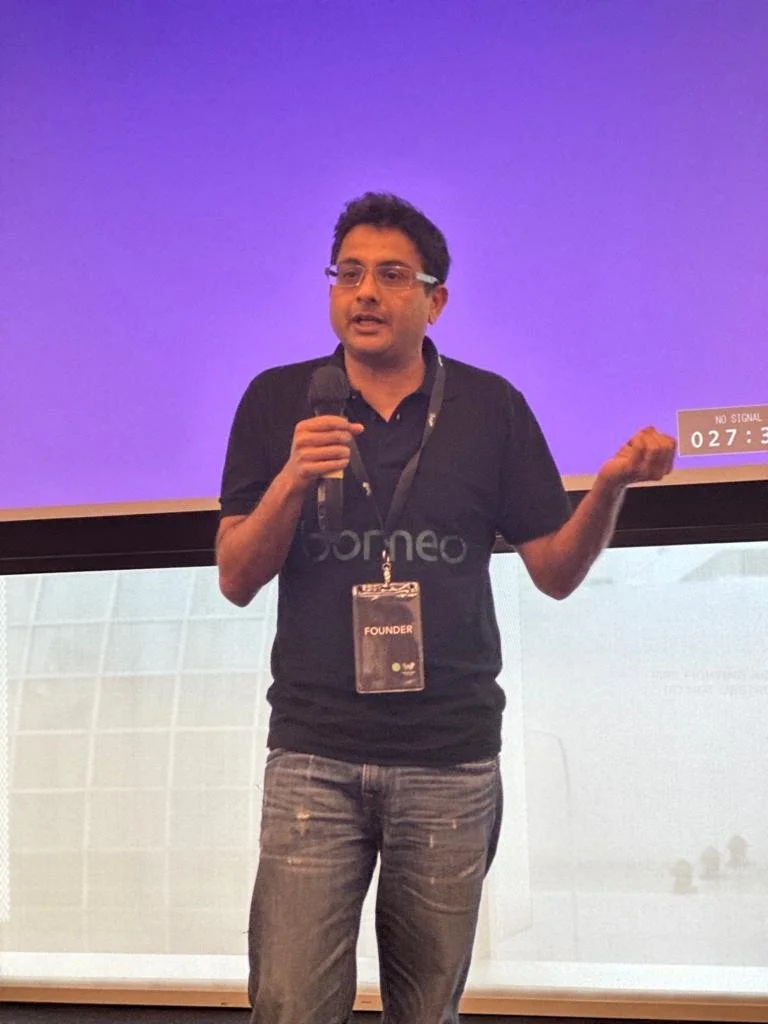
When introducing his account of the founder journey, Rai emphasized the people building the product. It is a revealing emphasis for someone with a résumé full of large engineering organizations. Company names are convenient shorthand. They tell a reader where somebody worked while leaving out the daily negotiations, shared knowledge and patient explanations that make a team useful.
“Companies don’t build great products, people do.”
Prithvi Rai
The customer side of that relationship was equally practical. Borneo offered tools for finding sensitive information and understanding the risks around its use. The ambition was to make work that required substantial expertise more manageable for security teams. Visibility has value when it helps somebody decide what needs attention; a longer list of things to worry about is a less compelling gift.
In September 2021, Borneo raised $15.5 million in a Series A round led by Vulcan Capital, with Prosus Ventures, Lytical Ventures and existing investor Wavemaker Partners participating. The round brought reported total funding to $18 million at that point. Those figures describe financing, rather than revenue or the founder’s personal wealth. They mark the resources available to develop the platform and meet customer demand.
Series A investment
Rai also made time for work beyond Borneo. His public record includes mentoring through INSEAD’s Entrepreneur-in-Residence program and board service at Singapore’s Home Team Science and Technology Agency, HTX. Both put an experienced operator in conversations where the useful contribution can be a question. A founder can know how to build something and still benefit from being asked why anyone needs it.
A small start for a large AI question
By 2024, Rai was participating in public discussions about artificial intelligence and its responsibilities. At MAP-TXS, he joined a panel that included Temasek’s Michael Zeller, Singapore Academy of Law chief executive Yeong Zee Kin and academic Simon Chesterman. The topic was AI safety, a subject broad enough to attract sweeping declarations.
Rai’s contribution was concrete. Organizations could begin with limited datasets and use cases, examining which models worked and which did not. He also called for clear standards and guidelines, with policymakers engaging industry. The advice fits an engineer’s instinct to give a large question a boundary that makes it possible to inspect.
There is an appealing modesty in that starting point. An organization considering AI has decisions it can make now: what information goes in, what task gets attempted and how the result will be judged. A smaller deployment gives those decisions somewhere visible to land. Clear expectations also make accountability easier to discuss before a system is operating throughout a business.
Later that year, Rai discussed responsible AI with Wayra chief executive Irene Gómez at Espacio Movistar. The conversation extended the subject to organizations and investors. By then, the relationship between technical capability and responsibility had become a recurring feature of his public work, as well as the reason his company existed.
The next owner of the problem
In February 2025, Borneo announced Agentic AI, describing natural-language security audits and automated responses to data risks. The announcement placed newer AI capabilities inside the company’s existing area of work. Its practical promise was assistance with the repeated tasks involved in understanding and addressing security problems. That is a recognizable destination for a career that had already involved building internal tools at scale.
Three months later, Borneo’s acquisition by Atlassian became public. Transaction adviser Altitude Cyber confirmed the deal on May 30. Atlassian executive Tiffany To welcomed Rai and the team, connecting their experience in security and monitoring to Atlassian Guard. The stated direction was greater visibility and protection for cloud customers.
An acquisition changes the size of the organization around a product. It also changes who can encounter the work. In this case, a company built around sensitive-data risks was joining a software business with its own enterprise customers and security responsibilities. The fit is understandable without turning the transaction into a verdict on every decision made along the way.
Rai’s story is full of changes in scale: small businesses, global platforms, a startup, then an acquisition. The work underneath has a steadier rhythm. Information moves. Organizations change. Somebody must keep asking where the sensitive material is and who is responsible for it. Those questions rarely receive the launch-day applause. They remain on the agenda after the room has emptied.
Follow the conversation
Writing, conversations and the developments behind this profile.