A company can have a privacy policy, a security department and an excellent collection of passwords, yet still struggle with a surprisingly intimate question: what does it know about you? Dimitri Sirota built his third startup around that awkward silence. The information existed. The computers worked. Finding every fragment belonging to one person was another matter.
There is something pleasingly unglamorous about the problem. Technology companies like to talk about the future. Sirota keeps asking them to look through their cupboards. A customer record here, an abandoned file there, a document copied into a system nobody quite remembers buying. Before a business can make promises about its information, somebody has to establish what is actually inside.
That became the premise of BigID, which Sirota co-founded with Nimrod Vax in 2016. A decade later, its work reaches into AI security and governance. The vocabulary has changed considerably. The question underneath has proved harder to retire.
Space, physics and the Winnipeg years
Sirota was born in Ukraine. His earliest memories are of Israel, where he lived until about five, before his family moved to Winnipeg. He stayed through high school. His description of the Canadian city puts its flatness front and center, a small geographical joke from someone whose imagination preferred space and science fiction.
He studied physics at McGill, then engineering physics at the University of British Columbia. Those subjects offer an interesting preparation for entrepreneurship: you become accustomed to the possibility that an attractive explanation may fail when tested. A business, too, has to survive contact with something outside its founder’s imagination.
His education remains a useful lens on his public conversations. In a 2022 discussion about product innovation, Sirota explored company building through scientific hypotheses, product-market fit and the search for defensible differences. The attraction is understandable. A hypothesis gives ambition a job to do. It asks for an experiment, a result and, occasionally, the good manners to admit that the original idea needs work.
For Sirota, curiosity also has a practical destination. He has described the point of BigID as helping organizations know their information and take action on it. In that formulation, understanding is useful because it changes what someone can do next. The diagram must eventually leave the whiteboard.
The expensive art of arriving early
Before BigID came eTunnels and Layer 7 Technologies. Both dealt with the complications of connecting things securely. eTunnels worked on virtual private networks; Layer 7 addressed API management and security, the machinery that lets software services communicate. The names sound like infrastructure because that was precisely the territory.
At eTunnels, the business could be less orderly than the technical plan. Sirota has recalled raising money in amounts that would cover a payroll or a few payrolls, even as the organization expanded. Entrepreneurship offered the pleasure of building something and the recurring inconvenience of paying for it.
Layer 7 supplied a different lesson. Demand needed time to catch up. Cloud computing, mobile applications and the expanding use of APIs eventually made its work more legible to buyers. CA Technologies acquired the company in 2013. The sequence gave Sirota experience with both founding a business and working inside the organization that bought one.
There is an important distinction between a technology being possible and a customer being ready to buy it. A founder can control a product roadmap more readily than the calendar of an entire market. Sirota’s later attention to catalysts makes sense against that background. It is easier to explain a purchase when something in the buyer’s world has made delay uncomfortable.
A commuter notices the missing inventory
At CA, Sirota worked on strategy and encountered the market from the acquisition side of the table. During his New York commuting years, the repeated accounts of personal information being misused kept catching his attention. The anxiety was visible everywhere. A purpose-built way to understand and protect the underlying information seemed much less visible.
BigID’s founding wager was that privacy needed direct knowledge of data. Questionnaires and spreadsheets could describe what employees thought an organization held. They could drift away from what its systems actually contained. Sirota wanted a closer relationship between the description and the thing being described.
In 2018, he put the argument neatly: “Good security requires good knowledge, and good data security requires good data knowledge.” It is a sentence with very little room for a sales demonstration to hide. If the knowledge is missing, the rest of the promise has a problem.
“Good security requires good knowledge, and good data security requires good data knowledge.”
Dimitri Sirota · 2018
His conversations about privacy also emphasized a second question: whose information is it? A collection of files becomes a different management problem when the business must connect those files to an individual. Locating a category of information and finding everything associated with a particular person are related tasks, but the second requires relationships as well as labels.
That distinction gave the company an approachable story. The point of discovery was to make stewardship possible. People care about what organizations do with their information; organizations need a workable account of where that information lives. A privacy promise needs an inventory behind it.
The day the cupboard problem won a trophy
In April 2018, BigID won the RSA Conference Innovation Sandbox contest, selected from ten finalists. Privacy had earned a conspicuous place on a security stage. The award mattered because the company’s argument crossed boundaries that organizations often keep in separate departments: personal information, technical protection and responsibility for how data gets used.
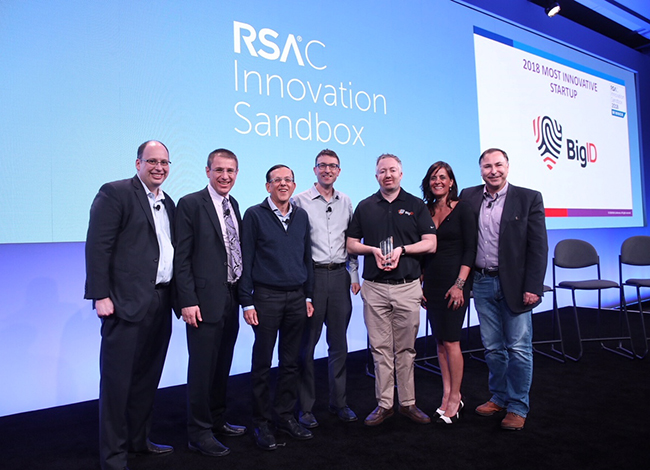
At the time, Sirota said his hope was to make the privacy problem less painful for companies. That is a revealingly workmanlike ambition. An enterprise buyer needs a problem reduced to something employees can handle on a Tuesday afternoon. A grand statement about trust will eventually meet a very ordinary queue of tasks.
The financing accelerated too. BigID announced a $14 million Series A in January 2018, followed less than five months later by a $30 million Series B led by Scale Venture Partners. Money enabled expansion, but also introduced the familiar founder’s transition: the person who explained the idea now had to build an organization capable of delivering it repeatedly.
Sirota’s comments about hiring from that period contain a welcome human detail. “We should laugh at each others’ jokes,” he said of finding a sales leader. He also wanted experience and cultural fit. A revenue plan may run on numbers; the people expected to execute it still have to enjoy being in the same conversation.
Enterprise sales, with the tie removed
For all the institutional language around BigID, Sirota can tell a distinctly informal sales story. He has recalled closing Nike, the company’s first enterprise customer, from beside the pool at his home in Mamaroneck, without a shirt on. Intel followed as the second customer. The setting did little to diminish the seriousness of the work.
The anecdote punctures a convenient assumption about enterprise selling: that a small company must disguise its size to win a large account. In his telling, the customer knew how small the team was. The task was to explain a problem clearly enough, and offer something useful enough, for the difference in scale to become manageable.
It also fits a recurring part of his public personality. He can discuss enterprise architecture and then tease the audience about his age. The humor brings the discussion back to the person doing the selling. Behind the diagrams sits someone who has spent years learning which explanations travel and which leave buyers staring politely at a slide.
Learning to let other people decide
By July 2025, Sirota was describing a change in his management style toward greater autonomy and a more collaborative organization. He also discussed leading a remote-first business and adapting its commercial approach as buyers and markets evolved. These are less photogenic milestones than a funding announcement, but they alter the founder’s working day.
Autonomy changes what leadership has to provide. When decisions spread through a team, priorities and responsibility need to be understandable beyond the founder’s desk. A growing company must develop a way for people to act without waiting for the person who once handled everything. Otherwise, growth simply creates a longer line outside one imaginary office.
Sirota’s account makes room for learning from failure and changing how he leads. That gives the story a useful second direction. The business expands its capabilities; the founder adjusts his own habits. Experience becomes valuable when it permits revision.
AI arrives with another set of keys
In March 2024, BigID raised $60 million in a growth round led by Riverwood Capital, with Silver Lake Waterman and Advent International participating. Its valuation exceeded $1 billion. The intended expansion included AI data security and compliance. Once again, a change in technology was creating new reasons to inspect the information underneath.
The practical work has continued. In January 2026, BigID introduced Concierge, offering experienced operators to supplement customers’ teams. In May, it appointed Mahesh Chukkapali, whose background includes Palo Alto Networks, Google Cloud and HackerOne, as chief operating officer. Sirota’s company was adding operational help alongside its expanding software ambitions.
His public conversations now reach into who owns AI governance across an organization. Security, privacy, legal and data teams can each have a piece of the responsibility. In a July 2026 discussion, he returned to the difficulty of turning those overlapping interests into clear accountability. A committee can contain many capable people and still leave an awkward vacancy where the decision ought to be.
For Sirota, the next chapter keeps returning to visibility, access and responsibility. AI gives information more ways to move and more systems capable of acting on it. His career has followed several generations of connections, from networks to APIs to enterprise data. The persistent challenge is giving those connections rules that people can understand and use. Before handing the software another set of keys, it helps to know which doors they open.