Justin Lie once had to reassure prospective customers that his company would not run away with their money. This was an unfortunate conversation for someone selling protection from fraud. The problem began with the name: CashRun. Clients heard it and supplied their own interpretation. A business intended to make online commerce safer sounded, to some of the people paying for it, like an instruction to the thief.
He has since told the story with some amusement. CashRun became CashShield; eventually, CashShield became SHIELD. The progression is tidy enough for a branding presentation. Living through it required selling the product while the name was still doing its best to sabotage the introduction. His recollection contains a useful piece of business history: customers were asking whether they could trust him long before his company made trust its central message.
The polished domain came later. So did the conference stages and institutional investors. At the beginning was a much less glamorous transaction: someone ordered gaming products, and the payment turned out to be fraudulent. Lie had intended to sell things. His customers, or at least a troublesome subset of them, had other plans. The business problem arrived before the business idea.
An order is only good news if it is real
At 16, Lie was reselling gaming products from American suppliers to local gamers, first through eBay and subsequently through his own e-commerce websites. Cross-border commerce offered a young seller an appealing possibility: find supply in one place, demand in another, and connect the two. Stolen credit cards introduced an extra participant who expected to be paid by neither side.
Lie responded by teaching himself to write risk algorithms. He devised rules to distinguish ordinary orders from abnormal ones, accepting some transactions and turning others away. This is the part of his story that explains the career which followed. He encountered fraud as the merchant whose business was being attacked. The measure of success was whether the system helped an actual shop keep trading.
SHIELD dates its founding to 2008. The original problem gradually became a product other companies could buy. It is an unusually direct route into enterprise software: first need the tool, then make it, then discover that other businesses have been having much the same unpleasant afternoon. There was no need to invent a customer persona. Lie had already occupied the seat.
A return ticket was not a sales strategy
An algorithm still needs someone willing to use it. As an undergraduate, Lie travelled to Europe alone to pitch his work to companies. He persuaded a German company to partner with him and built the business there. For a Singaporean student, Europe was a considerable distance to go in search of a first commercial foothold. The journey also made his ambition practical: he had to explain why a company in another market should take a chance on his idea.
By January 2017, the business was being described publicly as operating in 15 countries, with deployment across more than 37 multinational companies in seven industries. Those are historical figures, and they belong to that stage of the story. Their significance is the route they describe. An undergraduate project had crossed borders, found partners and become useful to enterprises well beyond its founder’s home market.
Lie graduated from the National University of Singapore with a BBA in 2010. In November 2017, he returned for an alumni homecoming discussion with MoolahSense CEO Lawrence Yong, entrepreneurship professor Michael Frese and moderator Hum Sin Hoon. It was a different sort of sales conversation: an entrepreneur back on campus, explaining the journey to people whose own careers were still taking shape.
- 2008The business begins
- 2010NUS BBA graduation
- 2017First US office
- 2022Trust Summit in Singapore
- 2024Trust Summit in Bangkok
Choosing when to take the money
In September 2017, CashShield announced a $5.5 million Series A and its first American office, in Menlo Park. Its backers included GGV Capital, Tony Fadell, Heliconia Capital Management, Stream Global and Razer. Fadell brought a connection to the iPod and Nest; Razer brought the perspective of a gaming business that also used the product. The company’s early connection to gaming had acquired a rather different scale.
Lie said the business had been built to support itself financially, giving him time to choose investors. That position matters more than the ceremonial photograph of a funding announcement. Outside money brings expectations, introductions and a new pace of work. Arriving at the negotiation with a functioning business changes the conversation about what the money is for.
A $20 million Series B followed in June 2018, led by Temasek and GGV Capital, bringing announced financing to $25.5 million. The company said the funding would strengthen its fraud technology and widen the types of screening it could provide. These were corporate financing rounds, rather than a measure of Lie’s personal fortune. For his working life, the consequential change was the expanding organization and the decisions that came with it.
The phone changed the question
The original merchant problem was easy to describe: should this order go through? Mobile applications complicated the question. A platform could lose money through fake registrations, abused promotional codes or stolen accounts before anyone reached a conventional checkout. By 2020, Lie was arguing that fraud protection needed to follow the whole user journey. A suspicious payment might be the ending of a story that began much earlier.
His explanation of SHIELD’s technology in 2022 focused on device and network information, patterns associated with risk, and monitoring throughout a session. He described a particularly inconvenient tactic: someone could open an app innocently enough, then switch on a malicious tool after the initial check. Inspecting the entrance once leaves a great deal of the visit unexamined.
The underlying idea is understandable without learning the software vocabulary. If the same operator is trying to make several accounts look like several unrelated customers, the device can provide clues that the account details obscure. SHIELD’s current positioning puts that device intelligence at the centre of its work. The company lists customers including inDrive, Alibaba, Meesho and TrueMoney, reflecting the variety of places where the question of a real user now arises.
There is a commercial awkwardness here which Lie knows from the seller’s side. Make every legitimate person prove themselves repeatedly and the shop becomes tiresome to use. Let coordinated abuse pass and the incentives intended for customers may go elsewhere. The work lives in those ordinary decisions: who gets admitted, who gets challenged, and who gets to complete what they came to do.
Conceptual illustration of Lie’s explanation of continuous session monitoring. No performance data implied.
Even algorithms need people to agree
Running the company brought a less programmable lesson. After the Series A, Lie experienced departures when people’s visions for the business no longer aligned. His conclusion was plain: “it isn't possible to make everyone happy.” Investment could finance expansion; it could not guarantee that everyone wanted the same company to emerge from it.
His father, a businessman, had supplied an earlier education in financial responsibility. Once Lie and his brother earned money, they were expected to contribute to household expenses. Lie has said he wants to pass that practical attitude to his children. It is a small domestic detail beside the funding figures, but a useful one: earning money came with obligations, rather than simply permission to spend it.
At SHIELD’s fifteenth-anniversary retreat in 2023, he chose “Align & Scale” as the theme and compared the organization to a fleet searching for treasure. A collection of capable crews can still sail in incompatible directions. In his telling, alignment required shared direction while leaving room to adjust course. The metaphor is more cheerful than an organizational chart, although it carries much the same demand: people need to understand where they are going together.
In a 2024 video conversation, he also urged people to remain adaptable as AI changes work, to learn new technologies and to contribute across a wider range of projects. It is consistent with his own route from selling gaming goods to building fraud software and running an international business. Each stage required a different kind of competence. The algorithm could evolve; its founder had to do some learning too.
A collection of capable crews can still sail in incompatible directions.On Lie’s fleet metaphor for alignment
A dinner invitation becomes part of the job
Lie has described a turning point that arrived through a modest request. Partners wanted him to arrange dinners with other companies. The request suggested that SHIELD occupied a useful position between organizations which needed to speak to one another, sometimes including competitors. Building the software had also placed him in the business of convening people.
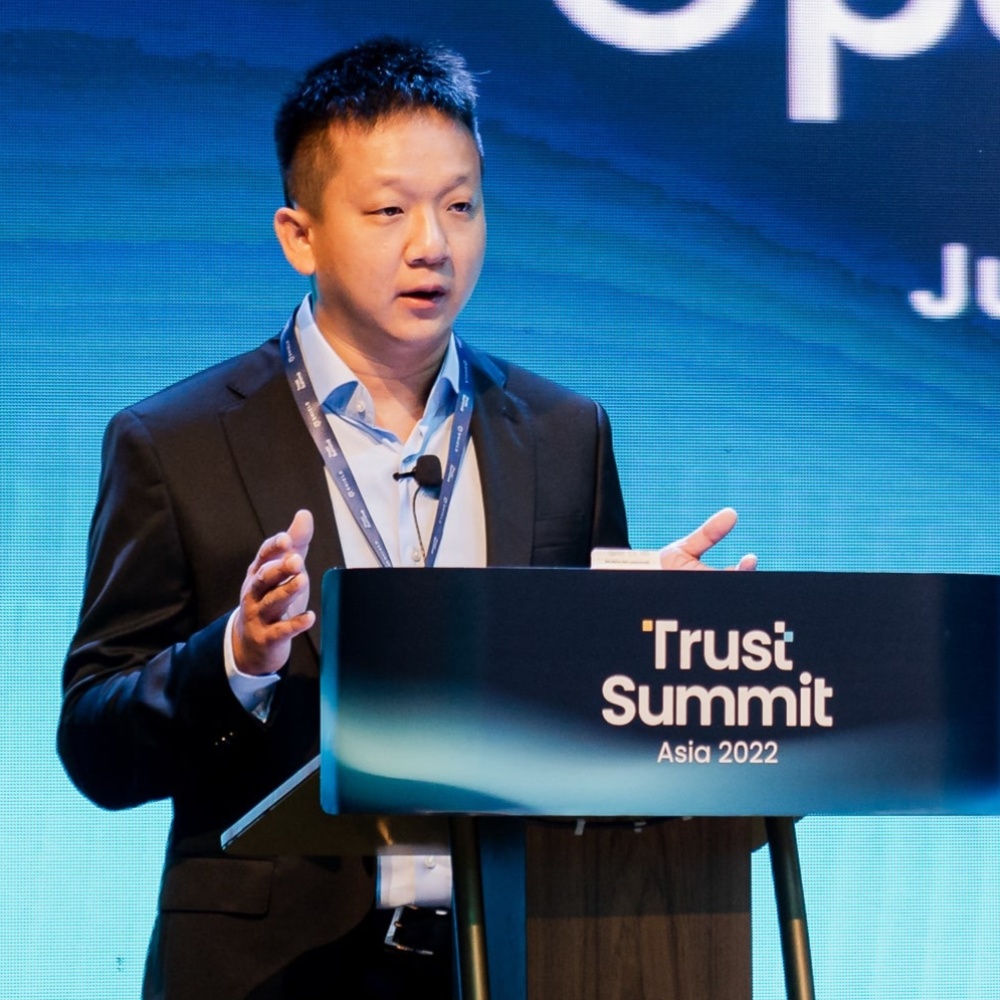
The Trust Summit began in Singapore in 2022 and reached Bangkok with Money20/20 Asia in 2024. At the Bangkok event, SHIELD recognized organizations including Astro, inDrive, Maya and TrueMoney through its Trust Awards. The gathering made his collaboration argument tangible: people from different businesses could compare problems that did not respect the boundaries between their companies.
There is room for a less solemn version of the same idea. Before his Money20/20 Asia keynote panel in 2024, Lie invited people to SHIELD’s booth to play Whack-a-Fraudster and have coffee made with beans roasted in Kyoto. Fraud prevention is usually presented through warnings and dashboards. A game and a decent coffee give someone a friendlier reason to stop and talk.
In September 2026, SHIELD was named to the NextGen Tech 30, the programme powered by Granite Asia. Lie’s public response returned to device intelligence and the challenge of automated abuse that can resemble human activity. The tools have changed considerably since those early gaming orders. His recurring concern remains recognizable: how to tell whether the apparent customer is the person the business thinks it is.
The CashRun joke now reads like an early rehearsal for that question. Before the company could ask anyone to trust its judgment, its founder had to earn their trust in him. Years of product development have made the technical side more elaborate. The human transaction is still quite familiar: two strangers would like to do business, and each needs a reason to believe the other.