Oren Falkowitz remembers buying oranges with his mother in South Florida. The journey was short, a mile or so to Blood’s groves. The people selling the fruit knew them. They knew the people selling the fruit. In his account, the groves eventually disappeared, leaving a peculiar arrangement behind: oranges traveling into a place that had once grown its own.
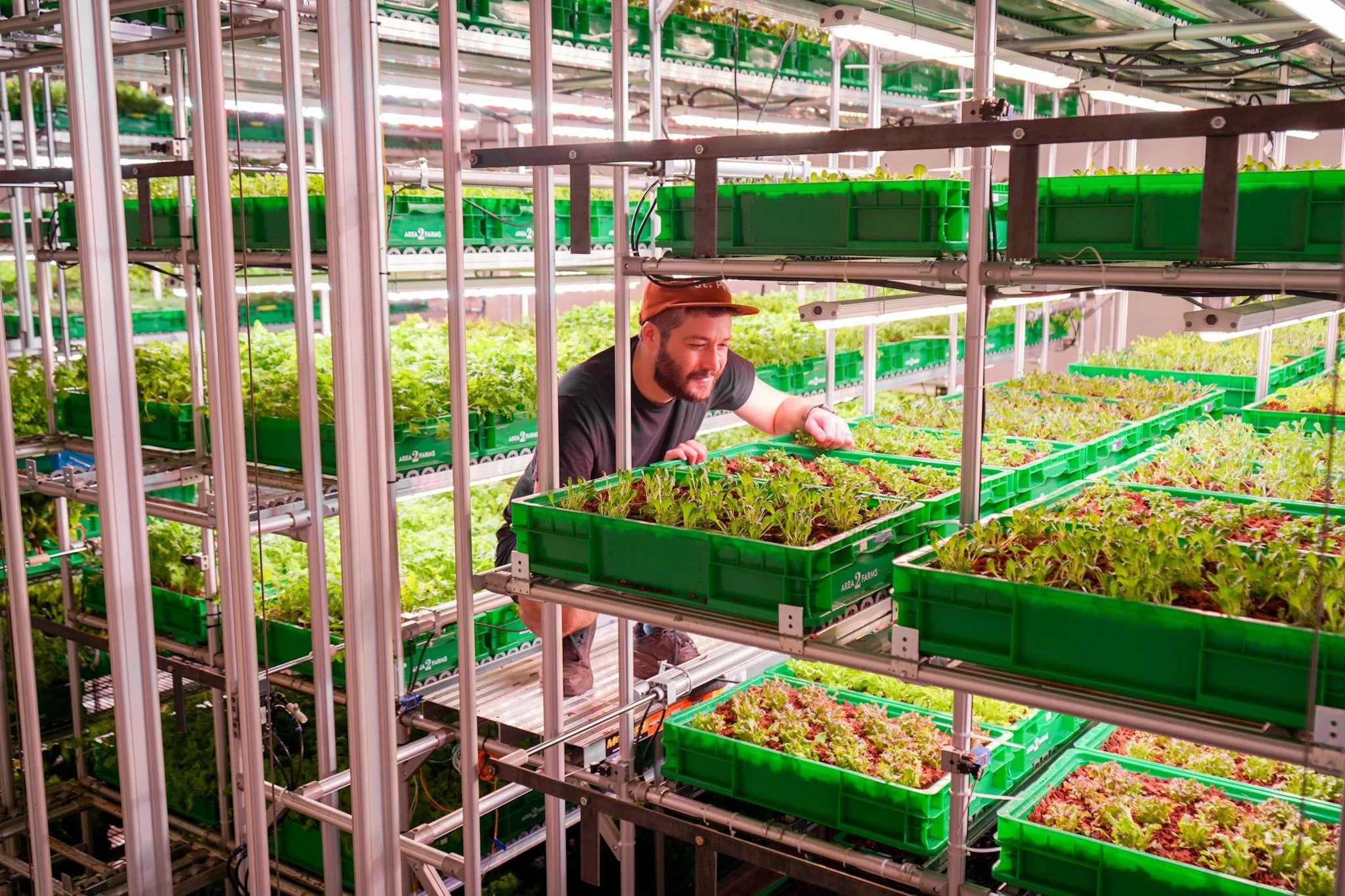
That memory gives his current business a more useful introduction than his old security clearance. Falkowitz co-founded Area 2 Farms with indoor-farming specialist Tyler Baras. In Arlington, Virginia, the enterprise grows produce indoors and sells it directly to nearby households. It belongs to the same career as his work at the National Security Agency, U.S. Cyber Command and Area 1 Security, though the vegetables do make the résumé take a turn.
His shorthand for the agricultural project is “move the farm, not the food.” Behind it sits a practical question: why accept the distance between production and everyday life as a fixed condition? A farm can be small. It can occupy an urban building. Its customers can meet the people growing dinner. The citrus grove offers a memory of that relationship; the machinery offers a way to attempt it somewhere else.
One way to read Falkowitz’s career is as a series of arguments about where to intervene. At Area 1, the intervention came before a malicious message could do damage. At Area 2, it comes before a harvest enters a long distribution chain. The resemblance is an interpretation, but it helps explain why the leap from phishing to farming feels less random after a closer look.
Before the inbox, the intelligence work
Falkowitz’s academic training was in political science and international relations at the University of Central Florida. He led his fraternity chapter in 2003 and was recognized among the university’s top 100 student leaders. The early combination was already broader than a purely technical apprenticeship: institutions, people and the work of organizing them.
His government career put him inside the systems that businesses would later hire him to help defend. He held positions at the NSA focused on large-scale data and computer network operations, and served as chief data scientist at U.S. Cyber Command. By the time he was presenting to a cybersecurity program at the Hoover Institution, his subject was offensive operations and the intelligence needed to plan them.
He left the NSA in 2012 and co-founded Sqrrl, a company using data analysis in cybersecurity. He served as its CEO and president until March 2013. Area 1 followed later that year, with co-founders Blake Darché and Phil Syme. The move into commercial security carried a specific advantage: experience thinking about an attack from the side trying to make it succeed.
An inbox is a surprisingly good place for that experience to matter. Its contents arrive wrapped in ordinary obligations: a document to review, an invoice to approve, a request from a colleague. The message asks someone to behave like a helpful employee. That everyday plausibility was central to Falkowitz’s argument about why simply asking employees to be more suspicious would never be enough.
A security lecture, with 64 chances to lose the room
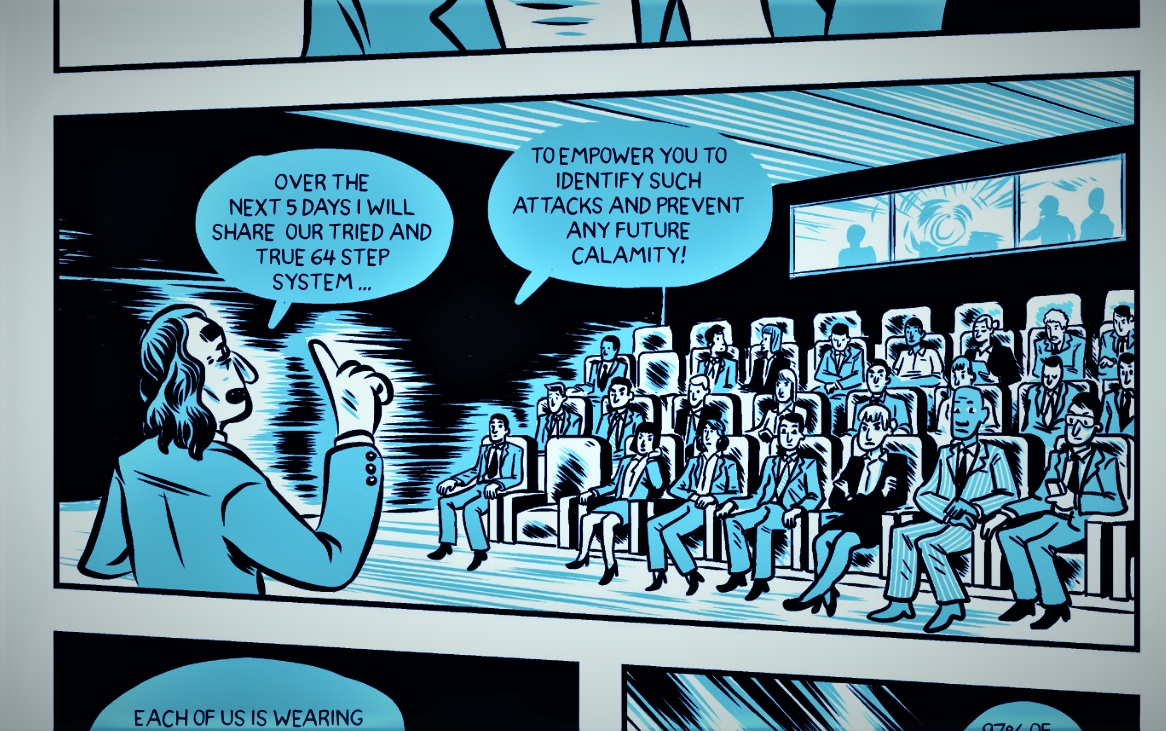
In 2016, Falkowitz took the argument into a comic book. Pineapple Sparkle, illustrated by François Vigneault and sponsored by Area 1, satirized the corporate ritual of security instruction. Its security chief presents a 64-step system for avoiding phishing. When the system proves insufficient, the natural bureaucratic response is to add more steps. Anyone who has survived a mandatory presentation can supply the atmosphere.
The joke had a commercial and technical purpose. Falkowitz argued that people are employed to open documents, follow links and communicate. A convincing request from a superior can exploit precisely that willingness to do the job. Protective technology therefore has to carry more of the burden. The comic makes his impatience with impractical instruction visible without requiring the reader to sit through another training session.
Putting a price on an intercepted phish
Area 1 also experimented with the commercial side of protection. In October 2018, it introduced a pay-per-phish model. The announced price was $10 for a phishing attempt the service caught. Instead of selling only a broad promise and a recurring bill, the proposal attached a price to a particular outcome. It was an unusually literal way to ask whether security software had done its job.
The arrangement made incentives part of the product discussion. Falkowitz worried that expensive security programs producing disappointing results could leave businesses less willing to defend themselves. A performance-based offer put the vendor’s claims closer to something a customer could count. Whether such pricing would endure was a separate business question; the choice itself revealed what he wanted customers to examine.
He also brought the inbox argument into election security. In 2020, he discussed Area 1’s analysis of more than 10,000 state and local election administrators. The company found uneven protection and hundreds using personal email or technology intended for personal use. His emphasis was on the people administering elections and running campaigns, whose correspondence could expose the wider operation.
That focus made cybersecurity a matter of working conditions as well as software. Election administrators had numerous responsibilities and limited access to specialist help. Falkowitz called for more resources and expertise. In a public conversation about compromised accounts, he kept returning to the administrative work around an election: the people, their tools and the information they needed to exchange.
The announced price per phishing attempt caught under Area 1’s pay-per-phish model.
An acquisition is a milestone, not a whole biography
Falkowitz’s period as Area 1’s chief executive ended in June 2020, when Patrick Sweeney took over. Falkowitz became chairman, with responsibilities including the federal business, customer advocacy and research. That distinction matters to the chronology. He was the company’s co-founder and original CEO; he was already in a different role when its acquisition became public.
Cloudflare announced an agreement to acquire Area 1 in February 2022 at approximately $162 million, subject to adjustments. The deal closed on April 1. Cloudflare wanted email protection inside its broader security platform, bringing Area 1’s work into a network serving customers around the world. The outcome gave a corporate home to the technology Falkowitz had helped set in motion.
Cloudflare had also been a customer. Its account of the purchase described its own experience using Area 1 to reduce phishing reaching employees. There is a satisfying economy to that sequence: a company uses a product, finds it useful, then buys the business behind it. The acquisition rationale centered on an ordinary application that attackers could exploit with extraordinary consequences.
Yet Falkowitz did not turn the transaction into an uncomplicated endorsement of startup life. In a December 2023 conversation with Michael Fertik, he discussed frustrations with Silicon Valley’s venture-capital culture and board dynamics. He had moved back to Washington, D.C. A successful company sale and dissatisfaction with how parts of that world worked could coexist. He was willing to say so publicly.
- 2013Area 1 Security
Co-founder & original CEO - 2020A different seat
Transitioned to chairman in June - 2022Cloudflare acquisition
Completed April 1
The farm between the dog groomer and the repair shop
Area 2 makes the next chapter unusually tangible. Falkowitz has described the Arlington farm’s neighbors as a dog-grooming salon and a car-repair shop. It is a useful address for an argument about urban agriculture: the farm fits among the services a neighborhood already uses. No pastoral driveway is required.
The business combines indoor growing with weekly farm shares. Baras brings farming expertise; Falkowitz brings experience building companies. Customers receive a changing selection of produce rather than the complete inventory of a supermarket. Falkowitz has compared the proposition to a butcher shop, with a focused range of distinctive staples. The model asks for a repeat relationship between a household and a producer.
The operation also opens itself to visitors. Falkowitz has described thousands of schoolchildren passing through the farm, and the company offers tours. Seeing the growing space turns a subscription into something more concrete than a checkout page. A customer can look at the plants and ask the grower a question. For a founder whose earlier work involved invisible threats, this is a conspicuously visible product.
Even the produce can start a conversation. During an August 2026 television visit, Falkowitz discussed varieties including purple shamrock and blue cheese leaf. The latter comes with a pungent introduction built into its name. A weekly basket gives unfamiliar plants a route into someone’s kitchen, and gives the farmer something to explain beyond the price of lettuce.
Neighborhood farm→HARVEST
Weekly produce→COLLECT
Nearby households
A direct relationship between the grower and the people buying the harvest.
A national ambition measured in neighborhood miles
In March 2026, Area 2 announced a franchise model, adding a new question to the growing operation: could other local owners reproduce it? The announcement described soil-based production, direct sales and proprietary farming systems, with support from franchising adviser Paul Flick. It also identified investment from Alexis Ohanian’s Seven Seven Six. The company was preparing to turn its operating experience into a package another farmer could use.
Falkowitz has described a target of reaching 90 percent of Americans with farms within 10 miles. That remains an ambition. In discussing expansion, he acknowledged that the network still had much to prove. He wanted operators who could run teams and businesses and also wanted to deal with customers. Growing skill alone would not satisfy the job description.
There is a demanding piece of management hidden inside that preference. A neighborhood farmer must produce reliably and maintain relationships. The person serving the community is part of the offering. A network can share systems and knowledge, while each location still needs someone residents recognize. Scaling that relationship is a different exercise from scaling a software service.
The company’s current location listings give the ambition a concrete, unfinished shape: Arlington is growing, while Fairfax and Peachtree City are listed as coming soon. The gap between a national plan and those next openings is where the work sits. Each new farm has to function as a business and earn its place among the other doors on the street.
“We do have a lot to prove.”
Oren Falkowitz, on expanding Area 2 Farms · March 2026
A farm small enough to rebuild in LEGO
There are lighter clues to the person behind the operating plans. His investor Cowboy Ventures gives him the title of global ambassador for Bow-Tie Thursday. His Medium archive includes a declaration that he was once disqualified from a Peeps diorama contest. These are small departures from the solemn vocabulary that tends to gather around former intelligence officials.
On CareerVillage, where he has answered students’ questions, his profile carries a compact instruction: “Work Hard, Be Kind, Amazing Things will Happen!” It is a useful companion to the more argumentative public persona. The person challenging how companies buy security has also spent time helping people at the beginning of their careers.
More recently, Falkowitz shared a story about Ian, a young visitor who toured the farm and later returned with a LEGO version he had built. The company’s website now includes a photograph of a miniature farm. It is a modest kind of feedback, measured in bricks rather than transaction value, but it makes the attraction of the project unusually easy to grasp.
The oranges of his childhood came with a known grower. The inbox business asked how to protect people while they worked. The farming business offers a place they can actually enter. Falkowitz’s next test is whether enough neighborhoods want that place, and whether enough local owners can keep it running. For now, one visitor has already decided it was worth rebuilding by hand.