Ken Carnesi’s first internet business had an unusually tangible sales pitch. He put Wi-Fi equipment on the roof of his Boston apartment building, then went around the neighborhood with flyers. Pull off a tab. Pay $30 a month. Get online. The equipment, he later recalled, cost about $800. Before there was a cybersecurity company to run, there was a roof to borrow and somebody down the block who needed a connection.
It is a useful place to start with Carnesi because the work was so close to the customer. He was responsible for the connection people bought. Years later, when he became dissatisfied with a service he used to help run networks, he knew precisely whose problem it was. His own.
A roof, a router, and a customer list
Carnesi attended Boston College’s Carroll School of Management. His early working life included institutional equity sales and trading at Prudential Equity Group. Finance offered a possible route out of college; his wireless experiment offered another.
In his account of those years, a Prudential division shutdown left him without that job. He later took a Wachovia internship, but both he and his boss left to start a business. They put in $2,500 each. Anaptyx began in 2007. An early assignment involved proposing Wi-Fi coverage for a square mile of Dorchester. He and friends from college won the work, despite their limited experience.
The assignments grew into a business building and maintaining large wireless networks. Resorts, hotels, and government customers brought different requirements. A connection that works in one apartment is a beginning; a service that people pay you to keep running is an occupation. Carnesi had chosen an occupation in which failure could be reported almost immediately, often by someone trying to use the internet.
A customer with a competing idea
Filtering entered the picture through the networks he operated. Government work required it. On other networks, looking at traffic helped reveal threats and congestion. DNS, the system that translates internet names into addresses, provided a place to intervene without installing another piece of equipment at every property.
He used OpenDNS, then grew unhappy with the available choices. The frustration included pricing and the experience of being a service-provider customer. He began making something for his own use. DNSFilter’s 2015 beginning belongs to that period: a working customer deciding that the product he needed might be worth building.
At a local technology incubator, where he had volunteered as a mentor, Carnesi met Mike Schroll. The idea acquired a technically interested collaborator. Brian Gillis became another co-founder. An irritation now had people attached to it.
They also had something to learn. The early plan assumed they could deploy software and get going. Building the necessary global network brought them up against BGP Anycast, unfamiliar territory. Carnesi’s response was to seek out the author of an O’Reilly networking manual. A Skype conversation with the author in Austria helped point them forward. Asking the person who wrote the book has a pleasing economy to it.
“Talk to your customers.”
Ken Carnesi
The bunk beds came before the boardroom
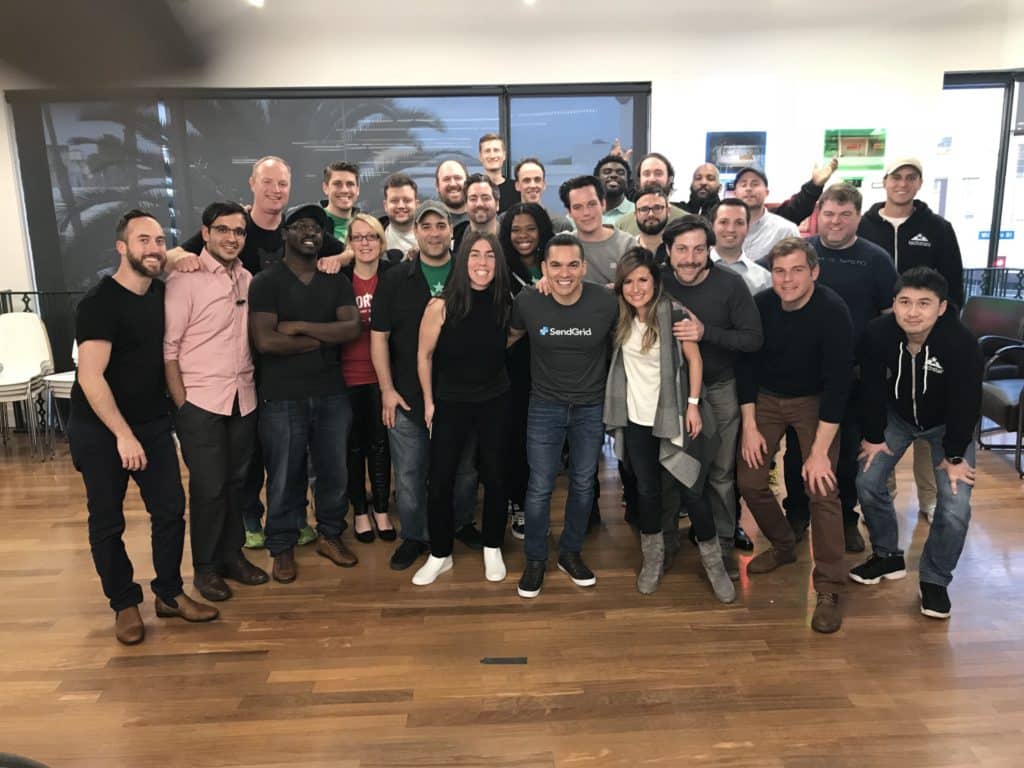
The company joined the inaugural Techstars Anywhere class in 2018. For a business already comfortable with distributed work, the program had an obvious attraction. Carnesi traveled to CES to meet its directors, Ryan Kuder and Karina Costa, and later went to Los Angeles with Gillis.
His contemporary account includes a detail unlikely to appear in a funding announcement: sleeping in bunk beds for the first time in 20 years. There were deep dives into business metrics, too. Startup education apparently came with both spreadsheets and the possibility of somebody climbing a ladder above your head.
That April, DNSFilter acquired Webshrinker. It had already been using the company’s domain categorization technology for nearly two years. Bringing it inside the business connected the filtering service more closely to the intelligence used to decide what a website was.
Webshrinker had its own practical origin. Adam Spotton started it in 2012 to automate website screenshots for an educational resource provider. Domain categorization became a central part of the product later. Two businesses that had begun by removing repetitive, inconvenient work were now joined together.
In a 2019 conversation about financing, Carnesi described using capital first for infrastructure and engineering, then turning toward sales and marketing. His ambition was to grow a substantial internet security company. The sequence was deliberate: build enough of the service to make selling more of it worthwhile.
In July 2021, DNSFilter announced a $30 million Series A led by Insight Partners. Thomas Krane joined the board. The investment was intended to support research, development, and hiring. For Carnesi, the job increasingly involved organizing the people who would build the next version, rather than personally handling every part of the present one.
The office was a set of decisions
A distributed company exchanges some familiar office problems for a less familiar collection of administrative ones. Carnesi has written about the details: paying people across borders, choosing tools, making knowledge available beyond the person who happens to remember it.
His 2020 account described adding a company wiki as information became harder to share. He also described meeting agendas and explaining board discussions to employees. These are modest practices on paper. Their significance becomes clearer when a colleague cannot simply lean across a desk and ask what is going on.
He was willing to let teams use different tools and change processes as the organization grew. The approach leaves room for revision. A system that suits ten people can become an obstacle to thirty-five; preserving it for sentimental reasons would give the software rather too much authority.
In 2021, DNSFilter introduced a rotating shorter workweek. Employees were split into two groups, each receiving every other Friday off. Coverage continued while people took turns with a longer weekend. Carnesi attached a clear condition to the experiment: “Numbers don’t slip and we don’t miss deadlines.”
It was an operating choice with a schedule attached. Alternating Fridays made room for time away while keeping the business staffed. That detail matters more than the attractive phrase “four-day week,” which can conceal several different arrangements.
Who gets to say no?
Selling a filter invites a question about authority. Someone decides what a user can reach. A company administrator, a customer, and a resolver operator occupy different positions in that decision.
In July 2021, Carnesi publicly supported Quad9’s objection to a copyright-related blocking injunction. He argued for customers retaining discretion over filtering rather than having a resolver impose the disputed block. His concern extended to the precedent for bringing action against third-party providers.
For a business founded to help people manage internet access, the distinction was consequential. A customer buying controls and a provider being compelled to block a destination produce different relationships with the user. Carnesi’s position placed customer choice at the center of that argument.
An interest with its own pit lane
Carnesi’s interests extend to car and motorcycle racing. His published biography lists BMW M School and California Superbike School, and reports a second-place finish in the SCCA SCR championship in 2016. It also lists fishing, gourmet cooking, reading, and travel. The range suggests several ways to spend a weekend without opening a company dashboard.
Racing has also become part of DNSFilter’s public business life. In 2024, the company partnered with Juncos Hollinger Racing. Carnesi spoke about sharing the experience with customers and prospects and using it to develop relationships.
For the 2025 IndyCar season, DNSFilter became an official PREMA Racing partner. The announcement placed its branding on the entries driven by Callum Ilott and Robert Shwartzman, as well as on driver suits. A personal interest now had a place on the corporate calendar, complete with rather louder equipment than the original rooftop router.
The next unfamiliar traffic
The company’s later acquisitions kept extending the kinds of information it could use. In April 2025, DNSFilter bought Zorus, which provided endpoint web filtering and user behavior analytics. The combination brought together work at the network level and on individual devices. Carnesi emphasized the service-provider customers that had helped shape DNSFilter from the beginning.
DNS queries processed daily, as reported by DNSFilter at its tenth anniversary.
By September 2025, DNSFilter reported serving more than 43,000 organizations. Its tenth-anniversary account put daily query volume at 180 billion. Those are company figures from a particular moment, but they provide a sense of the distance from neighbors buying internet by the month.
Carnesi’s own recognition had expanded too. DNSFilter reported his selection for the Washington Business Journal’s 2024 40 Under 40, followed by a second consecutive Washingtonian Tech Titan recognition in 2025. The founder who once needed permission to use a roof was now being recognized in the city where his professional profiles place him: Washington, DC.
In August 2026, after Black Hat, Carnesi described a preview of LUMINATE, a planned DNSFilter platform with controls for shadow AI and AI governance. His account focused on a recognizable customer problem: employees using tools that an organization had neither approved nor adequately understood.
September brought an expanded reseller program. Carnesi argued that protective DNS should support a durable business for partners. It was a commercial concern with a familiar shape: the person delivering the service needs a workable relationship with the company supplying it.
The destinations have changed since the rooftop experiment. So have the numbers, the colleagues, and the machinery. Carnesi keeps returning to the connection itself: how to provide it, how to understand it, and how to give the customer a useful say in what happens next.
Keep the connection
Conversations, writing, and public profiles.
- DNSFilter website ↗
- Ken Carnesi on LinkedIn ↗
- Ken Carnesi on X ↗
- GitHub: carnesik ↗
- Writing on Medium ↗
- Watch: dnsUNFILTERED, episode 26 ↗
- The Anaptyx years: 2017 interview ↗
- Carnesi on running a remote company ↗
- His 2021 response to the Quad9 injunction ↗
- His August 2026 Black Hat recap ↗
- September 2026 channel announcement ↗