The first surprise is the siren. Or, more precisely, the ambition to hear fewer of them. In late-1970s Salt Lake City, physician Jeff Clawson wanted to reduce the number of medical responses made with lights and sirens, and the vehicle accidents that accompanied them. Treat every call as equally urgent and you spend your scarce ambulances before you know which patient needs them most. The trouble began at the telephone.
- Ask in a useful order. ProQA turns emergency calls into structured questions, response codes and caller instructions.
- Look again. AQUA and analytics help centres examine decisions after the call.
- Practise the rare calls. AI SkillLab supplies simulated callers for repeated training.
- Budget for the whole method. Licences, support, integration and education all belong in the buying decision.
Priority Dispatch grew around that problem. Today it provides protocol products, software and services for emergency communications centres handling medical, fire, police and nurse triage work. The company reports that its system is used in 60 countries and handles more than 100 million calls a year. Behind the scale sits a modest proposition: when something terrible happens, the next question should not depend entirely on who happens to answer.
Priority Dispatch’s published figures for its system. Scale describes use, not an outcome guarantee.
A cookbook for a bad day
Clawson’s own conversion to protocols had an entertaining obstacle: professional pride. During his medical training in New Orleans, another resident showed him decision cards for handling patients. Clawson initially regarded them as a cookbook. Using them changed his opinion. In his later account, they reduced the strain of continually inventing a process and left him more attention for the patient.
Dispatch had its own informal cookbook: learn from the person beside you. Clawson described that apprenticeship as “sitting with Nellie.” The obvious defect was that the next recruit inherited Nellie’s errors along with her experience. Standard questions offered something teachable, inspectable and capable of revision.
“We called it ‘sitting with Nellie.’”
Jeff Clawson, describing early dispatcher training in a 2014 interview
His 1979 Salt Lake City card system covered 29 complaint types. It paired questions with instructions and dispatch priorities. Yet a correct procedure could still be awkward to use: early instruction diagrams were so tangled that they acquired the nickname “Uncle Squiggly.” Later panel logic made the paths easier to follow. It is a wonderfully unglamorous lesson in product design. Accuracy on paper is only the beginning; somebody has to navigate it while another person is frightened.
The question before the siren
ProQA is the software expression of this approach. It guides a calltaker through questions and instructions, producing structured information for the response. Medical, fire and police protocols address different kinds of incident; nurse triage extends the model to care routing. The caller gets a person with a defined process behind them.
The important distinction is between understanding the call and managing the response. Computer-aided dispatch, or CAD, handles dispatch operations. ProQA provides the questioning and decision support that can feed that system. In Columbus, public records describe ProQA as connected to CAD and phone systems and used for EMS and fire incidents.
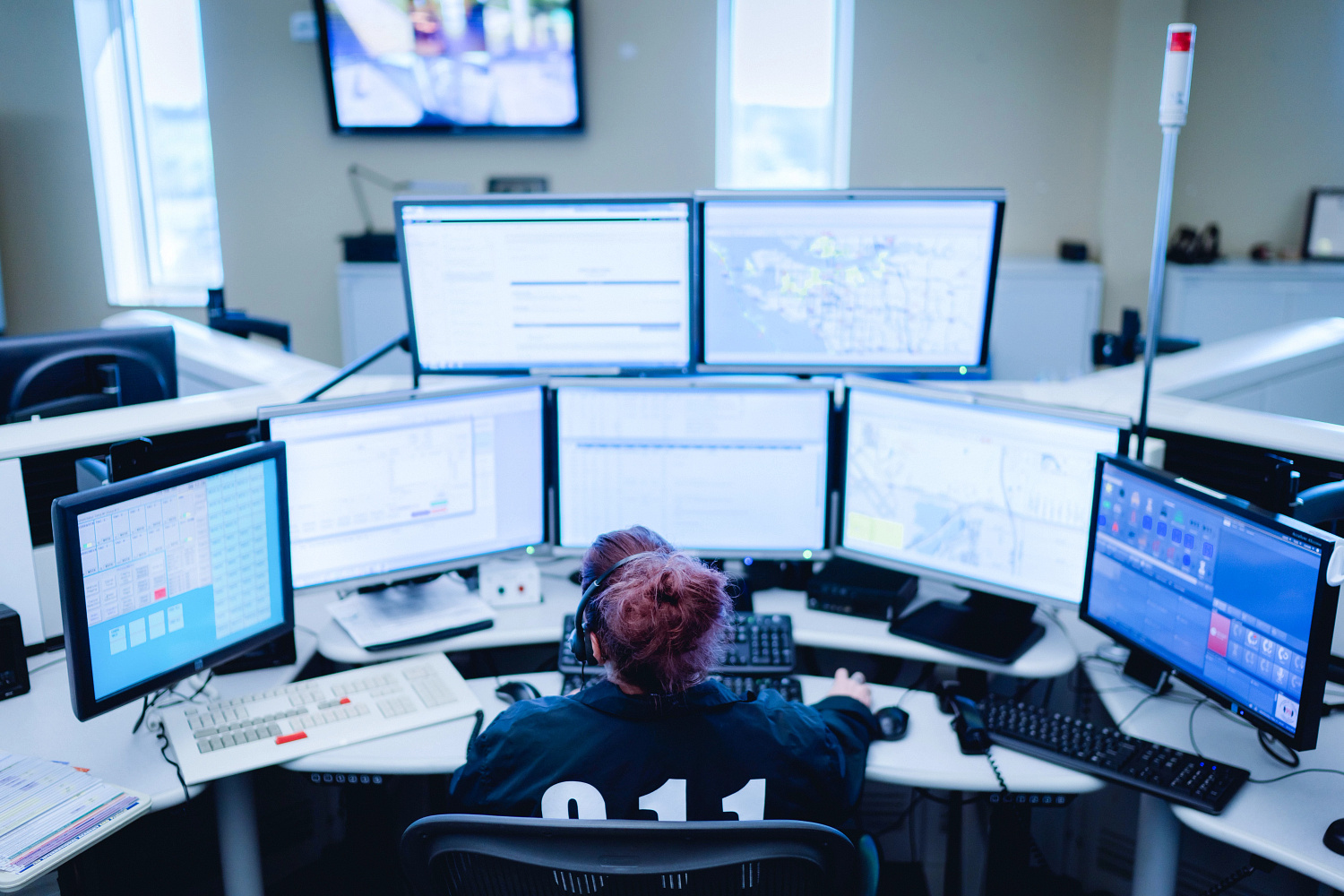
The connection took work. The company’s software history describes early interfaces to DOS and UNIX CAD systems as cumbersome. Richard Saalsaa’s Systems Plus merged with Medical Priority Consultants in 1990, helping develop those interfaces. Paper protocols had supplied a method; software had to make that method communicate with the rest of the operation.
Agencies retain a consequential choice: the resources attached to a dispatch code. Priority Dispatch’s ProQA materials say centres select response levels according to local resources and community needs. Standardising the questions does not make every town’s fleet, geography or service arrangement identical.
+ caller instructions
A second look, then another rehearsal
AQUA addresses what happens after the conversation. Reviewers can examine ProQA sequences against IAED performance standards, record feedback and generate reports. AQUA 8 Infinity uses a browser interface; appropriate intranet access lets reviewers work away from the centre, while updates take place on the server.
The company promotes feedback built around strengths. That is a practical stance in a profession where a review can easily feel like an invitation to defend yourself. The goal is to find a useful correction and give the dispatcher a fair way to understand it.
Academy Analytics, developed through the FirstWatch relationship, gives supervisors another view: patterns across calls. Its dashboards can flag outliers, show overrides and examine particular protocols or dispatchers. FirstWatch dates its partnership with IAED and Priority Dispatch to 2002. The inference for a manager is straightforward: a difficult call may reveal a training gap; a recurring pattern deserves a broader investigation.
AI SkillLab takes the resulting practice into simulation. A dispatcher speaks with an AI-voiced caller, and a training coordinator can assign scenarios and review performance. A rare, demanding incident can become a repeatable exercise. The advertised role is supplementary training, with human trainers still involved.

The bill is part of the system
Ingham County’s January 2025 paperwork makes the economics unusually concrete. Its proposal quoted $12,600 annually for ProQA licences, service and support in the first four years, plus $5,000 a year for AI SkillLab. The fifth-year combined amount rose to $18,520. The proposed five-year authorisation totalled $88,920, billed annually.
Annual amounts for years 1-4. Different scopes produce different prices; these are not a universal price list.
Columbus authorised $66,867 for support and maintenance of its existing ProQA system in 2024. These records show a business built on agency contracts, recurring support and additional services. A comparison of the two totals alone would tell a buyer little without knowing the deployments behind them.
Priority Dispatch’s particular market position includes exclusive licensing and distribution of IAED unified protocols. Competitors offer other methods: APCO supplies a locally customised EMD programme and guidecards; Total Response supplies integrated medical, fire and police protocols with CAD interfaces. An agency is choosing procedural rules and training commitments as well as a software interface.
Columbus treated maintenance of its installed proprietary ProQA system as a sole-source purchase. That is also a useful commercial clue. Once procedures, integrations and staff habits surround a product, switching becomes an organisational project. Buyers should consider that commitment at implementation, when they still have time to compare approaches carefully.
What changed in Ontario
In March 2026, Priority Dispatch reported that Georgian Central Ambulance Communications Centre in Ontario saw a 21% improvement in response times for its most critical calls after a year with MPDS. Its announcement also described improved allocation and lower overtime. Wasaga Beach mayor Brian Smith, who initially had concerns, was quoted calling the change a “massive improvement.”
This is a company-reported local before-and-after result. It offers a reason to investigate, rather than a percentage to paste into another agency’s forecast. The interesting mechanism is prioritisation: deciding more accurately which calls should reach the front of the queue. A protocol cannot create another ambulance, shorten every road or fix a centre’s staffing by itself.
Keep the questions current
A dispatch system has to move with the incidents it handles. Priority Dispatch’s 2025 updates included electric-vehicle fire questions and revised police criteria for crisis teams and alternative responses. Its roadway-safety work with the U.S. Department of Transportation highlighted instructions intended to reduce secondary crashes. The script is a maintained product.
The transferable lesson is to join the steps: specify a decision process, make it usable, inspect its application and practise the weak spots. That approach needs trained people, maintained integrations, local response capacity and time for review. Buy the software without those conditions and the method has little room to work. Priority Dispatch’s story is compelling because the smallest unit of improvement remains so recognisable: one person, listening carefully, asking what comes next.