The most revealing Primal product has a name that sounds like a committee failed to settle an argument: Kibble in the Raw. Kibble is dry, familiar and easy. Raw is fresh, fussy and freighted with opinions. Put the two together and you get Primal Pet Group's business in miniature - a company trying to preserve the nutritional and emotional appeal of minimally processed food while stripping away the chores that keep it niche.
The strategy began with a dog, not a market map. In 2000, Matt Koss's dog Luna showed signs of renal failure. On the advice of a holistic veterinarian, he began preparing a diet based on raw food and bones. Luna's appetite and energy improved, according to the company's account. Koss founded Primal Pet Foods in 2001 to offer other owners a prepared alternative to making such meals themselves.
Two decades later, private-equity firm Kinderhook Industries acquired Primal and paired it with Prairie Dog Pet Products, a maker of freeze-dried, smoked and natural treats. Himalayan Pet Supply and Holistic Hound joined the mix, creating Primal Pet Group in 2021. The umbrella company was less a conventional brand house than a collection of processing expertise: frozen, freeze-dried, air-dried, dehydrated and smoked.
01 / The propositionRaw nutrition, minus the second job
Primal's customers are dog and cat owners who inspect an ingredient panel with something close to grocery-store seriousness. They want recognizable proteins, fewer synthetic inputs and gentler processing. But many do not want to weigh organs, manage a freezer full of meat or remember to thaw dinner before leaving for work.
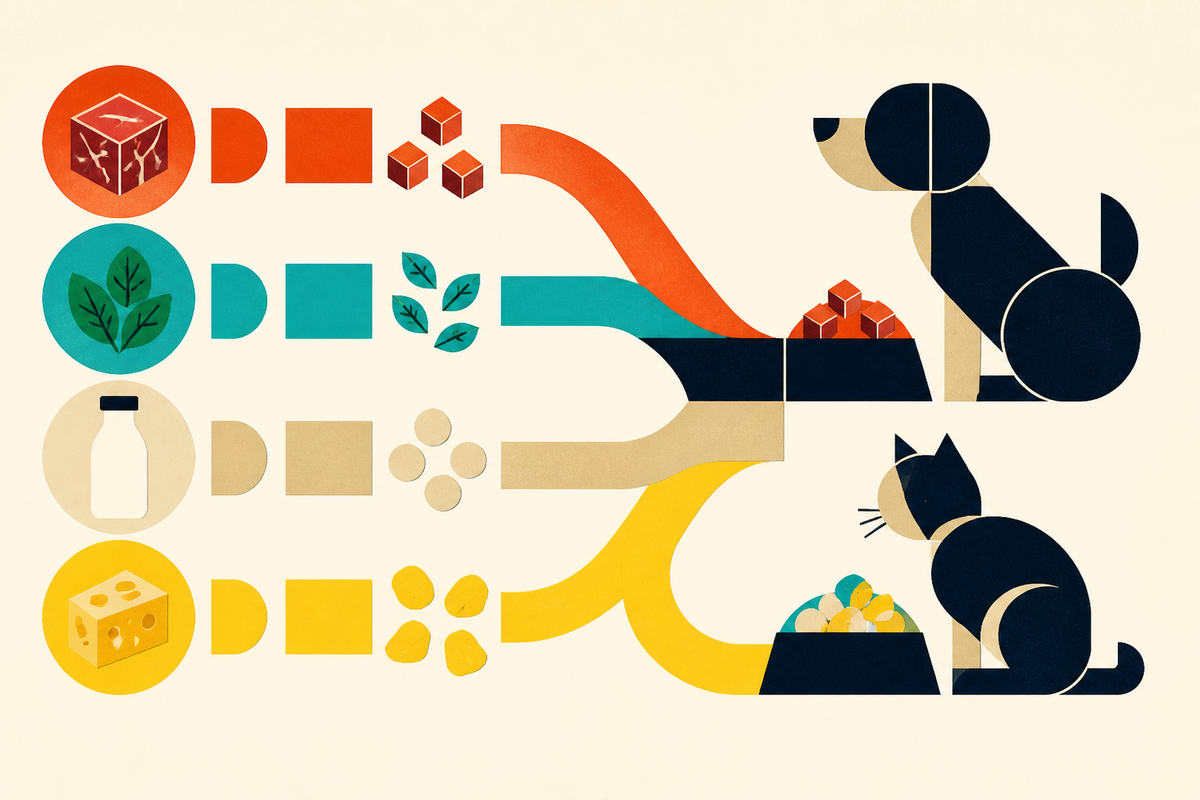
That gap is where the company earns its margin. Frozen patties and nuggets serve committed raw feeders. Freeze-dried nuggets can be a complete meal or crumble over another food. Scoopable Pronto reduces portioning friction. Goat milk, broths and toppers let a curious owner add a small amount without converting the whole bowl. Kibble in the Raw goes furthest: individually prepared ingredients are combined and freeze-dried into bites that pour like a dry food.
The portfolio also reaches beyond meals. Himalayan's signature chew came from churpi, the hard cheese eaten in Nepal. Co-founders Nishes and Suman Shrestha spent years adapting the idea for dogs, including reducing lactose and tuning texture. Their chews sold out at a Bellingham pet fair in 2007. It is an unusually vivid piece of product history: a cultural memory became a new shelf category, then a component of a national pet platform.
“We're committed to making raw nutrition more convenient and accessible for all pets and their parents.”Primal Pet Foods
02 / The machineryA brand story with a cold-storage bill
Primal sits in the premium end of a vast market, between conventional kibble and do-it-yourself raw feeding. Its visible competitors include Stella & Chewy's, Instinct, Vital Essentials, Northwest Naturals and Steve's Real Food. Fresh-food companies such as JustFoodForDogs and The Farmer's Dog compete for the same belief that processing matters, even when their methods and channels differ.
The distinction is not only a recipe. Primal owns a wider ladder of formats, allowing the same customer to buy a frozen base, a shelf-stable travel option and a topper. Specialized plants make that ladder possible. The company's renovated Abilene, Texas, operation covers 160,000 square feet and includes frozen storage, tempering space, production kitchens, an individual-quick-freezing system and packaging rooms. It returned to production in 2023 and became home to Kibble in the Raw.
The business model combines branded consumer goods with manufacturing and distribution. Independent neighborhood pet stores matter because raw food needs explanation, freezer space and staff who can answer anxious questions. Direct ecommerce works best for shelf-stable products and repeat orders. The channel mix creates a useful loop: specialists educate a shopper, while subscriptions and online replenishment reduce the effort of buying again.
That education function is easy to underestimate. A bag of ordinary kibble arrives with a culturally settled instruction: pour it into a bowl. Raw and freeze-dried products prompt a miniature consultation. Is it a complete diet or a topper? Does it need water? How slowly should a pet transition? How much freezer space will it occupy? Primal supports the sale with feeding calculators, format guides and retailer training. In this category, information is part of distribution.
The group structure offered another advantage. Prairie Dog's smoked and freeze-dried treats, Himalayan's durable chews and Primal's meals all speak to the same premium pet shopper, but they travel at different frequencies. Food is replenished on a schedule; a chew is an occasional purchase; a topper can be an affordable experiment. Together they give a retailer several entry prices and give the manufacturer more than one reason to call on the account.
Expertise therefore accumulates in less glamorous places: sourcing animal proteins, controlling moisture, preserving nutrients, testing finished goods and choosing packaging barriers. A conventional consumer brand can outsource much of that work and concentrate on media. Primal's positioning depends on production decisions that customers never see. Its marketing claim and its factory floor are unusually close together. If a freeze-dried bite crumbles incorrectly, a frozen pallet warms in transit or a pouch admits moisture, the brand promise fails before an advertisement can rescue it.
03 / The proof problemWhen “less processed” needs more evidence
Raw pet food makes a more complicated promise than a colorful bag can carry. Primal has tried to support it with research conducted with University of Illinois scientists. Published work compared frozen raw, freeze-dried raw, fresh and extruded foods in healthy adult dogs, examining digestibility, blood measures and fecal characteristics. The company summarizes the work as evidence that its formats are highly digestible and that minimally processed diets can retain more usable nutrients than high-heat alternatives.
The studies add substance, but they do not turn every feeding decision into a universal rule. They involved controlled diets and healthy dogs, and some authors were affiliated with Primal. For owners, the practical value is narrower and more useful: format changes can be studied rather than treated as lifestyle theology.
The promise
Whole-food ingredients, gentler processing and multiple ways to add raw nutrition without rebuilding a daily routine.
The obligation
Food-safety controls, transparent research and dependable production strong enough to justify trust and premium prices.
Safety is the unavoidable counterweight. In July 2022, Primal voluntarily recalled one lot of frozen beef patties after an FDA sample tested positive for Listeria; the recall was later completed and terminated. A 2023 FDA warning letter described preventive-control problems observed during inspection of the Fairfield facility. Primal now publicly emphasizes high-pressure processing, probiotics and test-and-hold procedures. For a raw-food company, those details are not back-office trivia. They are part of the product.
Packaging is another operational promise. Beginning in late 2024, Primal rolled out a clearer design using whole-ingredient imagery and moved shelf-stable items toward recyclable packaging carrying How2Recycle guidance. It sounds modest next to a new food format, but packaging must do three jobs at once: protect an oxygen-sensitive product, survive distribution and explain an unfamiliar category in the few seconds someone stands before a shelf.
04 / The new ownerA larger freeze-dried bet
In February 2026, Canadian pet-food company Pure Treats agreed to acquire Primal's pet-food and treats business from Kinderhook. The deal included manufacturing facilities in Abilene and Montrose, Colorado. Completion was reported in March as a purchase of substantially all operating assets. The combined platform brings Primal together with PureBites and PureSnacks, brands already fluent in freeze-dried meat treats.
The industrial logic is straightforward. Freeze-drying is expensive, capacity-sensitive and useful across meals, treats and toppers. Joining brands with complementary factories can improve utilization and distribution while giving retailers a broader assortment from one supplier. The consumer logic is more delicate. Primal's value comes from trust built over 25 years, and acquisitions create questions about recipes, availability and priorities even when the stated plan is continuity.
Founder Matt Koss endorsed the transaction as a return to private ownership. PureBites president Marc Cathcart said the goal was to restore dependable delivery and focus on local neighborhood pet stores and loyal customers. That language reveals the work ahead. A premium brand does not live only in formulation. It lives in whether the rabbit recipe arrives, whether a shop employee can explain it and whether tonight's scoop looks like last month's.
The convenience layer may be Primal's most defensible invention: not raw food itself, but a staircase into it.
05 / The marketA portfolio built around the bowl
Primal's place in the market is neither mass kibble nor boutique butcher shop. It is a premium bridge. The company can meet an owner at several levels of commitment: a splash of goat milk, a topper, freeze-dried nuggets, a scoopable meal or frozen patties. Each step asks for a little more money, storage or attention. Each keeps the brand's central claim intact.
That is what others can steal from the strategy. Start with the customer's desired identity - the person who feeds “better” food - then identify the habits that identity collides with. Build formats that remove one inconvenience at a time. The result is not merely a line extension. It is a migration path.
Primal still has to prove that scale can coexist with consistency, safety and specialty-retail intimacy. Yet the company has already made one useful observation concrete: a pet parent may be willing to rethink the bowl, but dinner still has to happen on time.