Consider the little shop that never appears in your spreadsheet. It sells soap, soft drinks, perhaps a bag of rice. A manufacturer knows what it sent to a distributor. It may know considerably less about what this shop received, what the shopkeeper charged, or whether the soap is sitting behind a rival’s display. Somewhere between the warehouse and the counter, a perfectly orderly business becomes difficult to see.
Premise sells a way to look. Its customers turn questions into paid assignments for people with smartphones: visit a location, photograph a shelf, record a price, answer a survey. The resulting observations travel back through checks and into analytical tools. An ordinary errand becomes a small piece of research infrastructure.
- Local contributors collect evidence that remote teams cannot easily see.
- Brands use it for retail decisions; public agencies and aid organizations use it for field research.
- The difficult work is designing the task and checking the answer.
The errand becomes an instrument
Founded in 2012 by David Soloff and Joe Reisinger, Premise emerged publicly in 2013 with an interest in economic measurement. The pairing made sense: Soloff had worked in finance; Reisinger brought machine-learning experience from Google. Both had worked at Metamarkets. They were interested in a world whose physical activity moved faster than its published statistics.
The phone supplied a practical opening. Instead of organizing every research trip from headquarters, Premise could distribute small assignments to people already nearby. Today, its website reports more than six million contributors across more than 140 countries. Those are company-reported network figures, rather than a count of people working simultaneously.
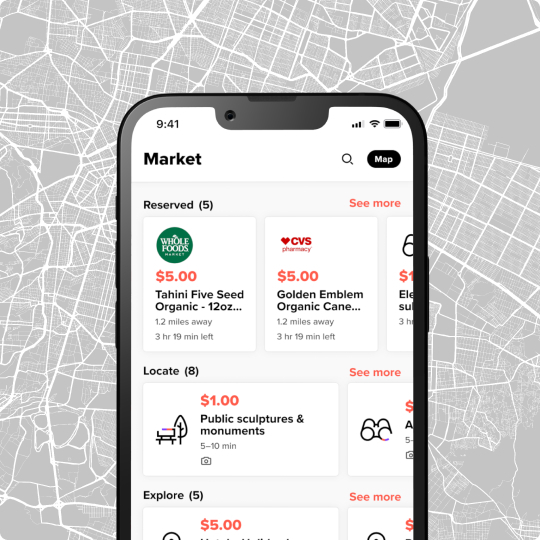
A customer configures a campaign around a place, population, and question. Contributors select tasks in the app. Submissions pass through automated and manual review before reaching dashboards or exports. The app supports offline collection, useful when the interesting place has an uninteresting mobile signal.
- 01 Configure
- 02 Collect
- 03 Check
- 04 Visualize
That third step deserves the attention. In May 2023, Premise described problems with bots, rushed surveys, and people repeatedly choosing answers in the same position. Its response included a bot-detection model retrained weekly. Paying for responses creates an incentive to respond; getting thoughtful responses requires additional engineering. The company’s technical writing makes that distinction unusually concrete.
The corner shop gets an address
The commercial application becomes especially interesting in traditional trade: the small, independent outlets that are awkward to measure through centralized retail systems. Premise’s proposition is to connect broad market questions to individual places where a sales team can act.
The products follow that logic. Availability Tracker and Price Tracker examine stock and prices. Rolling Retail Census builds recurring observations about stores. The Market Performance System, introduced in 2023, connects that census with modeled sales and market-share analysis. A modeled result remains an estimate; the underlying store visit gives it a physical reference point.

Customers named in company announcements include Coca-Cola, Mondelez, and Heineken. A multi-year relationship with Coca-Cola FEMSA in Mexico accompanied the Market Performance System announcement. These are buyers with an immediate reason to care whether a particular outlet carries a particular drink.
Premise also bought depth. It acquired Native in November 2021 and Grupo Meiko in August 2022. Meiko brought retail-measurement expertise and subscriptions covering more than 200,000 Latin American stores at the time. An acquisition could supply customers, recurring assignments, and local knowledge together.
Prime, announced in December 2024 as live across Mexico, adds standardized collection and computer vision for identifying products and brands. Its announced international expansion was a plan. The useful distinction from a conventional report is the attempt to connect an observation, a location, and a next action. Whether it beats another provider depends on the market and the question.
A network still needs a business
This infrastructure costs money. Premise announced an $85 million Series E in January 2021, led by WestCap. The business sells research and analytics to organizations while paying contributors for accepted work. Recurring measurement creates recurring demand for visits.
In a CEO interview following that financing, then-chief executive Maury Blackman described proofs of concept costing customers roughly $10,000 to $20,000. Treat those as historical examples, not today’s menu. The operational point is still useful: a buyer can test whether an observation changes a decision before expanding the assignment.
“the human logistics problem”
Matt McNabb’s description of fieldwork, February 2024
Matt McNabb, Native’s founder, became Premise CEO in February 2024. Explaining why he had sold Native, he described an opportunity to take a shared approach to research marketplaces global. Recruitment, training, management, and payment had made traditional fieldwork cumbersome. His reference points included rideshare and delivery platforms. The same logistical insight could move an observation instead of a passenger.
There is a lesson here for organizations buying research, too. A question such as whether customers like a brand is different from asking whether a store stocks it. One needs a carefully selected set of people; the other needs carefully selected places and a repeatable inspection. Premise can support both kinds of work, but choosing between them is the buyer’s first responsibility. A polished map cannot make that choice afterward.
Someone still has to check
The network extends beyond shopping. A partnership with Planet Federal pairs satellite imagery with local observations. In a published Addis Ababa construction example, the companies combined views from above with information gathered nearby. Different distances reveal different things.
In February 2025, Premise introduced AEGIS, a development-stage humanitarian monitoring system combining local collection, open sources, and generative AI. Its first DRC report used a week’s assessment of 400 respondents in North and South Kivu. Researchers checked the AI’s work. Premise offered the developing product free to humanitarian users.
North and South Kivu, DRC. The February 2025 AEGIS pilot paired a local needs assessment with open-source research and human review.
The workflow matters because automated writing can make a result look finished before its evidence has been examined. Here, the company described researchers checking the output and improving visualizations. For a humanitarian team weighing scarce resources, that review is part of the product’s usefulness, alongside the speed of collection.
The practical lesson is to specify the observation before commissioning the dashboard. Choose the locations, repeat the measurement, and decide what evidence would change your next move. More submissions alone cannot fix a biased sample. Thin local coverage, inaccessible sites, or badly rewarded tasks can weaken the answer. Premise’s business depends on making those ordinary details work. For the customer, the payoff begins with something modest: knowing what is actually on the shelf.