Praveen Shanbhag’s sister had reached the part of college that was supposed to be straightforward: walking across a stage while someone read her name. Her family had come to celebrate. Relatives had travelled for the occasion. Their parents, who had immigrated to the United States, had long hoped to see their children earn college degrees there. The announcer got her name wrong.
The error did not cancel the achievement. It did, however, intrude on the moment set aside to recognise it. Shanbhag remembered the reader trying, and remembered the embarrassment. That detail matters to his story. A person doing their best had still left a graduate and her family feeling poorly recognised. Better intentions alone would have produced much the same ceremony.
Shanbhag was then working towards a philosophy doctorate at Stanford. He began learning to program between stretches of dissertation writing, with friends available to help. His first idea was pleasantly literal: collect students’ recordings of their names and give them to the people who would announce those names. A graduation reader could prepare by listening to the graduate.
There is a modest comedy in the arrangement. A university can certify years of advanced study, yet require a little additional instruction before it can congratulate the student. Shanbhag gave that instruction somewhere useful to live. In September 2014, he founded Namecoach. The ceremony that had bothered him supplied a starting point, rather than the limits of the business.
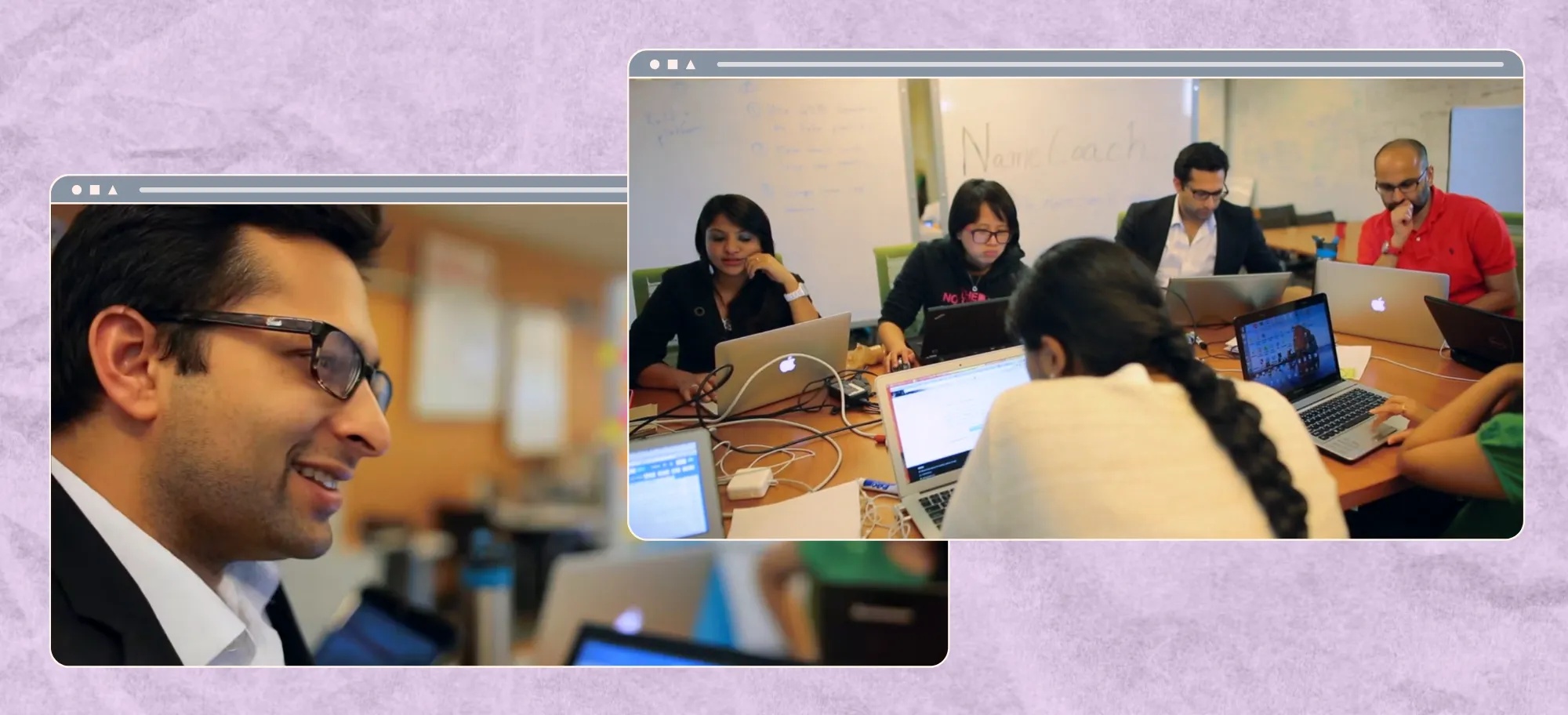
Before the play button: space, time and public policy
His route to software ran through several kinds of inquiry. At Harvard, he earned a joint bachelor’s degree in history of science and philosophy. His undergraduate research considered whether biology could be reduced to physics, alongside arguments about funding the Superconducting Supercollider. These were large questions about what science explains and what societies choose to support.
A National Academies biography from his 2006 fellowship describes him completing an interdisciplinary master’s at Columbia, concentrating on the philosophy of space and time. It also records a White House Office of Science and Technology Policy internship researching energy-efficient technologies. He was already interested in how knowledge could be put to public use, well before names became his business.
Cambridge followed. Its dissertation catalogue lists his 2006-07 MPhil work on the relationship between knowledge, governance and science policy. Stanford’s philosophy department records the completion of his doctorate in 2014, with Michael Friedman, and a dissertation titled Space, Mind, and Discursive Knowledge. He also taught at Stanford and held a Patrick Suppes fellowship in philosophy of science.
That is a considerable amount of formal education to bring to an introduction. Yet the contrast can be overstated. A name is familiar knowledge to its owner and uncertain knowledge to a stranger. Namecoach offers one practical way of moving that knowledge between them. The software makes a small exchange easier; the social question surrounding it remains recognisably philosophical.
The teacher who hesitated
Shanbhag has also described being on the other side of the difficulty. While teaching at Stanford, he sometimes hesitated to call on students whose names he was unsure how to pronounce. Concern about making a mistake could result in avoiding a name altogether. The person who knew how mispronunciation felt could still struggle when it was his turn to speak.
This admission gives his work a useful lack of sanctimony. It allows for a classroom where the teacher cares, the student belongs, and the interaction still goes awry. Preparation needs a place in the routine. If the right pronunciation is available before the class begins, neither person has to make the entire room an audience for the correction.
By 2016, Stanford was preparing to put recordings into class rosters and student services systems. More than 2,000 students had used the service over two commencement cycles. Registrar Tom Black wanted a speaker button wherever a name appeared in campus software. The ambition was to make hearing a name part of the ordinary work of looking someone up.
A ceremony offers a single conspicuous test. A roster offers many quieter ones. That distinction helped make the product useful beyond graduation. In a college, the same student meets instructors, advisers, administrators and classmates. Each introduction is an opportunity to learn the name, and each system can either carry that knowledge forward or leave everyone to begin again.
For every name, there is someone somewhere who doesn’t know how to pronounce it.Praveen Shanbhag
A little rehearsal, without an audience
Namecoach’s approach puts audio beside the written name. Its tools include personal recordings, pronunciation recommendations, integrations and a personal Namebadge. In business settings, the company offers pronunciation assistance within tools such as Salesforce and Microsoft Outlook. The point of the placement is practical: make the information available while someone is preparing to use it.
An employee opening a contact record is already doing the work of getting ready for a conversation. A pronunciation button can fit into that preparation. A separate directory asks the employee to remember another errand. Shanbhag’s business depends partly on that unglamorous distinction between an available answer and an answer encountered at the right time.
His own Namebadge provides a more personal demonstration. It identifies the origin of his name as India and includes a recording. It also explains the meaning of Praveen, followed by a joke about his qualifications for it. The founder of a pronunciation company has left room for uncertainty about being an expert. It is a welcome use of a profile field.
“'Praveen' means 'Expert.' In what, I'm not sure yet...”
The badge allows someone to introduce their name before a meeting, while keeping their own voice in the exchange. Meaning and personal stories can sit beside pronunciation. That gives a recipient something more interesting than an instruction to avoid error: a small opening into another person’s history. The technology works best when the introduction still feels like an introduction.
When avoiding the name becomes the problem
In a 2021 Namecoach study, 22 percent of respondents said they had avoided introducing someone because they did not know how to pronounce the name. Sixteen percent reported avoiding conversation with a coworker for that reason, and 13 percent reported not calling on someone in a meeting. These are company survey findings, rather than a census of working life.
Uncertainty can turn into avoidance.
They nevertheless describe a mechanism that is easy to understand. The feared mistake is audible; the avoided interaction may leave no obvious trace. Nobody hears the introduction that never happens. Shanbhag’s account of his own teaching makes that possibility concrete without requiring a villain. Courtesy can become an awkward form of distance when people have no reliable way to prepare.
He has warned against assigning an unwanted nickname or asking to substitute an easier name. The underlying preference is straightforward: give people help learning the name a person uses. The burden of making a conversation convenient need not fall entirely on the person being addressed. Rehearsal is a fairly inexpensive contribution for everyone else to make.
The company gets a larger microphone
The work carried him into conversations beyond university administration. In 2017, he presented with Stanford registrar Thomas C. Black at the AACRAO annual meeting on bringing pronunciation and identity information into campus systems. In 2018, he appeared in the Can•Innovate programme with a session on Namecoach for equitable classrooms, including its use at Foothill College.
By 2020, he was participating in the University of Colorado’s COLTT discussion of inclusion in education. The sequence shows a founder explaining his product alongside people responsible for the environments in which it would be used. There is a useful discipline in that audience: a teacher or registrar eventually needs to know how the thing fits into the working day.
In November 2022, Namecoach announced an $8 million Series A led by Impact America Fund. Shanbhag also appeared on Cheddar News that month to discuss funding and integrations. The larger company still had to answer the early product question: how do you get a usable pronunciation to someone before they need to say the name?
His public conversations have ranged from workplace software to the sound of speech itself. In 2023, he joined Bill Banham on HRchat and dialect specialist Paul Meier on In a Manner of Speaking. Names belong in both discussions. A pronunciation is a sequence of sounds, but the reason anyone bothers learning it usually involves a relationship.
- 2014A company beginsNames recorded for people to hear.
- 2016Into the rosterStanford expands campus use.
- 2025Voice AI ambitionsShanbhag outlines a new direction.
Now the machine needs practice
In April 2025, Shanbhag described a business reporting more than $4 million in annual recurring revenue and looking towards voice AI. He discussed combining human recordings, user verification and generated pronunciations. He also described partnerships and distribution goals still being pursued. Those ambitions were plans at the time, rather than completed results.
The current Namecoach site advertises early access to Euphonia, its speech synthesis API. A public filing signed on April 29, 2026, still lists Shanbhag as founder and CEO. The vocabulary of the business has expanded from graduation lists to software interfaces for generated speech. The moment of recognition at the centre of it remains much the same.
For a talking machine, a personal name is an exacting piece of dialogue. Fluency in the rest of a sentence does little to rescue an incorrect introduction. The challenge gives Shanbhag a new version of the question that started his company: how should the speaker learn what the person being addressed already knows?
There is a pleasing continuity here. The early product asked the graduate to speak first, so the announcer could listen. Years later, voice AI adds another speaker in need of instruction. Shanbhag has followed a family disappointment into classrooms, business software and synthetic speech, carrying a surprisingly durable assignment: practise the name before taking the microphone.
Hear the name. Meet the thinker.
Start with his voice, then follow the conversations.
- Praveen’s personal Namebadge - hear him say his name
- Praveen Shanbhag on LinkedIn
- Namecoach - company and mission
- Watch: Feel Like You Belong with Alan Headbloom (YouTube)
- Listen: In a Manner of Speaking, episode 65
- Listen: HRchat with Bill Banham
- Watch: Cheddar News interview
- Read: Shanbhag’s account of the Namecoach origin
- Read: the April 2025 founder interview
- Read: Stanford’s campus rollout
- Explore: Euphonia early access