The person at the microphone has a list of names. The graduates have spent years earning the right to hear theirs. Somewhere between those two facts sits a tiny administrative disaster: a name written down, a reader guessing at it, a correction arriving after the applause. Praveen Shanbhag saw such a mistake at his sister's college graduation and built his first tool for the seconds before the name is spoken. Students could record themselves; readers could listen. A social problem had acquired a play button.
- Namecoach began as a way for graduation readers to hear students say their own names.
- Its audio, phonetic guides, and verification now appear in ceremonies, learning systems, email, CRM tools, and a developing voice AI product.
- The company says it serves more than 300 education and business partners worldwide.
- A public order form prices one Outlook integration at $3,000 per college for 12 months; a university has also ended its contract over cost.
The insight sounds small until you try to scale it. A roster can contain thousands of names, and spelling is a poor instruction manual for a voice. A helpful colleague may know how to say one name but be absent when it matters. Namecoach's pitch is to put a recording, a suggested pronunciation, or a phonetic guide where the reader is already working. Its original theater was commencement. The stage has since expanded to course rosters, contact records, Outlook inboxes, and voice agents.
The graduate gets the last word
For an event organizer, Namecoach Events begins with an attendee list. The software generates pronunciation audio and phonetic name cards. Attendees receive a link to hear the suggestion and correct it. Administrators can see who has verified a name, send reminders, and prepare readers. At the ceremony, a scan-and-play setup can pair a name card with its audio. It is a surprisingly elaborate system for a syllable, and that is precisely the point: the elegant moment on stage depends on rather unromantic work beforehand.
Generate name audio and printable phonetic cards.
Let the name's owner verify the suggestion.
Preview names before the podium, or scan at the event.
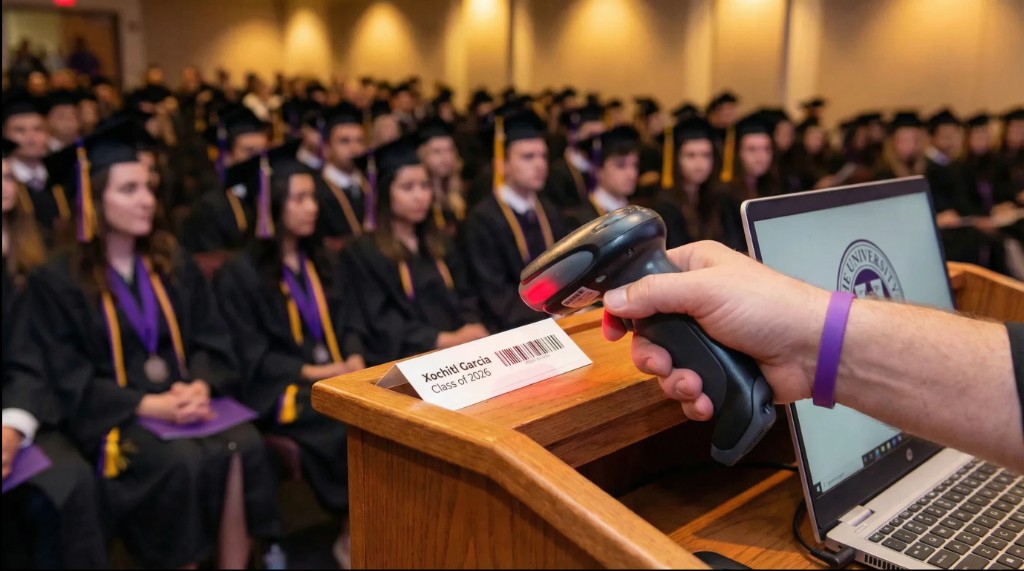
An event manager at Hamline University put the change plainly: “While I once thought name mispronunciation was inevitable, with Namecoach I have changed my mind.” It is a modest claim about a stubborn ritual: the mistake stopped looking like fate once the institution gave the reader a usable recording.
This is also what makes the product more than a pronunciation dictionary. A dictionary can offer a likely answer; a person can supply the preferred one. The company combines professional recordings, user submissions, and algorithmic suggestions. When a suggestion is wrong, the attendee can fix it. The crucial design decision is who gets to approve the sound. It is easy to imagine a machine confidently pronouncing a name incorrectly. Namecoach's ceremony workflow at least gives the human with that name a vote.
The play button leaves the stage
Shanbhag founded Namecoach in 2014. By 2016, he said hundreds of schools used its software and services. The next question was obvious: if a commencement reader benefits from hearing a name, why should a teacher looking at a class roster have to guess? Namecoach built integrations for learning systems including Canvas, Blackboard, Sakai, and D2L. At the University of Washington School of Medicine, a student can record or upload audio, add a phonetic spelling, and have that information appear in Canvas and an education profile. Case Western Reserve University connected student recordings in its information system to access for faculty and staff in Canvas.
The same principle travels into business software. In Salesforce, a salesperson can hear a lead's name on the contact record. In Outlook or Teams, a colleague can listen before a meeting. The company offers an API and recording widget for teams that need the sound embedded elsewhere. This is Namecoach's distinction from a standalone name lookup and from the casual social-profile recording: it tries to meet the speaker inside the workflow, at the moment the speaker needs help. The alternative, of course, is still available and often wise: ask the person directly and accept a correction gracefully.
The company has named Salesforce, NetJets, and PwC among customers, while public campus guides show deployments at Brown, Western University, and other institutions. The mix is telling. A university buys for a ritual, then for the daily classroom. A business buys for the first contact. The word “inclusion” appears in the company's mission, but the software earns its place by solving a specific piece of preparation that staff would otherwise do manually.
What the courtesy costs
Namecoach sells cloud software to organizations, with fees set by contract. A rare public number appears in a California community college ordering page: NameCoach Outlook is listed at $3,000 for a 12-month period per college. That is one product and one procurement channel, not a universal price list. The personal Namebadge, a shareable recording of one's own name, is complimentary. The economic question for institutions is whether a central subscription makes enough introductions better to justify a line in the budget.
The University of Minnesota supplied an unusually clear answer for its circumstances. In March 2026, it said the Namecoach contract would not be renewed and its Canvas and APLUS integrations would be removed in May. Its academic support office called the tool valuable and said the decision was solely about an expense its budget could no longer sustain. That is a more useful criticism than an abstract argument about the value of names. The problem is real; the buyer still has a ceiling. A school considering the product should count how many classes and ceremonies will use it, who will maintain recordings, and whether existing systems already support a workable version.
Now the machine has to learn the name
In 2022, Namecoach raised an $8 million Series A led by Impact America Fund, with Authentic Ventures, Metaplanet, Engage.VC, Founders Fund, and Bisk Ventures among participants. It planned more integrations and sales capacity. It also invested in the harder part of the product: a database of pronunciations and models that recommend among possible versions of a name. The company has described research into how sounds convert across languages. Even an apparently simple written guide can mislead if two readers interpret its letters differently.

The newest extension is Euphonia, an early-access pronunciation layer for voice AI. Rather than replacing a voice provider, it sits between an agent's text and the text-to-speech service. It can send provider-specific guidance using the International Phonetic Alphabet, Arpabet, or a respelling. Its public demo plays the same words through several providers and shows how the guidance changes the output. The scope now includes drug names, acronyms, brands, and places as well as people's names. It is a plausible next market for a company whose first insight was that a speaker needs the right sound before speaking.
A ceremony team can copy the method without copying the software: collect each attendee’s preferred pronunciation in advance, let them hear what the reader will hear, mark corrections, and give readers time to practice. A sales team can put the same habit beside its call list. The useful unit is not a giant database; it is the verified pronunciation at the point of use.
There is a practical lesson in the path from graduation to voice AI. Namecoach did not start by asking everyone to visit a new pronunciation destination. It put the answer in the reader's existing path, then repeated that move in the classroom and the contact list. The approach works best where many names pass through a predictable system and where the person named can verify the answer. It has less to offer when a recording is never supplied, a budget cannot support the subscription, or a one-off conversation is easier than installing software.
A name is a compact piece of biography, and an introduction is a compact public test of attention. The reader at graduation still has to care enough to press play. Namecoach's business is built on making that small act possible before the room goes quiet.