In Poland, a foreign film can arrive with a peculiar extra character: a single voice, reading every part over the original soundtrack. The hero gets it. So does the villain. So, inconveniently, does everyone else. Mati Staniszewski grew up with that sound. Years later, he and his friend Piotr Dąbkowski decided that a movie ought to travel across a language border with more of its people intact.
The complaint has the scale of a living room, not a business plan. That is what makes it useful. A spoken line carries its own private weather: urgency, irony, a pause that changes the meaning of the next word. Flatten those details and translation gives you the plot while quietly misplacing the performance. Staniszewski and Dąbkowski began to ask whether software could keep both.
By 2022, the question had a company name: ElevenLabs. Four years on, Staniszewski is its cofounder and CEO, and the company does much more than dub films. It makes speech for creators and publishers, supplies voices for games, and builds agents that can conduct live conversations. The distance from a flat voiceover to a responsive machine is large. His story explains why the distance seemed worth crossing.
Two boys, one difficult friendship to outgrow
Staniszewski was born in a town outside Warsaw and moved into the city for high school. At Kopernik 33rd, he met Dąbkowski when they were 15. They took to each other quickly, in part through a shared interest in mathematics. The friendship survived the usual tests of adult life: different work, new places, and the tempting idea that a good school friend should remain only a school friend.
They studied, travelled and kept making things together. Staniszewski later described years of weekend projects, including an optimizer, a recommendation algorithm and a speech product. The first voice software they built detected accents. It is easy to see the thread after the fact. At the time, it was one experiment among several. The company did not begin with a polished story about destiny. It began with two friends repeatedly choosing to spend their free time on another problem.
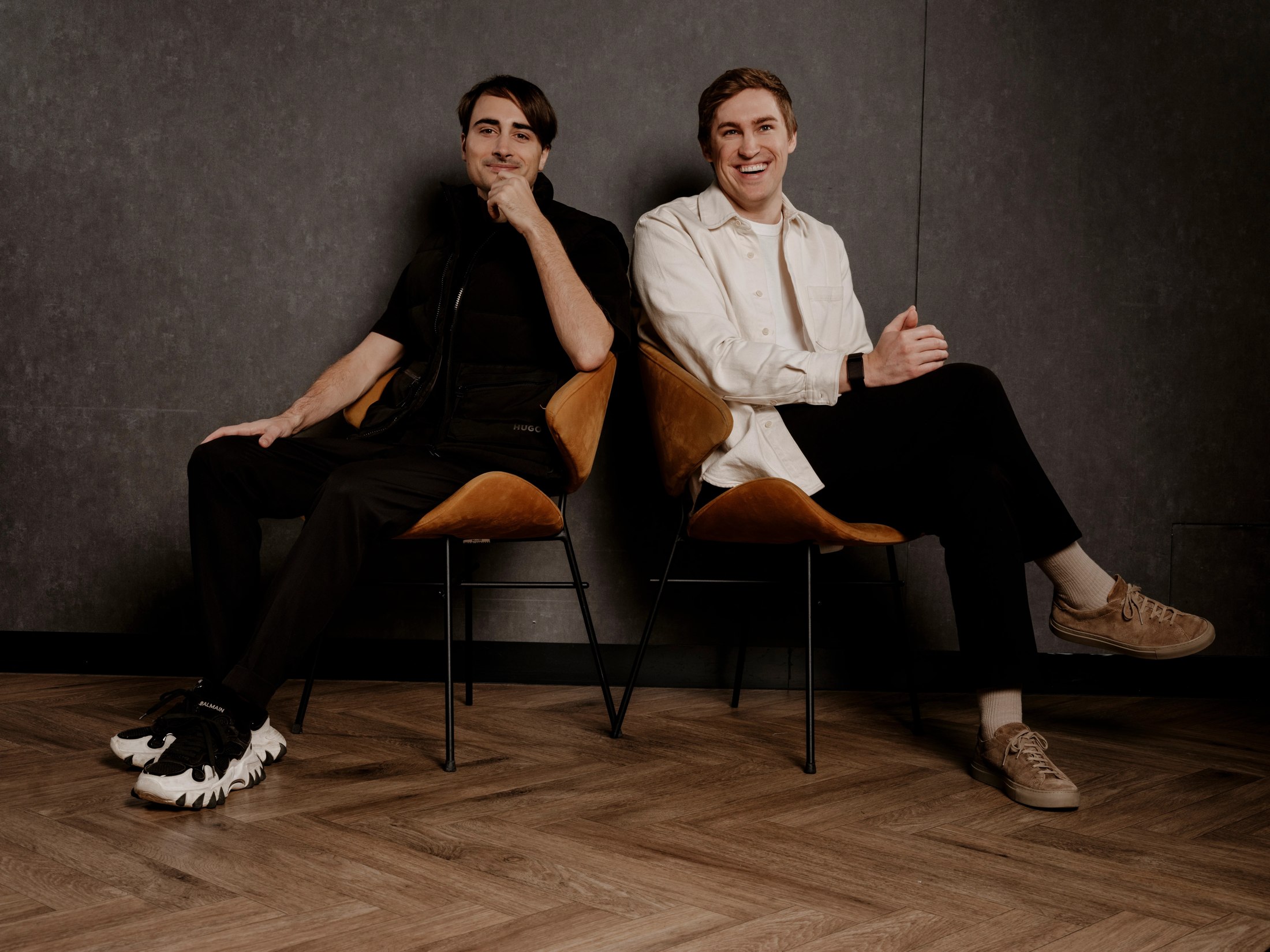
There is a useful distinction between friendship and ease. Building a research company means spending a lot of time near questions nobody can answer on schedule. In Staniszewski’s account, having someone he enjoyed working with mattered as much as the technical idea. Dąbkowski brought deep machine learning experience; Staniszewski brought a taste for turning an idea into an organization. The project eventually consumed the weekends and then the working week.
A mathematician in the room
At Imperial College London, Staniszewski studied mathematics and helped create Mathscon, a student-led conference about the playful side of the subject. He recalled coordinating a team of 20 and an event for roughly 300 people, as well as learning poker maths with Liv Boeree and talking about everyday geometry with Conrad Wolfram. It was a modest rehearsal for a founder’s life: find people, persuade them that an idea is worth their time, and make sure the room is ready when they arrive.
After university came product work at Opera Software, BlackRock and Palantir. The jobs put him close to the practical work of getting technology into use. At Palantir, he helped enterprises and governments deploy new tools. That experience appears in the company’s later movement toward large customers: a good model still has to function when someone on the other end has a real task and little patience.
Don’t follow the trends and keep focused on what you believe in.Mati Staniszewski, 2023
In 2023, with ElevenLabs still small, he offered that advice in an interview. He also described the danger of interesting detours. Customers were asking for adjacent tools; the research that might make dubbing genuinely good demanded sustained attention. The tension was familiar to any young company: do the immediately useful thing, or continue toward the harder thing that might justify the company’s existence?
The first voice was built at home
The founding idea sharpened around 2021. In one account, Dąbkowski and his girlfriend were watching a film in Poland and encountered the same monotone voiceover the founders had known growing up. Staniszewski and Dąbkowski had already been experimenting with speech analysis. Now the engineering and the irritation met. They wanted dubbing that could retain an original speaker’s distinctive qualities while changing the language.
They founded ElevenLabs in 2022, and later said they built their first voice model in Warsaw. Early work concentrated on research, then on getting that research into a product. Publishers and independent authors became a practical starting point. A book, unlike a short demo, makes demands on the consistency of a synthetic voice. A listener may forgive a strange syllable in ten seconds. Over ten hours, the same mistake becomes a companion.
A broader market found the work. The platform came to serve people making narration and translated material, then developers and companies that needed speech to happen in real time. In a 2025 interview, Staniszewski said the customer mix had changed sharply: enterprise use, once a small share, was approaching parity with the individual side. By May 2026, ElevenLabs reported that it had crossed $500 million in annual recurring revenue. The figure describes a company, not a voice. It also shows how far a question about a movie had traveled.
When the voice answers back
A dubbed film is finished before its audience hears it. A conversation is less cooperative. The speaker changes course. A question has two meanings. A person pauses because they are thinking, or because they expect an answer. To build a useful voice agent, realistic sound alone cannot carry the whole exchange. The system must respond at the right moment and in the right manner.
Staniszewski has made that challenge a public ambition. He speaks about combining intelligence with emotional awareness: an agent that can slow down, speak up and register the mood of the person across the line. In September 2026, he and Dąbkowski announced Eleven v4 and a faster Turbo variant. The company says the models support more than 90 languages and are designed to better handle pacing, tone and dialogue. Those are product claims, but the direction is clear. The work has moved from making text audible to making an exchange feel coherent.
A Fortnite project made the change vivid. ElevenLabs helped create an interactive Darth Vader, in partnership with the estate of James Earl Jones, so players could speak to the character and receive responses. Staniszewski pointed to the difference between stored lines and a character who can react. A game is a forgiving place to try the idea; the audience knows the figure is fictional. The same naturalness in a customer call raises a question about candour.
Asked in September 2026 whether businesses should tell customers when they are talking to an AI agent, Staniszewski said they should. His reasoning was plain: people do not want to feel tricked. He suggested giving callers a choice when a human queue is long. That answer has an awkward honesty for a company whose engineers work to make the artificial voice harder to distinguish. It acknowledges that better performance can make disclosure more necessary, not less.
He has also discussed traceability, moderation and tools for detecting generated audio. None of these measures makes a realistic voice simple to govern. They do show that the original dubbing problem has acquired a second half. If a machine can carry human expression, someone has to decide who may use that expression, and under what terms.
Back to Warsaw, with an audience
In June 2026, the company held a summit at Warsaw’s Teatr Wielki, Poland’s National Opera theatre. Staniszewski called it a homecoming. He and Dąbkowski had grown up near the venue, met nearby at school, and built their first model in the city. The event brought together around 2,500 people. A 2011 school class photograph appeared in the company’s account of the day, an unusually effective reminder that founders are, before anything else, former children in old pictures.
The opera house was a fitting setting without needing to serve as a metaphor for everything. Opera depends on words, yes, but it also depends on what a singer can do between them. ElevenLabs’ researchers work on a different kind of performance. Their tools now travel much farther than the Warsaw rooms in which the partnership began, while the city remains a place to which Staniszewski and Dąbkowski can bring the work back.
Staniszewski’s ambitions have widened with the company. In 2023 he imagined spoken content available in any language and people able to communicate across a language divide while still sounding like themselves. More recently, he has talked about voice becoming a natural interface for technology. The idea is grand; its daily tests are small. Does the line sound right? Does the agent wait its turn? Does the person listening know who, or what, is speaking?
Those questions leave the story open, which is probably appropriate for a founder who began with one voice saying too much. The school friends wanted a film to keep its cast when it crossed a border. They now work on machines that may join the conversation themselves. The task has become larger, but the ear behind it is recognizably the same: attentive to the little things a flat voice leaves behind.
Hear him in his own words
Writing at ElevenLabs · LinkedIn · X · The ElevenLabs story, a16z video · Conversation at AI Ascent 2026 · Early founder interview · Warsaw homecoming · TIME interview · TechCrunch interview