The actor was furious. Or tender. Or trying to be funny. The Polish voiceover was having none of it. When Piotr Dabkowski and his friend Mati Staniszewski watched foreign films as children, a single narrator would speak over the original soundtrack. Somewhere underneath, the actor's performance still flickered through. On top sat a voice that could make a quarrel, a joke and a confession sound as though they belonged to the same sentence.
Years later, the two friends described that childhood irritation as the beginning of ElevenLabs. They had imagined the actors speaking Polish while keeping their own voices. In 2022, Dabkowski left Google and Staniszewski left Palantir to build the tools that might make such a thing possible. It is a charmingly specific way to begin a technology company: first, be annoyed by television; then spend a decade becoming qualified to fix it.
The question was more difficult than translation. Words carry plot. A voice carries age, pace, hesitancy, warmth, impatience, comic timing. Change the language without those things and a performance can arrive with its luggage missing. Dabkowski's work at ElevenLabs sits at that crossing. As cofounder and chief technology officer, he leads the research and engineering teams that build its audio models. The company has spread beyond dubbing into speech generation, transcription, music and conversational systems. The first question, however, still gives the enterprise its human scale: how much of a person can a voice take across a border?
The friend from the classroom
Dabkowski was born in Gdańsk, then moved with his family to Warsaw. He wanted to study abroad and enrolled in the Copernicus International Baccalaureate programme. There he met Staniszewski. Their friendship outlasted the school years, the move abroad and several ideas that did not become companies. Later, the pair recalled an app that could detect an accent from a speech sample. They also explored a recommendation system built on people one trusts, a preference based optimizer and a tool for suggestions about speech. Some ideas are useful because they work. Others teach two friends that they still like building things together.
Their roles eventually separated without pulling them apart. Staniszewski studied mathematics in London and worked at Palantir, with an eye on deploying products. Dabkowski studied engineering at Oxford and advanced computer science at Cambridge, where research and coding, he said, became increasingly absorbing. One would become the chief executive, the other the technical lead. That division sounds tidy in a company biography. The longer history sounds more like a partnership that kept its schoolroom habit of testing possibilities aloud.
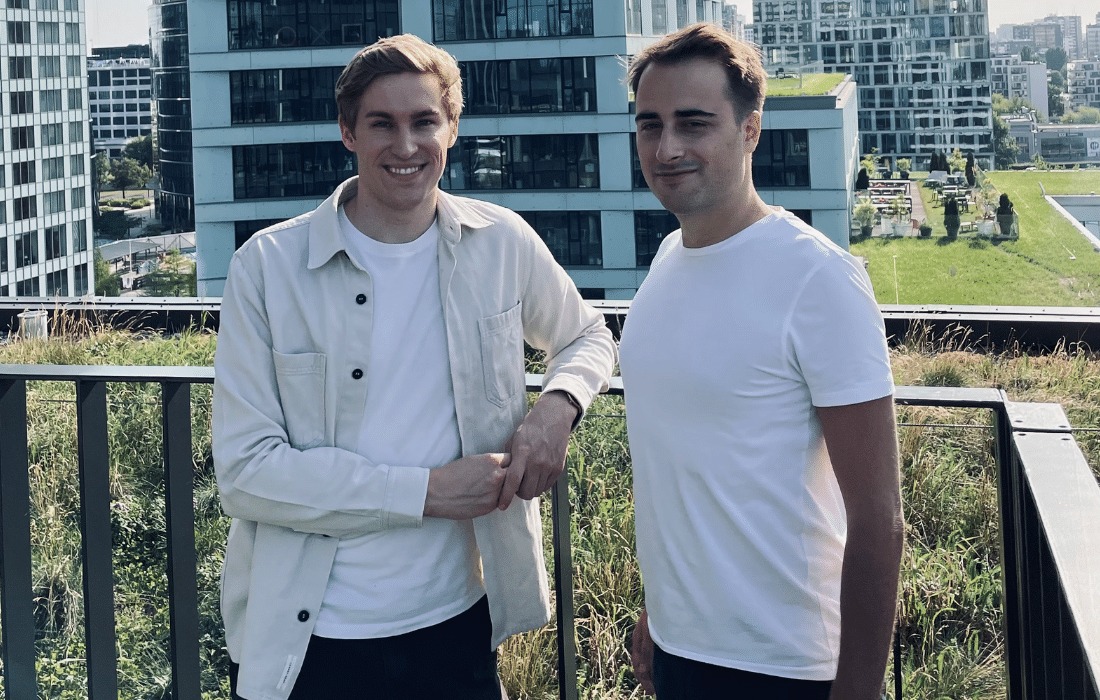
The company they founded was their first full business together. That matters to the origin story. ElevenLabs was not a shortcut from a childhood memory to a polished product. It followed years of education, jobs and experiments, along with the unusual advantage of a shared reference point. They could both remember the same kind of soundtrack: a lively voice buried beneath a level, serviceable Polish narration.
First, teach a machine to explain a picture
Before he worked on synthetic voices, Dabkowski worked on what an image classifier notices. At Cambridge, he and researcher Yarin Gal wrote a paper on real time image saliency, published at NeurIPS in 2017. The aim was to identify the parts of an image that mattered to a classifier's decision. Their proposed model produced a mask that could show those important regions in a single forward pass. The subject was visual, but the deeper preoccupation was familiar: what, exactly, is a model paying attention to?
His public GitHub work gives the technical years another texture. Js2Py, a JavaScript interpreter written in Python, sits among his repositories. It is a different kind of project from an audio model or a research paper, and a reminder that a technical founder often has a trail of practical curiosities long before a company turns any one interest into a job description.
Dabkowski went on to work on machine learning at Google. By 2022, he and Staniszewski had identified a problem they knew from experience and thought the technology was ready to tackle. They resigned from their jobs and began ElevenLabs. Their early description was exacting. Automatic dubbing should preserve a speaker's distinctive features and tone across languages. Imagine a video creator recording in English and reaching Spanish speakers without exchanging their voice, personality or emotional register for somebody else's. The phrase “native-grade Spanish” appeared in the founders' example, but the interesting part was the possessive: your voice.
Cambridge research with Yarin Gal is published at NeurIPS.
Dabkowski and Staniszewski found ElevenLabs.
Dabkowski appears on the TIME100 AI list.
ElevenLabs announces a $500 million Series D and a new Polish initiative.
This was a research problem with a deadline imposed by ordinary ears. A sentence could be grammatically perfect and still sound wrong. Timing, breath, stress and emotion had to survive. It also made the work unusually easy to demonstrate: a listener does not need to read a benchmark table to hear a flat voice where a living performance ought to be. The technical paper and the old voiceover complaint are years apart, but both reveal Dabkowski's preference for outputs that can be examined rather than merely announced.
A bigger stage for a small complaint
ElevenLabs' first public chapter attracted users quickly. By September 2024, when TIME included Dabkowski in its annual AI list, the company offered voice generation and dubbing across 29 languages and had worked with publishers and media groups. The valuation at that point was $1.1 billion. Those numbers charted a fast ascent, but they did not settle the technical question. A fluent sounding voice is one thing; a voice that preserves the intent of a particular person through a particular sentence is a more slippery target.
The founders were thinking beyond films from the start. They pictured podcasts, audiobooks, games, advertising and live conversation moving between languages. The applications differ, but the loss they wanted to avoid is consistent. A documentary narrator depends on trust. A game character needs timing. A creator's audience may recognize them in pauses as much as in words. If software can carry those cues across languages, more people can encounter the work as its maker intended.
“Our vision is to help make content universally accessible across languages.”Piotr Dabkowski and Mati Staniszewski
As the uses multiplied, so did the responsibility attached to a convincing synthetic voice. Dabkowski said in 2024 that ElevenLabs monitored generations and could trace them back; the company also built a classifier intended to identify audio made by its models. The ability to preserve somebody's vocal character raises an obvious question about who has permission to use it. A system good enough to translate a performance deserves the same precision about consent and provenance as it does about pronunciation. Dabkowski's public comments acknowledged that the safeguards would have to keep evolving with the technology.
The company also changed shape. A service associated with text to speech grew into an audio stack: speech to text, dubbing, sound effects, music and conversational models. In February 2026, ElevenLabs announced a $500 million Series D at an $11 billion valuation and said it had ended 2025 with more than $330 million in annual recurring revenue. These are company figures, not a measure of one engineer's personal wealth. They do show how far the original experiment had traveled from the television memory that set it in motion.
Dabkowski's own account of that expansion focused on the relation between research and use. In February 2026, he described building foundational models across the full audio stack and then tuning them for the products people actually encounter. It is a practical distinction. A laboratory can make speech impressive in isolation. A creator, publisher or customer service team needs it to work in a messy production setting, at the right speed and with a voice that sounds right for the moment.
Back where the conversation started
For a founder whose company operates across many countries, Dabkowski has been unusually plain about home. He has said he had returned to Warsaw after time in Britain and Switzerland. He liked its combination of traditional and modern life. That sentence does little work in a funding announcement; it does a great deal in a life story. The city was where he met his cofounder, and where the sound of Polish cinema gave them a problem neither quite forgot.
In June 2026, ElevenLabs announced that the Polish state had taken a stake in the company through Vinci, part of the BGK Group. It also announced AI Lab Poland, an effort intended to bring capital, technology, science and talent together. The company described the Warsaw connection as a homecoming. Corporate language can make a return sound inevitable; Dabkowski's route was anything but straight. Gdańsk, Warsaw, Oxford, Cambridge, Google, a stint in Switzerland and an audio startup all sit on the map.
The clearest detail remains the smallest one. Two teenagers heard a voice on a film that did not quite belong to the face on screen. They kept asking what it would take to make the voice fit. Dabkowski acquired the tools to answer with code, research and a team; Staniszewski helped turn the answer into a company. Now the question has grown to include creators, readers, businesses and conversations in many languages. The original test is still wonderfully unforgiving. Press play. Does the person on screen sound like themselves?