The first useful thing Mike Pappas did for his future co-founder was interrupt him. Carter Huffman was at a whiteboard at MIT, working through a physics problem. Pappas, then a freshman, hovered nearby long enough to notice a missing step. He pointed it out. It was an awkward hello, the sort of social opening available mainly to people for whom an unfinished equation is more alarming than a silence between strangers.
They became fast friends. Both studied the large and distant questions of physics, including dark matter and cosmic expansion, while spending their later college years testing much nearer business ideas. A social network came and went. So did a scheduling app and a robotic delivery system. None survived contact with their own enthusiasm. The partnership did.
Pappas had grown up in Winchester, Massachusetts, as what he now calls a “quintessential nerd.” He finished his math homework early, played video games and tried to keep the gaming portion of the evening discreetly beyond parental notice. At MIT, he expected physics to become his profession. Internships altered the equation. Research could produce enormous value, he concluded, but its effects might arrive on a long clock. He wanted to do useful work on a shorter one.
Learning to build on human time
After graduating from MIT in 2014 with a degree in physics and applied mathematics, Pappas joined Bridgewater Associates. As a cloud engineer, he worked on infrastructure, but the more durable lesson was cultural. Ray Dalio’s system of transparency and accountability showed him an organization treating the quality of thought as something people could examine and improve. Pappas liked the ambition while questioning an implementation he felt depended too heavily on selecting and removing people, rather than teaching them. The tension became part of his own interest in leadership.
Next came Lola, the travel startup founded by Kayak co-founder Paul English. Pappas worked in machine learning and software architecture, built recommendation and analytics tools, and spent unusual amounts of time with the customer-support team. The proximity mattered. Code stopped being an elegant object and became a thing used by a person with a queue, a deadline and a complaint. He could also watch a startup acquire customers, habits and a culture from the inside.
Huffman, meanwhile, had gone to NASA’s Jet Propulsion Laboratory and encountered research on highly efficient machine-learning models. An experiment in applying style transfer to audio drew Pappas back into their old habit of building together. By 2015 they had a neural network capable of changing a voice in real time. The term “deepfake” had not yet become dinner-table vocabulary. Their creation felt part magic trick, part new medium.
Gaming companies were the audience that leaned forward. They saw the entertainment in changing a voice, but they also saw protection: a player could conceal age or gender and avoid becoming an immediate target. As Pappas and Huffman spoke with studios and social platforms, the harder need emerged. Voice created camaraderie and conveyed emotion, yet safety teams had few practical ways to moderate it at scale. Text filters could scan words. Voice arrived with timing, overlap, irony, accent, background noise and the ancient human talent for making “fine” mean almost anything.
A transcript keeps the first band. Modulate’s premise is that the other five can change the meaning of the first.
The pivot hiding inside the demo
Modulate was founded in 2017 around a broad ambition: make online interaction feel more human, meaningful and less toxic. ToxMod became the concrete expression of it. Rather than treating speech as a bag of forbidden words, the system assesses risk and sends relevant moments to human moderators. Competitive game chat is a brutal test. Affection can sound hostile. Hostility can arrive wrapped in a joke. Context does not politely wait its turn.
The company’s technology eventually entered some of gaming’s largest rooms. Activision deployed ToxMod in Call of Duty. A published case study reported an 8 percent month-over-month reduction in repeat offenders and a 25 percent reduction in player exposure to toxic voice chat during the period examined. Rockstar Games later integrated ToxMod into GTA Online, tuning it to that game’s community guidelines. Pappas also helped launch the Gaming Safety Coalition with organizations spanning technology, moderation, research and advocacy.
There is a neat founder lesson in the route from voice changer to moderation platform. The original technology was not wasted; it was a lantern. It illuminated a problem with sharper consequences and more durable demand. Pappas and Huffman did not need to abandon the science. They needed to revise the sentence describing what it was for.
Capital followed the revision. After earlier seed rounds, Modulate announced a $30 million Series A led by Lakestar in August 2022. The company planned to expand its team, languages and moderation features. Pappas’s preferred fundraising story is less stately. Early on, he met a gaming executive at a venture-capital cocktail hour, which led to lunch with a possible angel investor. The investor opened by saying the founders were about to waste their lives and that he had come as a courtesy to talk them out of it. He left committed to writing their first check.
A company appears at the window
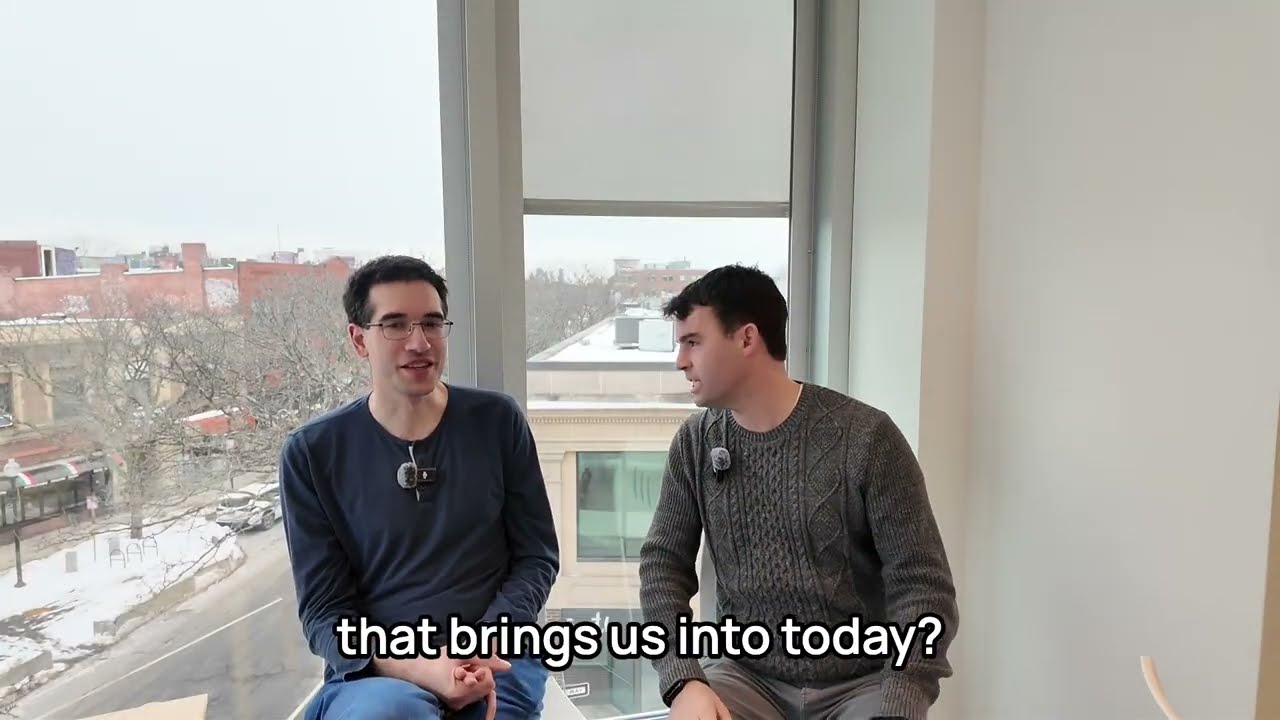
About a year into Modulate, when the team numbered roughly six, Pappas and Huffman booked an exquisitely bad business trip: Boston to San Francisco and back in a day, with a red-eye on each side. They returned to Boston exhausted but dutifully went to the office. Before opening the door, Huffman stopped. Through the window, colleagues were energetically working through an AI architecture problem at a whiteboard. Pappas has described it as the instant he understood that Modulate had become larger than Carter and Mike.
The image rhymes almost too perfectly with their first meeting. A whiteboard began the friendship. Another showed that the friendship had produced a team capable of arguing without them. For a founder thinking about culture, that is a fine test: what happens in the room before you enter it?
MIT degree completed; cloud engineering begins at Bridgewater.
Pappas joins Lola and works close to both machine learning and customer support.
The old MIT collaborators turn their audio experiments into a company.
A $30 million Series A backs broader deployment of ToxMod.
Velma and Ensemble Listening Models extend the work into enterprise voice intelligence.
Listen first, specialize second
By 2025, Modulate was applying lessons from gaming to voice fraud. The connection is less strange than it first sounds. Both problems require a system to notice behavior inside noisy, adversarial conversation. A scammer and an abusive player may have different goals, but neither kindly announces the relevant category for a classifier. Pappas described VoiceVault as a fraud-focused extension of the same attention to tone, intent and context.
In 2026, Modulate introduced Ensemble Listening Models, an architecture that coordinates many specialized audio models rather than asking one general model to do every job. Its product Velma was made available through an API in June. The pitch is architectural and philosophical: voice should be analyzed as voice, not flattened into text before the interesting work begins.
That view matches Pappas’s skepticism of companies declaring themselves “AI-first.” He prefers “right tool for the right job” and says Modulate strives to be mission-first. This is not modesty about machine learning. It is insistence that the tool answer to an outcome. He makes a similarly unfashionable point about AI business models: companies should understand their costs and build something capable of making money. Intelligence may be artificial. The invoice remains stubbornly real.
- Favorite game: Super Smash Bros. Melee
- Pikachu to win; Jigglypuff for mischief
- Favorite candy: Mounds
- Favorite local escape: the Middlesex Fells
- Prefers reading in print
- Makes themed cocktail lists
His public advice to parents of young gamers is equally grounded: play with your kid. Familiarity with the game and its social culture, he argues, is more useful than distant instruction, and playing together makes a child more likely to ask for help after an unsettling encounter. It is a small expression of the larger Modulate idea. Safety begins by staying close enough to understand context.
Pappas also runs long distances, builds themed cocktail menus and retains the loyalties of a Nintendo childhood. In Super Smash Bros. Melee, he chose Pikachu when he wanted to win and Jigglypuff when he wanted to annoy his friends. His favorite candy is Mounds, a choice that prompted affectionate concern from people in his life and a cheerful refusal to recant. The systems thinker, mercifully, contains some chaos.
The work remains an argument about what software should notice. For years, the industry treated transcription as the destination. Pappas treats it as one layer of evidence. The difference matters in a game lobby, on a call with a possible fraudster, or during the pause before a customer decides whether to leave. Human beings have always known that speech carries more than words. Mike Pappas built a company because computers had not yet caught up.