The Thesis
A company built around the cost of being wrong
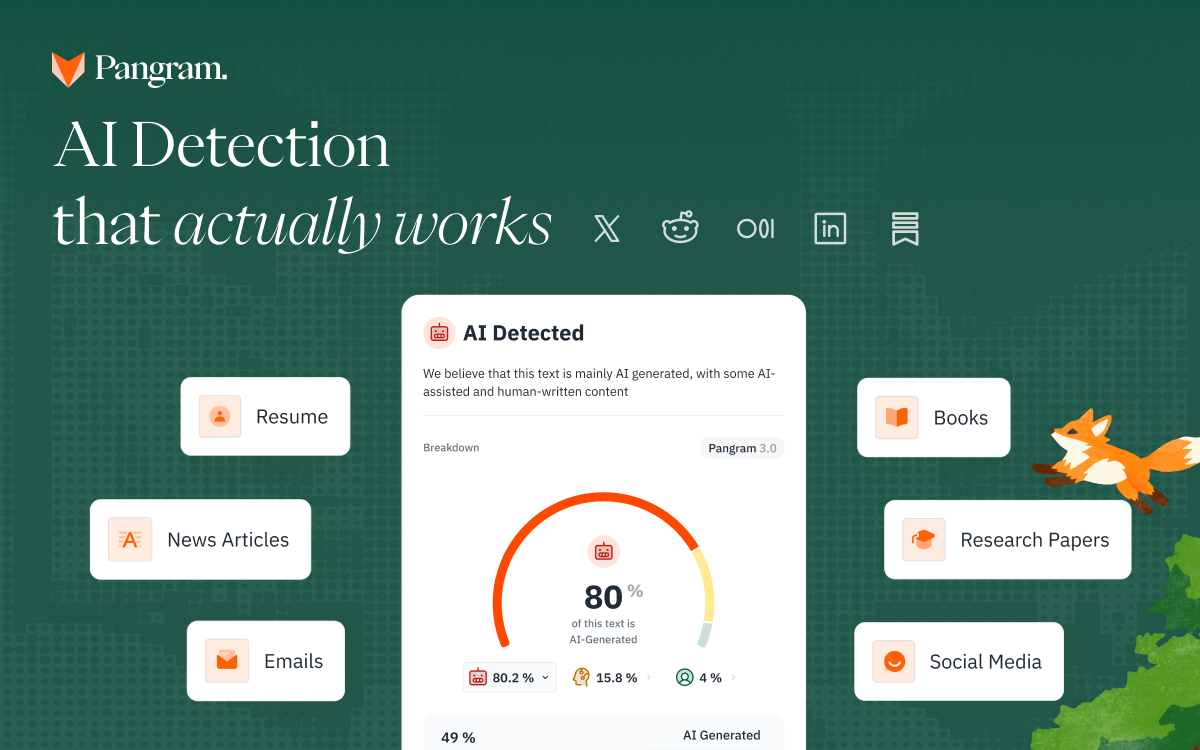
Here is a thing about AI-detection startups that is a little bit funny, in the way that a lot of finance is a little bit funny: the product everyone wants is the one nobody believes in. Teachers want to know if a student used ChatGPT. Platforms want to know if a review is real. And the entire industry that promises to tell them has a reputation for crying wolf. Pangram Labs' pitch is that it is the exception, and its evidence is not a bigger accuracy number - it is a smaller error number.
The distinction matters more than it sounds. Any detector can achieve high "accuracy" by aggressively flagging things as AI - you catch all the robots, and also a pile of humans. That trade is invisible in a marketing deck and catastrophic in a classroom, where a false accusation can end a semester. Pangram Labs' founders decided early that the number to obsess over was the false-positive rate: roughly one in ten thousand, they say. Catch the machines, almost never accuse a person.
That framing explains a lot about how the company works. Founded in 2024 by two Stanford classmates, Max Spero and Bradley Emi, Pangram (originally launched as Checkfor.ai) refuses the standard toolkit. Most detectors lean on "perplexity" and "burstiness" - statistical tells that older AI text tends to leave behind. The problem is that newer models are trained precisely to erase those tells. So a detector built on them ages badly, in months.
Pangram's answer is a training loop it describes with the phrase "synthetic mirrors." It takes the documents its model finds hardest to classify, generates AI versions that mimic them closely, and retrains against those - over and over, each time a meaningful new model ships. It is less a static classifier than a treadmill, which is either exhausting or exactly the point, depending on how you feel about the pace of AI.
The company then did the unusual thing of letting other people check its homework. Researchers at the University of Chicago and the University of Maryland benchmarked it independently; Pangram points to results showing error rates many times lower than leading commercial tools across ten text domains and eight different language models. In a field thick with self-reported claims, "someone else published this" is itself a feature.
The Operators
Two people who used to teach machines to see
Spero and Emi met as freshmen at Stanford and stayed in the same orbit for a decade. They arrive at AI detection from an unlikely place - self-driving cars - where the job was teaching computers to perceive the world. The pivot to text is really the same problem viewed from a different angle: not "what is this," but "who made this."
Co-founder & CEO
Max Spero
Machine-learning engineer who led active-learning work on autonomous vehicles at Nuro, with earlier stints at Google, Two Sigma and Yelp. B.S. in theoretical computer science and M.S. in AI from Stanford. Publishes under his own name and set the company's fixation on the false-positive rate.
Co-founder & CTO
Bradley Emi
AI researcher who worked on Tesla's Autopilot computer-vision team and led deep-learning research at Absci. B.S. in physics and M.S. in AI from Stanford, with published work from the Stanford Vision Lab. Architect of Pangram's retraining approach.
What You Can Actually Do With It
One question, many front doors
Web app
AI Detector
Paste or upload a document and get a verdict - with segment-level highlighting that shows which passages read as AI and roughly how much of the text is machine-written.
Extensions
Chrome & Firefox
On-demand scanning of whatever is on screen, so moderators and editors can check content without leaving the page.
Developers
Detection API
A REST endpoint for high-volume pipelines - the same engine behind trust & safety teams filtering AI-written reviews and spam at scale.
Education
LMS Integrations
Plugs into Canvas, Google Classroom, Moodle and Brightspace so authenticity checks sit inside the grading flow teachers already use.
Academic
Plagiarism Checker
Combines AI detection with traditional plagiarism scanning in one pass for schools and publishers.
Global
Multilingual Detection
Coverage across 25+ languages, from Spanish and French to Chinese, Arabic, Japanese and Korean - because AI spam is not an English-only problem.
The Customers
Teachers, publishers, and the fake-review economy
Pangram's most visible market is education, where it has picked up traction as the high-accuracy option for judging whether student work is a student's own. That is the sympathetic use case, and the one that most tests the company's false-positive obsession, because the human on the other end of a wrong answer is a specific, nervous eighteen-year-old.
But the larger volume is quieter. Thousands of businesses use Pangram mainly to sort through public reviews - the ratings and testimonials that shape what people buy, increasingly polluted by AI-written fakes. Named users and partners span Canvas, Google Classroom, Quora, ChatPDF, NewsGuard, WikiEdu, Varsity Tutors and Inspera, across education, media and platform moderation.
The through-line is that "who wrote this" turns out to be the same question whether the artifact is an essay, a five-star review, or a breaking-news post. Pangram sells one detector and lets each industry bring its own anxiety. It is a tidy business shape: a single hard technical problem, rented to a lot of people who each experience it as their own crisis.
The Money & The Milestones
A twenty-person bet on trust
2024 · Founding
Checkfor.ai becomes Pangram Labs
Spero and Emi launch the company and later rebrand - a "pangram" being a sentence that uses every letter of the alphabet, fitting for a firm preoccupied with the full texture of written language.
2024 · Pre-Seed
$1.25M led by Haystack VC
The first outside capital to build the detector and the retraining loop behind it.
April 2025 · Product
New AI writing-detection model shipped
An upgraded model with broader language and model coverage.
June 2025 · Seed
$2.7M+ led by ScOp, ~$4M total
ScOp Venture Capital leads, joined by Script Capital, Cadenza and returning backer Haystack - pushing the combined raise to roughly $4 million for a team of about twenty.