Company File · AI & Education · New York
GPTZero
The detector that reads writing to figure out who - or what - actually wrote it.
The detector that reads writing to figure out who - or what - actually wrote it.
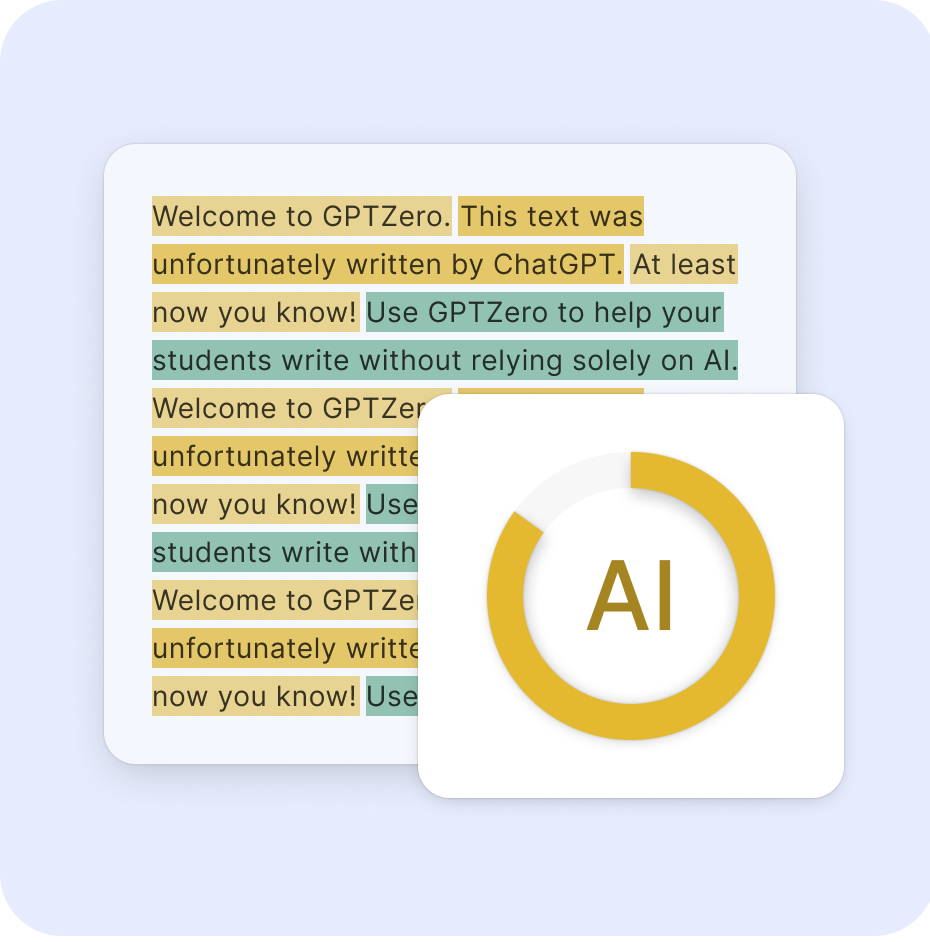
It is 11 p.m. The essay is good. Too good, maybe. The sentences are clean in a way that feels less like talent and more like a setting. So the teacher copies the paragraph, opens a tab, and pastes it into GPTZero. A few seconds later: a percentage, a few highlighted sentences, a verdict that is more honest than the essay was.
This scene plays out millions of times a week now. GPTZero is the company behind that box - a New York startup that built a tool to answer one deceptively simple question: did a person write this, or did a machine? It has grown from a viral experiment into a platform used by more than 10 million people and 100-plus organizations across education, hiring, publishing, and law.
Late 2022 broke a quiet assumption the written world had relied on for centuries: that text came from a person. ChatGPT arrived, and suddenly a passable essay, cover letter, or news article could be produced in seconds, by anyone, for free. The internet did not need more words. It got an infinite supply anyway.
That created a trust problem with no obvious owner. Teachers could no longer tell effort from autocomplete. Editors could not vouch for bylines. Recruiters read cover letters that read suspiciously like every other cover letter. The usual response - panic, then bans - solved nothing, because you cannot ban a tool you cannot detect.
Edward Tian was a Princeton senior studying computer science and journalism - a combination that turned out to be the whole point. He had written code at the BBC and The New York Times to help newsrooms flag machine-generated text. Over winter break, he built a rough app that scored writing on how predictable and uniform it looked, two fingerprints of language models. He called it GPTZero and posted it online in January 2023.
The servers buckled within days. Teachers arrived first, then everyone else. Tian's high-school friend Alex Cui, who had a machine-learning background and left a doctoral program to join, helped rebuild the prototype into a real product. They reached roughly 1.5 million users in five months and raised a $3.5M seed round - the rare consumer hit that landed before the founders had a company to put it in.
The bet underneath it was contrarian. While most of the industry raced to generate more AI text, GPTZero wagered that the scarce, valuable thing would be the opposite: proof of who wrote what. Not anti-AI. Pro-transparency.
The headline product is the free AI detector: paste text, get an estimate of how much was likely machine-written, across models like ChatGPT, Gemini, Claude, and Llama. Under the hood, the detector runs a multi-component analysis tuned for one stubborn goal - catch AI text while producing as few false accusations as possible, the failure that hurts real students most.
But the more interesting work happens around the box. GPTZero's Writing Reports replay how a document was actually composed, reconstructing the messy human process of drafting and revising rather than judging the finished surface. Its Origin extension flags AI content as you browse and inside Google Docs. Institutional integrations drop detection straight into Canvas, Moodle, and Google Classroom, and a developer API and Zapier workflows let other companies build detection into their own tools.
Free checker estimating AI vs. human text across all major models, with sentence-level highlighting.
Replays the drafting process to show how a document was really written - not just how it ended up.
Live AI detection while you browse and inside Google Docs, via the Chrome extension.
Developer API plus Canvas, Moodle, and Classroom integrations for institutions at scale.
Four products, one question, asked four different ways.
Adoption is the argument here. GPTZero reached profitability before its Series A - unusual for a consumer AI tool - and third-party trackers estimate it hit roughly $24M in annual revenue in 2025, up sharply from the prior year. The reach extends well past individual users: it works with the University of Louisiana System across nine institutions and about 82,000 students, and a partnership with the American Federation of Teachers put it within reach of roughly 1.7 million educators. Those are not pilot programs - they are the kind of institutional commitments that are hard to win and harder to walk away from.
User growth, 2023 to 2025. Bars scaled to the 10M+ figure. Sources: company & press reports.
The investor list reads like a vote of confidence from the people who once owned the trust business: Footwork led the Series A, with Reach Capital, Uncork, Neo, and Alt Capital, plus Tom Glocer and Mark Thompson - the former chief executives of Reuters and The New York Times. When the people who ran the newsrooms back a tool about authorship, that is a tell.
GPTZero frames itself less as a cop and more as a referee. The stated mission is to restore information quality, trust, and transparency online - and to keep human value at the center of writing as AI scales. That framing is why the core detector stays free, why the company runs a research arm studying how detection should evolve, and why it pushes "responsible AI" use rather than outright bans. The goal is not a world without AI writing. It is a world where you can tell.
Every model that gets better at writing makes detection harder - and competitors like Turnitin, Copyleaks, and Originality.ai are racing the same track. GPTZero's answer is to keep moving: multilingual detection, reduced bias against non-native English writers, and tools that look at the writing process, not just the polished output. The bias work matters more than it sounds, because a detector that wrongly flags an international student is not just wrong, it is harmful, and false positives are the one error this category cannot afford. As synthetic text becomes the default rather than the exception, proof of human authorship gets more valuable, not less. The referee does not retire when the game gets faster - it learns to run alongside.
Return to the teacher with the suspiciously clean essay. A few years ago, that teacher had a hunch and nothing else - no way to act on it, no way to be fair about it. Now there is a percentage, a few highlighted sentences, and a conversation to have with the student instead of an accusation to throw.
That is the small, specific thing GPTZero changed. Not by fighting AI, and not by pretending it would go away, but by giving the people who read for a living a way to know what they are reading. In an internet drowning in words, that quiet question - did a person write this? - turned out to be worth a company.