Pratik Thakker’s first shop had an unusually accommodating landlord: a small stool. A carrom board placed on top supplied the counter. The merchandise was Diwali firecrackers, bought with roughly ₹3,000 from his father. When the young seller could not secure a proper stall, the board acquired a second career. Some businesses begin with a pitch deck. This one began with somewhere to put the stock.
He was in Class 7, and he had recruited a friend with a proposition that deserves its own miniature place in business history: leftover firecrackers and a meal at a Chinese restaurant. They bought supplies in Mumbai’s Masjid Bandar wholesale market. Customers took an interest in the two boys, and the partnership returned for three more Diwalis. The reward was modest enough to understand and attractive enough to work.
Born in Kutch and raised around entrepreneurship, Thakker had a nearby example in his father’s spice shop. His own early commerce also included pickles and garments. Those products required an introduction, a conversation, and somebody willing to buy. Years before customer acquisition became his professional vocabulary, he was getting practical instruction in it. The counter has changed considerably since then; the need to persuade somebody remains.
Seed money from his father.
A carrom board for a counter.
An introduction is worth a great deal
His route into digital work included a spell in stock-market trading. In his telling, money accumulated over years disappeared within days during a crash. He subsequently moved toward technology and marketing. It is a less tidy beginning than the usual founder biography, in which every childhood activity appears to have been supervised by destiny. His interests shifted. Experience supplied reasons to change direction.
Nancy, his wife, encouraged the move from Mumbai to Israel. She had worked for El Al and knew the country through her travels. Thakker saw a place to pursue his interest in startups. Moving did not immediately produce an invitation into the technology industry. He took cleaning work while looking for an opening. The impressive thing about an unfamiliar market is how thoroughly it can ignore a person’s intentions.
His way into it was an offer posted in the Secret Jerusalem Facebook group: free websites for the first five people who responded. Within three months, he had about seven customers. Testimonials helped him obtain a webmaster position at Masa Israel Journey, where he later became director of digital marketing. The offer gave prospective employers something concrete to judge. An introduction arrived through work already done.

A customer asks a better question
Webzoly began in 2016 with a request. A startup client wanted help developing sales in India. Thakker had been consulting on paid advertising; the customer’s difficulty extended beyond advertising. He agreed to help. His familiarity with India and his experience inside Israel’s technology scene became useful together. Sales, marketing, partnerships, and outsourcing could connect a product in one country with customers in another.
The nickname “Israel’s tech ambassador to India” followed this business activity. It described his work connecting markets. A title can sound splendid on a conference programme, but the activity underneath it is often less ceremonial: finding local knowledge, explaining a product, understanding a customer, arranging the next conversation. Thakker’s account of Webzoly starts with precisely that sort of request, rather than a grand announcement about international commerce.
He also co-founded the talent-assessment business Testlify, extending his involvement into how companies evaluate candidates. Taken together, these ventures show a recurring commercial interest: the distance between a business and the people it needs. Sometimes those people are buyers. Sometimes they are employees. Technology supplies part of the connection; somebody still has to work out what the other side is looking for.
- 2016Webzoly begins with a client’s request for help in India.
- 2021Two TEDx talks explore opportunity, consistency, and work.
- 2026INSIDEA is listed as a HubSpot Elite Solutions Partner.
The audience had to be earned
Thakker’s public career grew alongside those businesses. LinkedIn became a place to discuss work, marketing, and leadership, though his earliest posts attracted little engagement. He kept publishing. By 2023, a company announcement described an audience above 200,000. The number records a stage in a longer process, rather than a permanent score attached to his name. An audience needs fresh reasons to return.
His explanation of personal branding was plain: “No product would sell if it is not marketed well.” He added, “And that is true even for people.” It is an observation one might expect from somebody who has sold both pickles and professional services. Being useful and being noticed are separate jobs. A quiet expert can remain quiet for a very long time if nobody encounters the work.
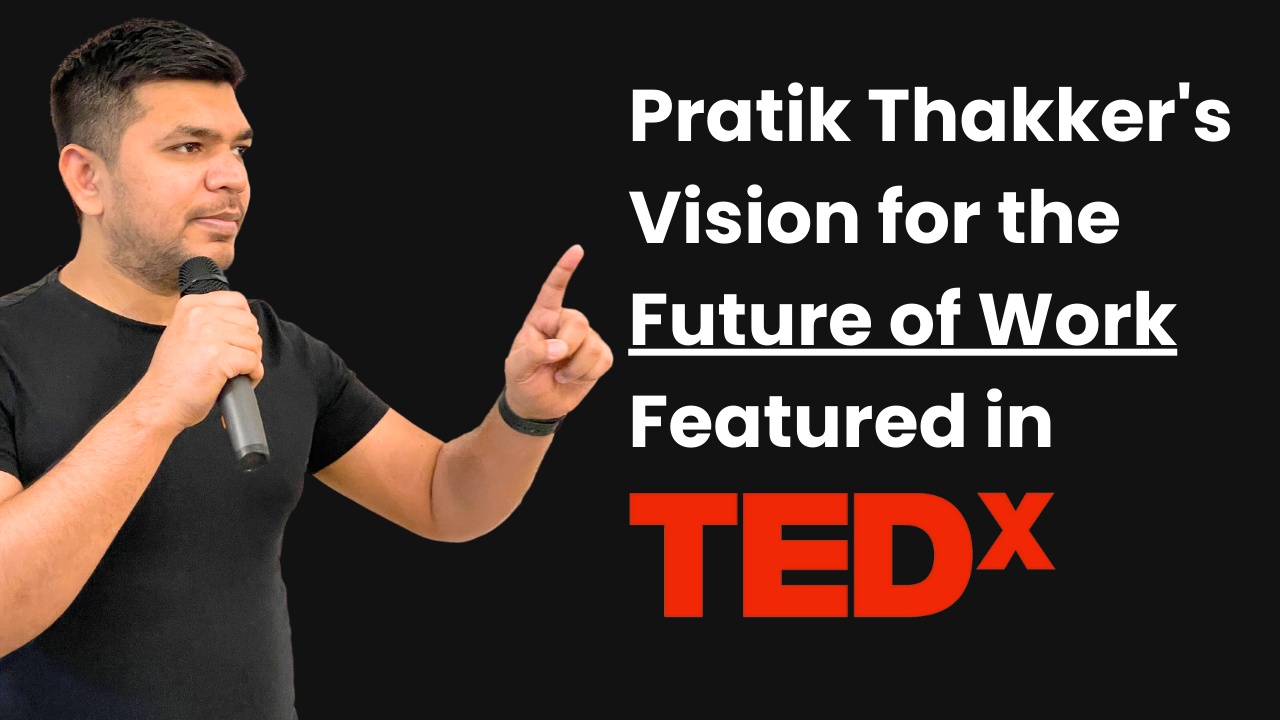
His two TEDx talks, recorded in December 2021, approached opportunity from different directions. At TEDxIIITV, he considered the future of work and the possibilities of working from anywhere. At TEDxVITVellore, he discussed goals, effort, and consistency. The topics fit the experience of a seller who had changed industries and countries. He was interested in how people could make more choices available to themselves.
There is a practical demand underneath that optimism: skills must keep moving. Remote work makes employers accessible across borders, while automation changes what they need. In his public discussion of the future of work, Thakker urged people to keep learning. The invitation to work from anywhere comes with homework. A laptop is easy enough to purchase; a useful skill takes rather more attention.
Building a team that can travel without moving
INSIDEA brought those interests into a company connecting businesses with digital expertise. Thakker explained its motivation through two observations: capable businesses struggled to market their products, and capable people could miss opportunities because of where they lived. His own move abroad gave the second problem particular weight. Remote collaboration offered a way to bring work to people whose lives were already rooted somewhere.
Making that arrangement function required more than agreeing that flexibility was desirable. He described the difficulty of recruiting a remote team, coordinating across time zones, and adapting to differences in language and culture. Those are specific management problems. They do not vanish because an organisation has adopted Slack. A message can cross an ocean instantly and still leave its recipient wondering what, exactly, is required.
Today, INSIDEA describes a team of more than 150 specialists serving over 1,500 businesses across more than 25 countries. Those are the company’s reported figures. Its work spans customer relationship management, marketing, operations, and AI. The ambition is to take responsibility for connected parts of a customer’s growth rather than leave the customer to coordinate a collection of separate suppliers.
HubSpot provides a concrete view of that work. INSIDEA is listed as an Elite Solutions Partner, with accreditations covering CRM implementation, custom integration, data migration, onboarding, and platform enablement. These labels describe jobs that begin after a software purchase: moving information, configuring processes, and helping people use the system. The glamorous software demonstration eventually has to meet somebody’s very unglamorous spreadsheet.
Company-reported totals. These describe INSIDEA’s operations, rather than personal performance metrics.
The people behind the partnership
Thakker’s account of INSIDEA’s HubSpot relationship includes names and memories. He credits Darren Shelton with guidance and introductions when the partnership was getting started. A later meeting at INBOUND in San Francisco prompted him to reflect on how those early conversations had developed into friendship. There is a familiar shape here: a connection becomes useful because somebody takes the trouble to help.
He has also publicly thanked Irina Rosenblit for her support of INSIDEA as a HubSpot partner. After knowing her for almost two years, he described finally meeting her in person at INBOUND. His emphasis was on her availability and involvement. The details give his otherwise broad writing about leadership a more personal dimension. He remembers who answered, who made an introduction, and who helped make an unfamiliar opportunity feel possible.
His podcast, SaaS Unlocked, gave him another role in those conversations: the interviewer. Its first-season archive contains 25 episodes, with guests including Formaloo founder Farokh and SocialJuice builder Sander. Discussing other people’s companies creates a different rhythm from promoting one’s own. For a founder whose business depends on understanding what another business needs, asking questions is an occupationally useful habit.
The Indian Achievers’ Forum records awards in 2021 and 2023-24. Recognition belongs in the picture, but the more revealing material is often smaller: the customer who asked for help in India, the people who backed a partnership, the friend promised dinner. His stories keep returning to exchanges between people. Even a career conducted across screens has a remarkably human cast.
“Failures are part of the journey.”
Pratik Thakker · 2021
A second self, subject to approval
A newer project, Pranan, begins with an awkward consequence of building across time zones: the founder becomes a queue. Thakker describes receiving more than 200 messages a day across Gmail, Slack, and Calendar while running multiple ventures. Colleagues needed decisions; clients needed replies. He also wanted to be present for his son. The same international reach that created opportunity had created a very crowded inbox.
Pranan is presented as an AI communication assistant that learns how its user writes and prepares replies for review. Its stated design keeps the person approving messages before they are sent. That arrangement gives his current interest in AI a particular purpose: reducing the routine first pass through communication. It also places a human decision at the point where a draft becomes somebody else’s received message.
This is a fitting continuation of his work, even as the technology changes. The questions are still about access and attention: who gets a chance to show what they can do, who discovers a useful product, who receives an answer. At INSIDEA, he is pursuing these questions through teams and customer systems. With Pranan, he is applying them to the founder’s own working day.
His advice to younger entrepreneurs includes a compact instruction: “be curious and be relentless.” The curiosity is visible in the changes of direction; the persistence is visible in the repeated attempts to find an opening. Back at the beginning, there was merchandise, a willing friend, and no suitable stall. A carrom board did the job. There are less portable ways to learn how a business starts.