A whitepaper is an unlikely place to begin a relationship. It offers diagrams, technical promises and, if you are unlucky, several new abbreviations. For Prakash Somosundram, reading about Efinity helped set a company in motion. The opportunity he saw was to help other people build businesses around the infrastructure Enjin was developing. The missing ingredient was an organisation that could bring those people together.
He had encountered Enjin at its first Singapore meetup in 2018. NFTs initially failed to persuade him. By late 2020, he was looking again. An introduction to Alvin Tang followed, and in April 2021 they began working on the idea that became Enjinstarter. They took their vision to Enjin’s founders and to Altcoin Buzz’s Shashwat Gupta. An emerging technology was acquiring the familiar furniture of a business: collaborators, backers and people willing to make the next introduction.
That sequence makes sense of a career that otherwise appears to change subjects rather often. Somosundram has worked in advertising, startup fundraising, digital assets and climate finance. Look past the terminology and a persistent occupation emerges. He assembles relationships around things people hope to build.
Before the token, the client brief
Yolk came first. Co-founded in 2001, the Singapore digital agency worked across a collection of services that now sound thoroughly ordinary: websites, online advertising, social media and digital strategy. In their day, these were the questions established companies were learning to ask. How should a brand behave online? How could it attract attention there? What would make that attention useful?
By December 2010, Yolk employed 40 full-time staff and had a presence in Malaysia, Thailand and Australia. Its client list included Canon, Microsoft and the Singapore Economic Development Board. Grey announced a majority-stake acquisition on December 20, bringing Yolk’s capabilities into its Asia Pacific operations. Somosundram was identified as a Yolk director.
There is a useful apprenticeship in agency work. Someone pays you to understand an audience, and eventually asks what happened to the money. The technology may be fashionable; the client still expects an answer. Reading his later interest in communities alongside this earlier work, the connection is hard to miss. He had spent years in a business where getting people to pay attention was part of the assignment.
The work between the introductions
After leaving the agency world in 2014, Somosundram became involved in helping startups with fundraising and exits. His advisory profile describes work on investor narratives, plans for selling a business and entry into Singapore. These are questions of translation: turning a founder’s understanding of a company into something another person can assess.
His Clarity profile gives that work a practical shape. He offers help with building the narrative for a funding pitch and considering the options for an eventual exit. One reviewer describes receiving specific advice and pitch-building tools, including Lean Canvas. The modest detail matters. An introduction may open a meeting; the founder still needs something coherent to put on the table.
In 2016, he helped bring The Marketing Group to a public listing in Sweden and served a term as a director. His own description places him within the team that did it. That distinction suits the work: listings, acquisitions and fundraising rounds depend on several parties agreeing about the same enterprise.
By 2018, he was Head of Acceleration at Singapore digital-assets firm XSQ Global. At an NUS-ISS seminar that October, he joined a panel about the practical future of blockchain. The programme’s questions concerned adoption, real applications and the distance between experiments and production. Even then, there was more to discuss than the machinery.
A launchpad needs somewhere to land
Enjinstarter launched in early October 2021, supporting blockchain gaming and metaverse projects. A launchpad helps projects approach a community and raise capital, including through token offerings. In Somosundram’s telling, the ambition extended to finding promising teams, investing in them and helping them develop. The sale was one event inside a longer relationship.
The beginning supplied an awkward demonstration of trust. He later recalled that the corporate website suffered a denial-of-service attack before the token sale. An attacker demanded half an ETH. He refused, and the team continued without the corporate site. A launchpad, it turned out, could have trouble getting its own front door open.
Institutional backing followed. True Global Ventures invested US$3 million in January 2022, then added US$2 million in July, taking its Series A investment to US$5 million. The distinction between money raised by Enjinstarter and money raised by projects using its platform matters. They describe different businesses and different responsibilities, even when both fit comfortably into a conference biography.
Money also leaves an audience problem unsolved. In his gaming discussions, Somosundram kept returning to entertainment and participation. People needed reasons to stay involved. A financial incentive could attract attention, but a game still had to be enjoyable. Somewhere beneath the token model, someone had to want another turn.
The table is part of the technology
At Echelon in October 2022, a photograph catches Somosundram at the far right of a discussion table. There are notebooks, name cards, paper cups and people listening to one another. It is an almost aggressively ordinary picture of a conversation about the future.
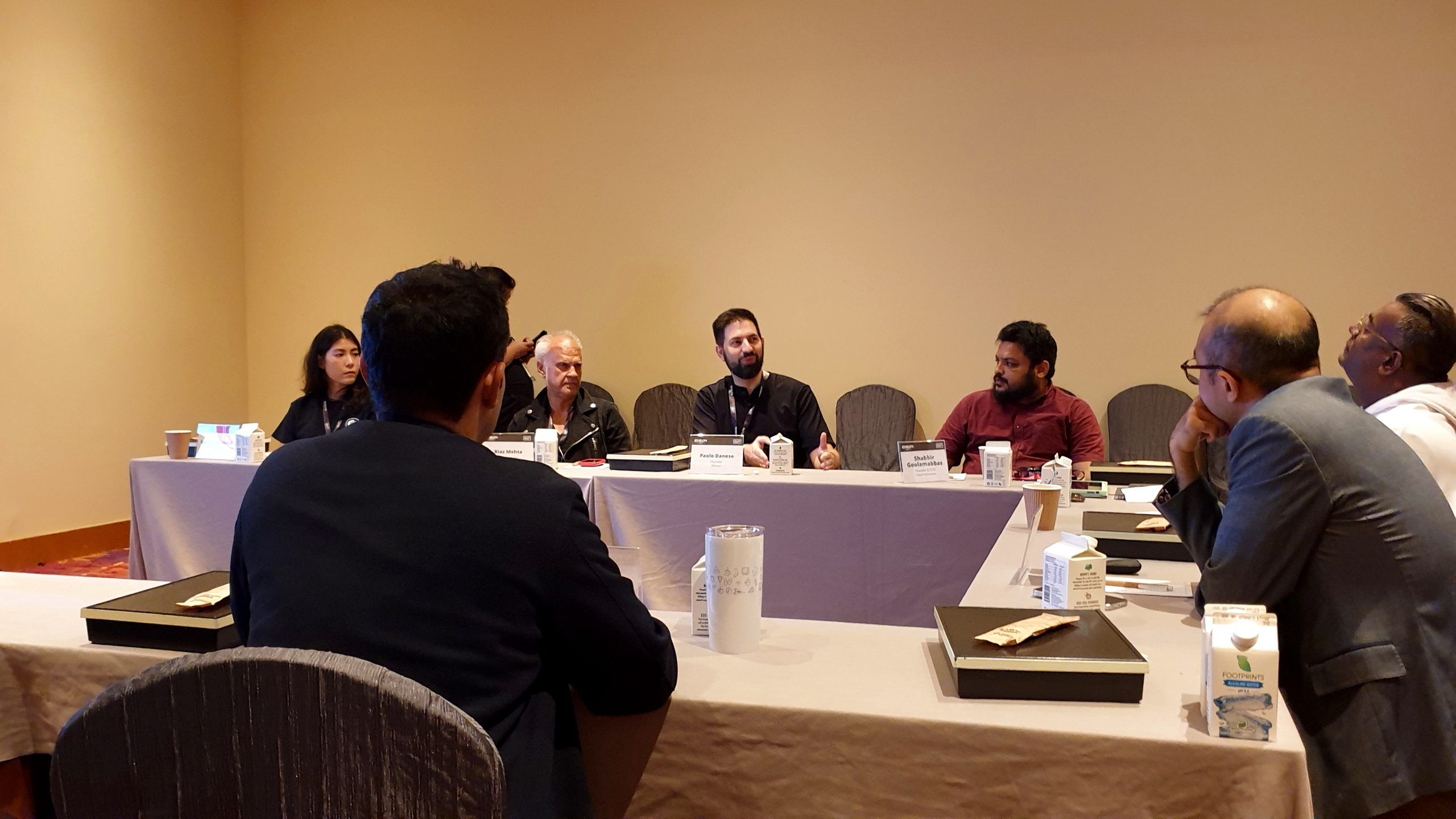
He and e27’s Thaddeus Jit facilitated the roundtable. Participants included founders working in film, writing and cloud technology. Their businesses differed, but the discussion kept encountering a shared difficulty: how to introduce unfamiliar technology to people who had other things to worry about.
That is a revealing setting for him. It combines the two sides of his career: the attraction of a new technical possibility and the practical work of explaining its use. A founder could imagine a different licensing system or a new way to pay creators. Getting an existing audience to understand and use it required another kind of effort.
His proposed approach to Web3 adoption allowed familiar interfaces to sit in front of blockchain systems. People should be able to use the product comfortably. It is a sensible concession to the customer, who may prefer an afternoon’s entertainment to a short course in wallet management.
Digital tattoos and other human preferences
The examples Somosundram discussed were often more tangible than the industry vocabulary suggested. Swallow worked with tattoo artists on wearable designs for virtual environments. The Orientalist Spirits connected digital membership with bottles, invitations and participation. Such projects began with recognisable desires: self-expression, belonging and access.
The tattoo example has a certain comic precision. Humanity had acquired the ability to create virtual worlds and promptly needed somewhere to get dressed for them. Yet it also made his point. People bring preferences and identities into new spaces. A technical environment becomes interesting when it gives those preferences somewhere to go.
“At the end of the day, it is all about communities.”
Prakash Somosundram, 2022
Enjinstarter also participated in Smobler Studios’ US$1.2 million seed round in 2022, alongside other backers. Smobler’s work brought virtual architecture together with an interest in social impact. Somosundram welcomed its emphasis on impact and venture philanthropy. The investment offers a concrete example of his expanding interests: the platform could support games, but he was also looking at what people might build around education, organisations and shared spaces.
From digital worlds to mangroves
By 2023, climate finance had become a more explicit part of the work. AYA, Enjinstarter’s climate-focused brand, launched in the UAE during COP28 that December. Its proposed role was to connect environmental ventures with investors and provide technology and incubation support.
The areas described included reforestation, nature credits, mangrove conservation and sustainable agriculture. These are a considerable distance from an avatar’s wardrobe. They also bring a different set of questions. A project has to explain what it will do in the physical world, how it will be financed and how its work can be assessed.
AYA’s December 2023 announcement described a licence approval for its Dubai entity while making clear that regulatory prerequisites remained before operations could begin. That qualification belongs beside the ambition. Finance operates through permissions and obligations, and a proposed funding bridge has to be built carefully at both ends.
His conversation with Arjun Vir Singh on Couchonomics ranged across digital ownership, trust, regulation and carbon markets. The breadth captures his interest in moving between industries. It also exposes the challenge of doing so: each new field has its own specialists, constraints and reasons for distrusting an easy answer.
A community beyond the company
There is a civic thread alongside the commercial one. In 2013, Somosundram chaired the communications subcommittee of Action Community for Entrepreneurship. He has also served with North East Community Development Council and the Social Development Network Council. These roles put the language of community into an institutional setting, with duties that extend beyond a company’s next transaction.
In 2021, he received Singapore’s Public Service Medal, or PBM. In July 2026, he joined the board of the Singapore Indian Chamber of Commerce & Industry for its 2026–2028 term. The chamber identified his experience in artificial intelligence and emerging technologies as part of what he brought to the appointment.
His T18N team biography gives him the title Rainmaker. It is an unusually cheerful description of advisory work, suggesting that weather can be improved with the right telephone call. The underlying work is more particular: understanding businesses, finding suitable counterparties and helping people consider what comes next.
The next introduction
On September 8, 2026, Somosundram announced that he was closing his Enjinstarter chapter. He acknowledged unmet expectations and his responsibility for decisions as co-founder and CEO. He also said that closing the chapter left responsibilities to address.
His next focus includes applied AI, business strategy and training future practitioners. He described an interest in helping founders connect funding, partnerships and execution. It is familiar territory with different tools.
The useful line in his reflection was brief: “Raising capital is a beginning.” For someone whose career has included so many beginnings, it is a demanding observation. An introduction leads to a meeting. A meeting can lead to money. Then come the decisions that determine what the introduction was worth.