A game can be available in your country and still be beyond your reach. The problem may sit on the desk in front of you: a computer that cannot run it. Daniel Wang’s career has brought him repeatedly to that awkward gap between a product having an audience and an audience being able to use the product.
Before he became the co-founder and CEO of Aethir, Wang worked on international publishing, global expansion and infrastructure at Riot Games, the company behind League of Legends. He also ran operations for its China business. These are jobs concerned with what happens after someone has made something people want. The work is getting it to them, reliably, across borders.
Now, based in Singapore, he deals in access to graphics processing units, or GPUs, the chips used for gaming and AI workloads. The change of subject is less abrupt than it sounds. Follow the player far enough beyond the screen and eventually you arrive at the machine.
Economics, with a publishing deadline
Wang studied economics at Princeton University from 2003 to 2007. His early career included private wealth management at Deutsche Bank Securities, followed by work that took him into corporate strategy. At HTC, he worked in strategy and global insights; at iFlow Systems, in strategy and corporate development. Finance and technology were already sharing space on his résumé.
His Riot Games years, from 2013 to 2019, gave that commercial background a particular application. His responsibilities spanned international publishing management, global expansion and infrastructure, and China operations. The vocabulary changes between those roles, but the practical questions travel well. Where can a business expand? What must be in place? Who has to coordinate the work?
A successful game brings an unusual discipline to those questions. Players encounter the result directly. A delay or a failed connection becomes part of the product they experience, regardless of which department owns the problem. A publishing plan may look immaculate in a meeting and still have an unhappy evening in the hands of a player.
Wang describes his attachment to games in considerably less corporate language. In 2024, he called himself a “hardcore gaming nerd at heart.” It is a useful detail in a career full of investment and operating titles. The audience for the infrastructure includes people doing something he enjoys.
“For us, gaming is in our DNA.”
Daniel Wang, 2024
A holiday home with no holidays
After game operations came investment work in the Web3 ecosystem. Wang held the chief investment officer role at YGG SEA, subsequently known as W3GG, and served as a venture partner at Infinity Ventures Crypto. Those positions placed him among teams trying to connect blockchain technology with gaming businesses and their communities.
His account of Aethir’s beginnings includes meeting fellow founders through a fund. They brought experience in Tencent cloud gaming; he brought the publishing and operating perspective. Their concern was the performance and cost of serving applications that need to respond quickly. A remote game cannot ask the player to be philosophical about every pause.
In March 2024, Wang reached for a more domestic explanation of the business: Airbnb. A holiday property may be empty while someone elsewhere wants accommodation. In his analogy, GPU capacity can also sit unused while customers need computing. Aethir’s task is to connect the available resource with the demand.
“Overall GPU utilization is quite low,” he said. His argument was that more consistent use could help hardware owners recover their investment and allow lower service prices. He also pointed to older GPU generations that lacked steady demand. Scarcity and idleness, in this account, can exist at the same time.
The analogy has a useful stopping point. Accommodation requires a suitable place on a suitable date. Computing adds its own requirements: the right hardware, bandwidth, response time and service conditions. A full booking calendar is only helpful if the guest can actually get through the door.
Somebody has to check the work
For Wang, the commercial promise depends on enterprise customers being able to rely on the service. A company offering a game or an AI application must answer to its own users. Spreading the hardware around does not remove that obligation. It creates a coordination job.
Aethir divides that job into three named roles. Containers execute and render applications. They are the remote endpoints doing the work that would otherwise happen on a local device. Cloud Hosts supply them, and the network’s design rewards both readiness and active service.
The Indexer matches a request to a suitable Container. Its criteria include whether the application is ready, whether the hardware meets the requirements, whether latency is acceptable and whether the price fits the developer’s budget. Capacity becomes useful through a series of specific choices.
Checkers assess the Containers. They verify specifications and examine performance at registration, while capacity is standing by, and during service. The design includes reading performance data and testing applications as a consumer would. Checking influences scheduling and quality control.
These details give Wang’s infrastructure argument a practical shape. A large inventory of machines does not describe the whole experience. A customer needs an appropriate machine at the moment of use, with some way to evaluate whether the promised service arrived. The inspector has a part in the story alongside the hardware owner.
Executes the application.
Finds suitable capacity.
Assesses service quality.
A signature in Abu Dhabi
Wang’s public role also takes him away from the engineering diagram. In August 2024, his WebX schedule in Tokyo placed him on two panels in one day: one about scaling decentralized physical infrastructure, the other about decentralization in AI. The pairing captured the two conversations his business was joining.
The speakers around him came from organizations including Mawari Network, OriginTrail, SKALE Labs and Nethermind. These were discussions about how distributed systems might support broader use, with the recurring questions of scale, access and implementation. Wang was bringing the GPU infrastructure business into that exchange.
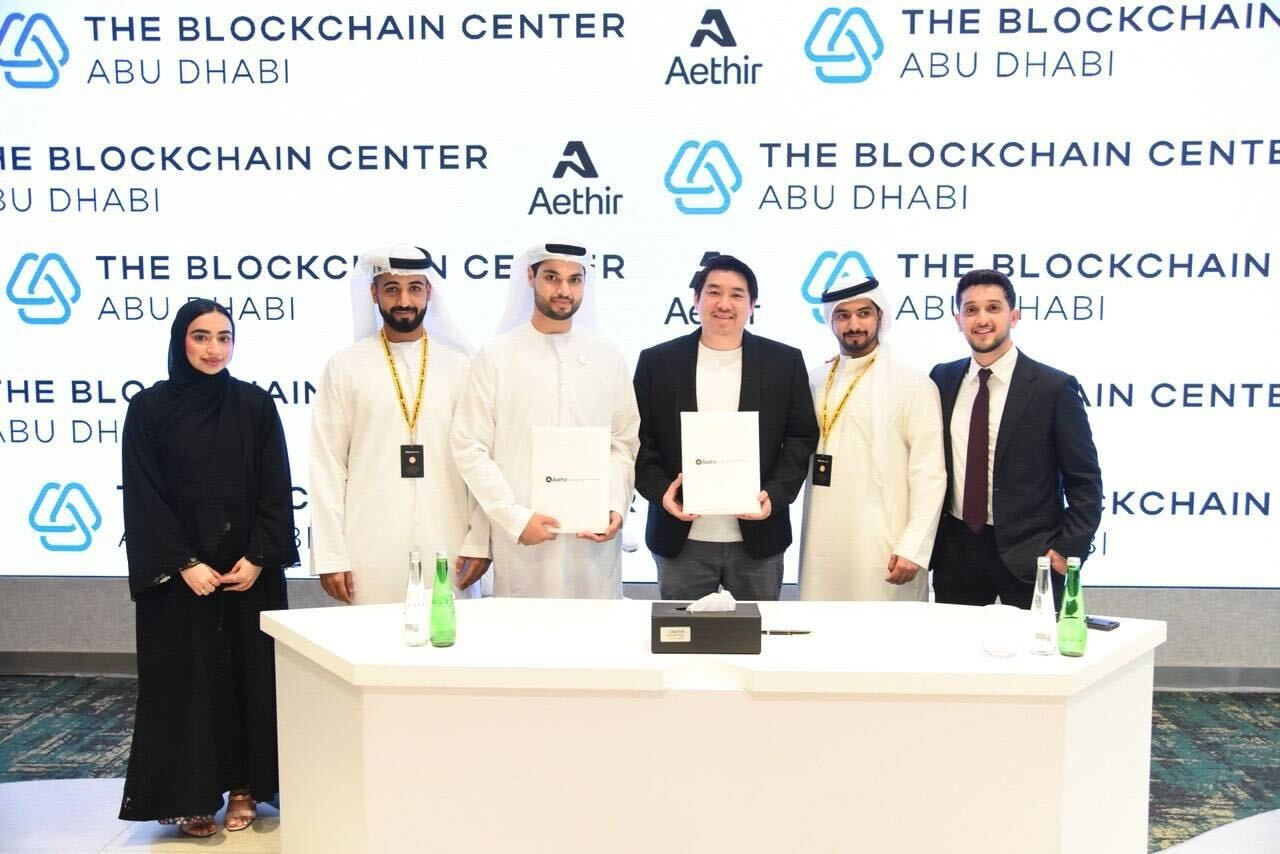
By December, he was in Abu Dhabi signing a partnership agreement with The Blockchain Center Abu Dhabi during Abu Dhabi Finance Week. The collaboration involved AI and gaming development through Aethir’s announced $100 million ecosystem fund. In the photograph, Wang stands fourth from the left, holding the agreement. Cloud computing occasionally requires a very terrestrial document.
He also appeared at Emergence in Prague that month, on a panel about crypto’s real-world applications. The geography matters to a business presenting computing as a distributed service. Customers, hardware providers and partners occupy different places. The chief executive’s work includes getting those separate interests into the same conversation.
When access means building capacity
By October 2025, Wang was discussing strategic compute reserves in a Bitcoin.com interview recorded at WebX. The conversation ranged across enterprise reliability, gaming, incentives and access for startups and smaller businesses. Computing appeared as a resource organizations might want to secure for future use.
That theme connects his investment background with his operating career. A resource has a price, an owner and a delivery problem. Planning for access requires attention to all three. A reserve is useful only to the extent that it can become working capacity when required.
In August 2026, Aethir announced ACCELERATE, a move toward developing physical compute capacity in the United States and Europe. The company said it had secured access to 10 sites totaling up to 20 megawatts. It described a plan to bring GPU capacity online against existing enterprise demand.
Company-reported site access and potential capacity. Build-out remained a plan at announcement.
The distinction between access to a site and a running facility matters. Aethir’s projected contract values were forecasts. Its announced approach added hardware procurement, data center capacity and infrastructure partners to the task of coordinating existing resources. Wang’s business was taking on more of the work behind the network.
Another change followed on October 21, 2026: Aethir announced daily ATH token burns funded by network fees, scheduled to begin in November. The proposed mechanism linked burns to network activity and introduced a floating fee. At this profile’s publication, that start date was still ahead. Plans have a tense, and it is worth keeping it.
Five minutes at the front door
Alongside the physical infrastructure plans, Aethir had been working on the experience at the other end. Claw V1, launched in April 2026, offered browser-based deployment of AI agents, with prebuilt capabilities and payments in crypto or conventional currency. The company promoted a setup process of under five minutes.
Wang described bringing together GPU infrastructure, hosting and the agent application layer. The deployment-time claim was Aethir’s own, but the intention was plain: fewer technical steps before someone could use the application. “This is how agentic AI reaches the next hundred million users,” he said.
It is an ambition that returns his story to the player and the inadequate computer. Hardware, cost and setup each create a point where someone can give up before an experience begins. His career has moved through several of the businesses responsible for those points: finance, publishing, investment and infrastructure.
A person pressing play rarely thinks about the publishing operation or the distant GPU. They want the thing to start. Wang’s work now sits inside that expectation, between an available resource and a usable experience. The test is pleasantly free of jargon: does it work when somebody arrives?
Follow the conversation
Wang’s public profile, interviews and the projects discussed here.
- Daniel Wang on LinkedIn ↗
- Aethir: website and company blog ↗
- The GPU utilization interview · March 2024 ↗
- Gaming, infrastructure and Aethir’s beginnings · April 2024 ↗
- Watch: Wang on strategic compute reserves · Bitcoin.com ↗
- Aethir Claw V1 launch · April 2026 ↗
- ACCELERATE announcement · August 2026 ↗
- The announced ATH fee and burn changes · October 2026 ↗