Pradeep Bhatia’s business begins with an awkward question for finance: why should a bank’s size determine the quality of its tools? A community institution can have commercial borrowers, interest rate exposure and customers sending money abroad. The work is real even when the trading floor is modest. Sophistication, like good tailoring, ought to be available in more than one size.
Bhatia knew the larger institutions from the inside. Before co-founding Derivative Path, he led bank coverage for derivatives at Wells Fargo and held senior roles at ABN AMRO, Société Générale and U.S. Bank. His subsequent venture addressed a familiar imbalance: smaller institutions needed ways to manage financial risk without assembling the infrastructure of a major dealer.
The company launched in May 2013, initially financed by its founding team. Bhatia’s career had brought him close to the institutions that would become its customers. The opportunity was specific enough to build around: put useful derivatives technology and experienced support within reach of regional and community banks. That would require more than an attractive screen.
Four colleagues, one shared departure
The founding story is a collective one. Bhatia, John Fleming, Frank Purnell and Zack Nagelberg came out of Wells Fargo with complementary experience in sales, technology, trading and risk. Their company took shape in the years after the 2008 financial crisis, when the gap between smaller banks’ needs and the tools available to them had become difficult to ignore.
That mix matters to understanding Bhatia. His venture combined software with advisory work from the outset. A derivatives program brings operational questions as well as a market view. Someone must structure transactions, follow their changing values, maintain records and support the people responsible for the program. A clever calculation has a surprisingly long administrative entourage.
He has continued to describe the business through its people. When Nagelberg became president in February 2026, Bhatia called him “a true partner in every sense of the word.” The promotion gave Nagelberg responsibility for enterprise priorities and execution of the growth strategy. Fleming remained focused on operations and Purnell on innovation. More than a decade after founding, the working partnership still shaped the organization.
The first product had paperwork in mind
DerivativeEDGE arrived in May 2014 after eight months of design and development. It offered institutions tools to price, process and track interest rate derivatives. The details were practical: cash flows, payments, market values, permissions and workflows. For a business often described in the language of markets, the early product showed considerable interest in what happened after a transaction.
The launch also addressed documentation and compliance requirements. Administrators could assign roles and separate duties. Live market data fed a service delivered through the cloud. Institutions could model and manage trades without buying the sort of software and infrastructure associated with a much larger operation.
Bhatia’s proposition becomes clearer at this level. Access means being able to keep doing the work tomorrow, when a payment falls due or a colleague needs a report. A trading tool has to survive ordinary office life. The ambition sat in the machinery: fewer disconnected tasks between the first conversation with a client and the ongoing management of the transaction.
Seven years before the outside cheque
In June 2020, Derivative Path raised $35 million from FTV Capital. It was the company’s first outside institutional funding, seven years after launch. By then, its platform had been used by more than 130 banks and institutional clients. Bhatia and his colleagues had built a business before bringing in that institutional investor.
The seven-year interval also helps explain the business Bhatia brought to investors. DerivativeEDGE had expanded beyond its original interest rate focus, adding automated hedge accounting and foreign exchange capabilities. Its pitch covered the connected work of front, middle and back offices. The funding announcement described a platform already serving as the system of record for hedges at regional banks. The next stage would build on those operating relationships, with outside capital available to broaden what the company could offer.
The investment was intended to expand products and support growth among financial institutions, end users and buy-side clients. FTV’s Robert Anderson and Brent Fierro joined the board. The platform already covered interest rates and foreign exchange, with functions spanning the trading desk, risk management and operations.
Bhatia’s comments at the time returned to the expertise of the founding principals and the professionals they had hired. His account put the team’s knowledge alongside the technology. There is a useful restraint in that emphasis. Financial software must be built by people who understand the consequences of its output, including the consequences nobody wants to discover at the end of a reporting period.
Follow the borrower, then follow the payment
The March 2021 acquisition of Monetics extended the business into debt management. Monetics’ platform helped commercial real estate participants organize loan portfolios and track debt timelines. Its arrival connected information about borrowing with tools for monitoring interest rate exposure. Bhatia’s stated ambition was a more unified capital markets experience for commercial clients.
Later that year, he began the podcast series Pathways with Pradeep. The opening conversation brought together Nagelberg and Monetics’ Adam Fischer to discuss the company’s beginnings and access to capital markets. It was a fitting cast: a founder talking with colleagues whose work connected different parts of the customer’s financial life.
Payments provided another opening. In his outlook for 2022, Bhatia discussed smaller banks’ opportunity to take greater control of international payments, pricing and service. He also described customers looking to grow commercial lending and fee income. His argument for technology stayed close to those commercial needs, down to faster presentation materials and less time spent producing internal reports.
An old employer becomes a new connection
In June 2022, Derivative Path announced a collaboration with Goldman Sachs Transaction Banking on foreign exchange and international payments. The arrangement combined its platform with Goldman’s payment capabilities. The intended beneficiary was still the regional or community institution seeking a service it could offer its own customers.
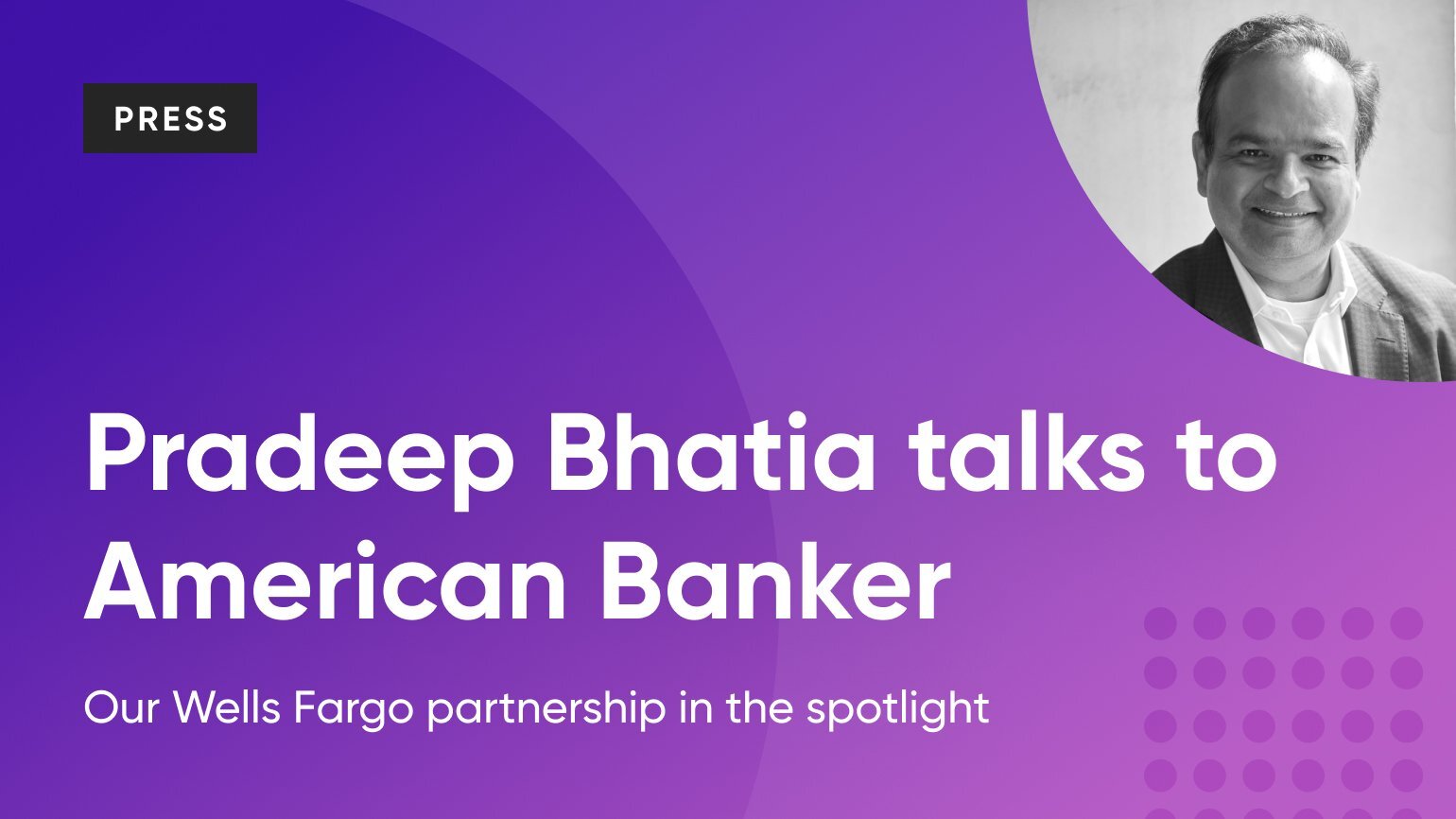
A January 2025 partnership brought Bhatia’s former employer, Wells Fargo, into the picture. Derivative Path paired its software with the bank’s foreign exchange payment APIs, providing access to real-time rates and more than 120 currencies. FirstBank in Nashville and Busey Bank in Illinois were named among the live customers.
The career has an appealing circularity here. Bhatia left a large bank to help smaller institutions, then connected his company to large banks’ capabilities. The smaller institution could retain the customer relationship while drawing on infrastructure beyond its own walls. That is a more interesting business story than a simple contest between incumbents and newcomers; the participants can be suppliers and partners as well.
A wider desk, with the same practical questions
DerivativeEDGE added commodities trading capability in June 2024, including support for US energy products such as oil, natural gas and natural gas liquids. East West Bank was an early adopter. The expansion put another category of financial exposure alongside interest rates and foreign exchange on the platform.
In November 2025, Frost Bank implemented DerivativeEDGE for its over-the-counter derivatives business, initially focusing on commodities and rates. The announcement described a multiyear partnership. Such customer decisions gave Bhatia’s expanding product range a concrete setting: established institutions choosing infrastructure for the work their own clients needed.
The company also received the 2025 WatersTechnology award for Best Cloud Provider to the Sell Side, its third consecutive win in that category. By the close of 2025, Bhatia said more than 300 clients used the technology as a system of record for rates, commodities and foreign exchange positions. He described a team spread across the US, Canada, Europe and Asia Pacific, and customers extending into private equity, private credit and corporates.
The next job is to give people back their time
In May 2026, Derivative Path launched ALM Strategy Builder for banks and credit unions. The product brought hedge modeling, stress testing, strategy comparison and presentation outputs into a single environment. It included an AI assistant and was offered as a standalone subscription, opening another route into the company’s tools.
“What they need is infrastructure that matches the seriousness of what they’re doing.”
Pradeep Bhatia · May 2026
Bhatia’s explanation emphasized the mismatch between the complexity treasury teams handled and the infrastructure available to them. The point fits the earlier business remarkably well. Customers had developed their programs; the next task was to reduce the effort required to analyze and explain them.
His public account of growth is similarly compact: “we listen, we innovate, we deliver.” The sequence starts with the customer, a sensible precaution in an industry where a feature can become a committee meeting with unusual speed. It also puts delivery last, where the promise must eventually become something a client can use.
By July 2026, Bhatia was describing customers preparing for different interest rate outcomes. Some banks were positioning for further increases while others were hedging against cuts. His observation showed why the business needs to accommodate more than one forecast. The platform has to support institutions arriving at different judgments, then help them examine and manage the exposures those judgments leave behind. Across the product’s successive versions, that practical requirement has remained a reason for keeping analysis, operations and experienced support close together.
Bhatia is based in the San Francisco Bay Area and enjoys travel. His professional travels, meanwhile, have carried him from derivatives coverage inside major banks to a company serving institutions across markets and countries. The recurring question has held up through the expansion: how much financial work can a smaller team carry out with the right help? His next chapter is being built around the hours that answer might return to them.