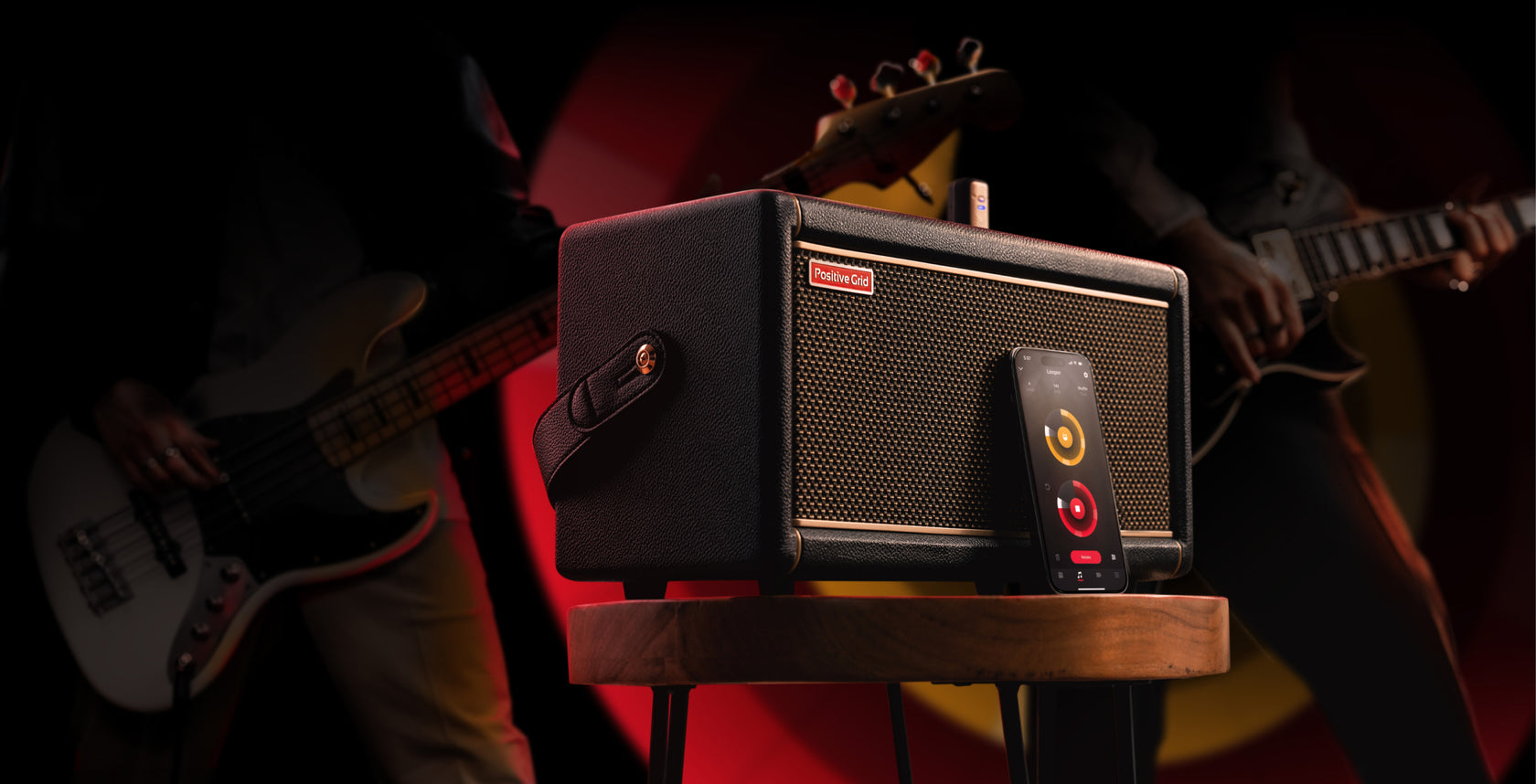
The most important feature of a guitar amplifier may be the distance between the couch and the first chord. Traditional rigs can make that distance feel absurdly long: find a cable, wake the tubes, arrange the pedals, locate a backing track, remember which knob made yesterday’s sound. Positive Grid built its modern business around collapsing that ritual. Spark, its breakout practice amp, looks like a handsome black speaker. The more revealing description is an app with a cabinet attached.
Plug in a guitar and the amp can call up modeled amplifiers and effects, stream music, display chords, provide bass-and-drum accompaniment and record into a computer. Open ToneCloud and other players have already shared sounds intended to evoke a band, song or guitarist. The customer is not buying one tone. The customer is buying fewer reasons to put the guitar down.
The software ate the pedalboard
Positive Grid began in 2011 with JamUp, an iOS guitar-and-bass effects system. BIAS Amp and BIAS FX went deeper, letting musicians construct virtual amplifiers and signal chains on phones and computers. That sequence matters. Before the company committed to manufacturing a physical amp, it had spent years learning which digital controls players touched, saved and shared.
Co-founder and CEO Calvin Abel and a team split across the United States and Taiwan then packaged that knowledge for a broader customer: the player at home. Spark arrived for preorder in 2019 as a 40-watt practice amp and Bluetooth speaker. It was less intimidating than professional modeling software and more playful than a conventional combo. Smart Jam listened to a player and generated accompaniment. Auto Chords analyzed songs. ToneCloud supplied community presets. A USB connection turned the amp into a recording interface.
The proposition reached beginners who wanted guidance, apartment players who needed manageable volume, hobbyists who did not want a floor full of pedals, and experienced musicians who wanted a compact scratchpad. The original Spark sold for about $299 at launch-era retail, while early preorder offers were lower. That placed an amp, effects library, practice companion, Bluetooth speaker and basic interface within reach of a single mid-priced purchase. Exact current prices move by market and promotion, but the architecture has stayed consistent: sell the device, make it better through free software, and offer accessories or premium software around it.
“If the tech is the thing the player notices, we’ve already lost.”Positive Grid’s 15-year retrospective
Then product-market fit hit the loading dock
Spark’s first conspicuous failure was not the concept. It was fulfillment. Positive Grid said demand in November and December 2019 far exceeded expectations. A shortage of an essential component forced production changes. Then COVID-19 closed factories and suppliers before spreading into global logistics. Customers who had paid months earlier watched estimated dates slide.
The company compounded a physical problem with an information problem. In July 2020, Abel wrote publicly that Positive Grid had not communicated effectively about the delays and obstacles. The apology was unusually direct for a gadget launch: production capacity, operations and logistics had to scale at once; the factory shutdown came after that scramble; shipping then broke in new places. Customer threads from the period make the cost legible in human terms - uncertainty, cancellation threats and suspicion about a product many had never seen outside an advertisement.
There is no reliable public total for what the episode cost in expedited freight, support or refunds. The visible price was trust. Positive Grid changed its communications, published recurring supporter updates, added order tracking and kept increasing output. By the middle of the decade, the more useful evidence was the product line itself: Spark did not disappear after a fraught launch. It multiplied.
One engine, many rooms
Positive Grid now behaves less like a single-product amp maker and more like a platform company with knobs. Spark MINI shrank the system into a battery-powered 10-watt box. Spark GO made it backpack-small. Spark 2 answered a persistent customer complaint by adding a built-in looper, along with 50 watts, upgraded processing, optional battery power and line outputs. Spark NEO moved the rig into wireless headphones. Spark CAB, Control and LINK products widened the accessory shelf.
LIVE and EDGE added multiple inputs for singers and other instruments, turning the practice concept toward small performances and PA duty. In 2025, BIAS X introduced desktop tone creation from natural-language prompts and reference audio. In June 2026, REACTOR pushed that idea into a 50- or 100-watt 1x12 combo. Its app can build a signal chain from text, audio or even an image, while the cabinet offers the decidedly unglamorous things stage players require: selectable wattage, MIDI, an effects loop, line out and physical controls.

That expansion shows the company’s market logic. Bedroom practice is the beachhead, not the boundary. A player can begin with a GO, keep presets in the same app, add wireless control, record with BIAS software and eventually carry related tools into rehearsal or a show. Artist editions with Steve Vai, Zakk Wylde and Paul Gilbert add collectible grilles and presets, while collaborations such as PosterLad’s geometric Spark EDGE grille turn a black box into something closer to decor.
The money comes principally from selling the boxes. Positive Grid runs its own Shopify storefront and also appears through music retailers and marketplaces, giving it both direct customer data and the reach of established dealers. Hardware creates a natural ladder: an amp can lead to a case, foot controller, wireless link, battery or powered cabinet. Paid BIAS software serves producers and desktop players, while the free Spark app performs a different commercial job. It keeps the purchased hardware useful, familiar and open to another preset tomorrow.
That model asks two disciplines to cooperate. Hardware teams think in inventory, safety approvals and components that must still work years later. Software teams can ship an update next Tuesday. Positive Grid’s public culture description - musicians, engineers and designers testing ideas with users in agile cycles - sounds tailored to bridge the two. The 2020 launch showed what happens when the cycles fall out of tune. A firmware fix can travel through the air; a missing component still needs a factory, a container and an honest delivery email.
Where the edge is - and where it isn’t
Boss Katana, Yamaha THR, Fender Mustang, Blackstar ID:Core and Line 6 all offer credible modeling alternatives. Some are sturdier, louder or happier without a phone. Reviewers have praised Spark’s range, price and practice features while criticizing the original 40’s boomy bass and limited physical outputs. A traditional rig also has an obvious advantage: a pedal still works when an app, login or wireless connection does not.
Positive Grid’s difference is the full loop between approachable hardware, mature modeling software and user-made presets. Its expertise is not merely digital signal processing. It is translating that processing into a prompt, a searchable tone or a button a tired person will actually press. The risk is symmetrical: because the app makes the amp special, software support and connectivity become part of the instrument’s reliability.
The strategy works best for players who enjoy exploration, practice with recorded music, value compact gear and accept a phone as part of the setup. It works less well when a musician needs instant app-free certainty, repairs anywhere on tour, traditional tube response, maximum stage durability or a product whose behavior will never shift after a firmware update.
What another builder can steal
- Prove the difficult engine in software before paying for molds, freight and inventory.
- Package expert controls around a beginner’s desired outcome, not the expert’s vocabulary.
- Let customers create the library. Shared presets make every new user useful to the next one.
- Treat delivery communication as part of the product. Silence can turn demand into distrust.
- Expand by following the same customer into adjacent moments: desk, backpack, headphones, rehearsal, stage.
The next chord
Positive Grid says millions of musicians use its products, but it does not publish audited revenue, funding or valuation. Its LinkedIn page places the team in the 51-to-200 range, with offices in San Diego and Taipei. The more telling measure is how far the original behavior has traveled. What began as effects on an iPhone now spans desktop software, amps, headphones, wireless links, controllers and a stage-oriented combo.
REACTOR is the cleanest test yet. At home, convenience forgives plenty. Onstage, a missed preset or failed connection arrives through a 100-watt speaker in front of other people. Positive Grid has added physical controls and professional I/O, signs that it understands the difference. If its app-first instincts can survive that environment, the company will have crossed from making a clever practice system to making a credible working rig. If not, Spark’s best home remains the room where it first made sense: close to the couch, always ready, one cable away from a song.