Three microseconds is an awkward unit of time. You cannot feel it pass. But on the specification sheet for Polarity’s 7kW microwave tube test set, it has a job: the electronic crowbar, a protective circuit, is specified to act on that timescale. The machine supplies high voltage to a microwave tube. It also has to protect what it powers. That second responsibility tells you quite a lot about this company.
- Polarity builds RF amplifiers, high-voltage supplies, test equipment, and drone tethers.
- Its customers integrate the hardware into radar, communications, manufacturing, and other demanding systems.
- The useful distinction is its combination of power conversion, protection, cooling, and custom engineering.
Based in Rancho Cordova, California, Polarity was founded in 1999 to address demand for reliable, affordable high-voltage systems. Its catalog now runs from equipment for microwave tube factories to electrical tethers for aircraft. At first glance, those products seem like distant relatives. Look at the power supply, the heat, the controls, and the consequences of a fault, and the family resemblance becomes easier to see.
01 / The part behind the signal
Polarity occupies an industrial layer that most people never encounter. A radar system needs an amplified radio-frequency signal. A satellite link needs power behind its transmission. A tube manufacturer needs equipment that can exercise its product under controlled conditions. Polarity supplies hardware for those jobs, including traveling-wave tube amplifiers, solid-state power amplifiers, converters, and complete transmitters.
The customers are equipment builders and technical organizations: military contractors, communications integrators, industrial users, and research facilities. One historical customer is unusually specific. A company announcement dated March 3, 2012 reports delivery of a W-band amplifier to Raytheon Missile Systems for applications including radar transmitters. It is a useful glimpse of the business: specialized hardware entering somebody else’s larger system.
That position changes the sales conversation. The buyer needs to know whether the unit fits the available space, accepts the available electricity, survives the operating environment, and speaks to the host controls. Polarity’s custom offerings cover electrical design alongside thermal and mechanical work. The enclosure and the interface belong in the same conversation as the watts.
02 / Read past the watts
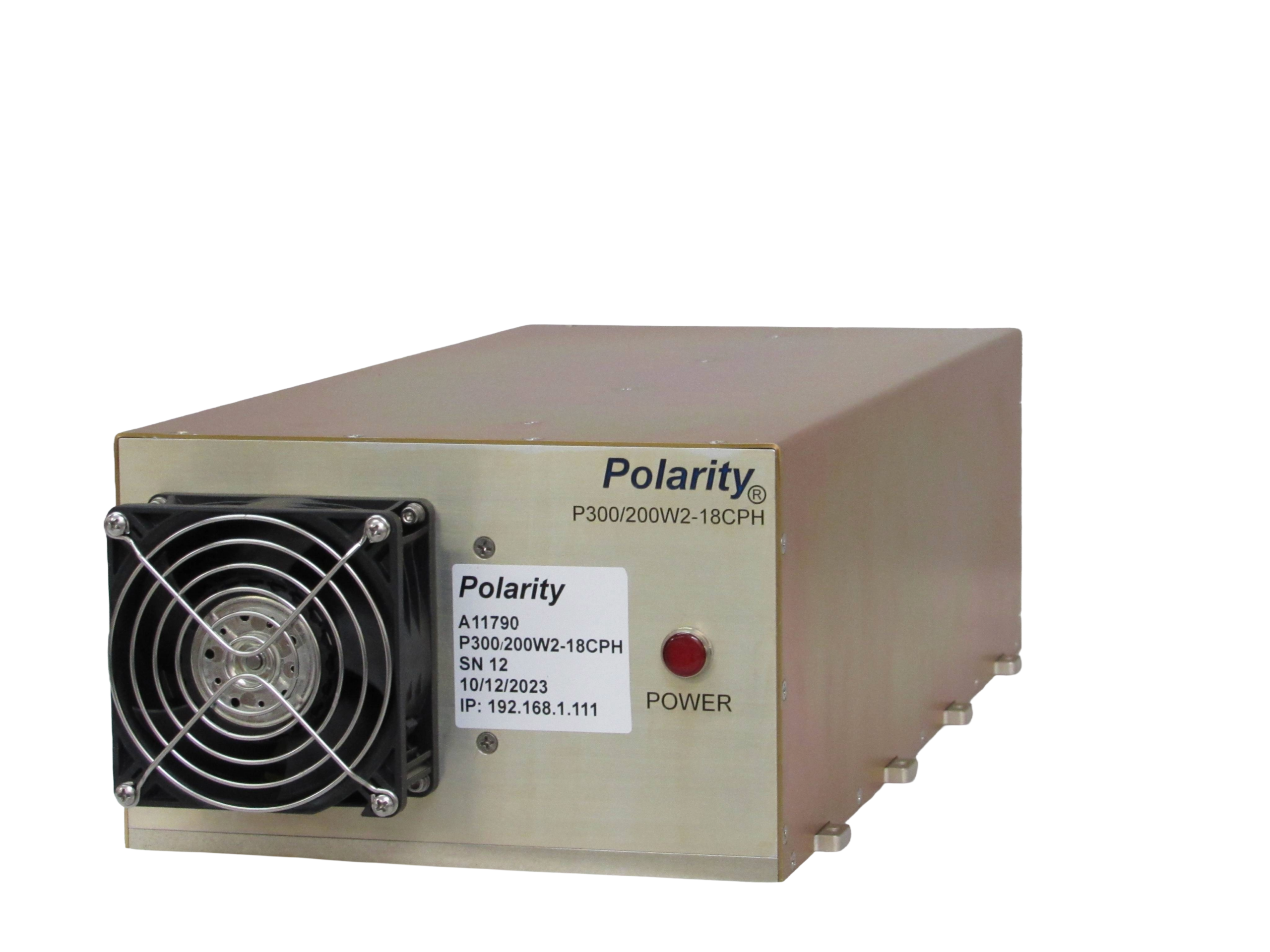
Consider the P300W2-20CP. Polarity describes a solid-state amplifier covering 2 to 20GHz, with 300 watts of saturated output. It combines gallium-nitride amplifier devices in a rack-mounted package with forced-air cooling, an internal driver, and Ethernet and RS485 interfaces. Those details identify a working instrument, with a place to live and a way to be controlled.
The tube-based POL1000Ka answers a different brief: 34 to 36GHz, 1,000 watts of peak output, greater than 10 percent duty cycle, and conduction cooling. Peak output and sustained output answer different questions. A reader comparing equipment has to keep the operating conditions attached to the number. Remove them, and the headline wattage becomes a poor shopping guide.
Solid state · forced air
TWT · conduction cooled
Different bands and operating conditions. These ratings are not a performance ranking.
Nor does Polarity’s mix of tubes and solid-state devices establish an exclusive technological advantage. Communications & Power Industries also sells microwave amplifiers, including TWT equipment. Polarity’s pitch rests on its engineering breadth and willingness to tailor the system. The meaningful comparison happens against a customer’s requirements, where cooling, frequency, packaging, and controls can matter as much as output.
03 / A flying machine with a power cord
The drone tether makes the tradeoff visible. Polarity’s TPS500-3KW connects ground equipment to an aircraft through a 500-foot tether. The published output at that distance is 3kW average and 5kW peak, with 24V or 48V options. Its 2017 announcement describes a 1Gbps communications link that can be multiplexed into four channels. Electricity and information travel together.
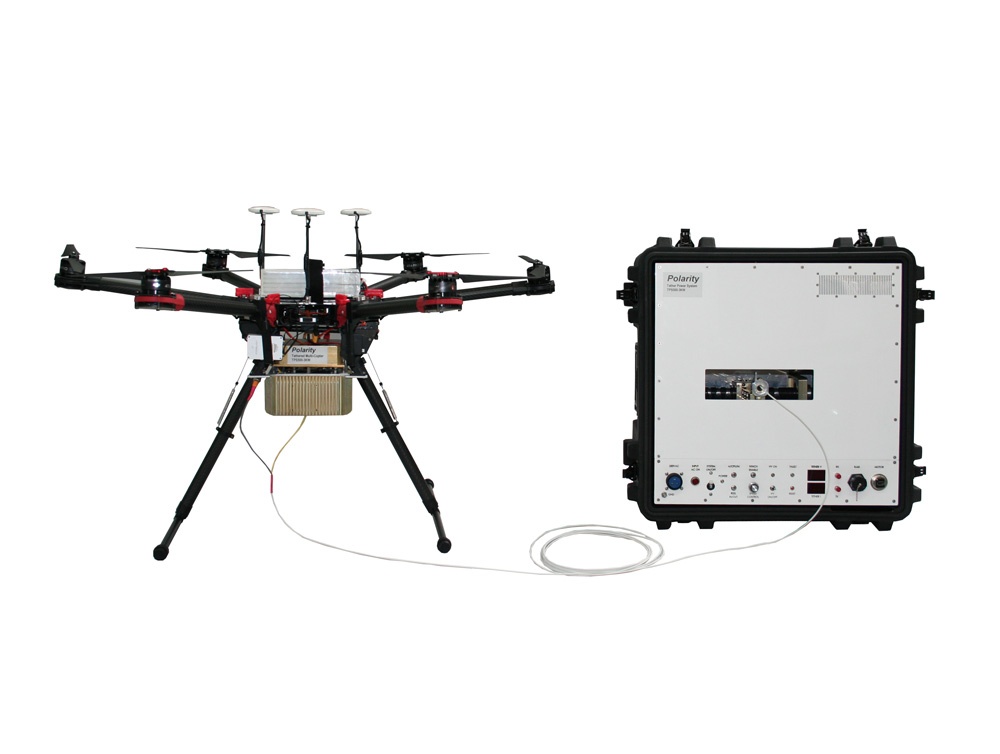
The ground unit accepts 240VAC single-phase power; Polarity recommends a 6kW generator. The winch offers autonomous, manual, and adaptive modes, while the protection list includes arc detection and backup battery management. The apparent simplicity of plugging in an aircraft conceals a collection of power, cable-handling, and control problems.
For a mission that can stay close to its ground station, that architecture offers an alternative to relying only on onboard energy. It also imposes a physical boundary. The aircraft remains connected to a cable and a power source. A buyer who needs unrestricted travel has a different problem to solve. The tether’s appeal depends on accepting that bargain.
The same catalog includes solar inverters and converters for charging and discharging high-voltage energy storage. These are different applications of power electronics, with different customers and operating requirements. Their presence helps explain why calling Polarity simply a drone company or a radar supplier would miss much of its work. The common thread is the electrical system.
04 / Sell the whole operating envelope
Polarity’s business model follows the hardware: standard products and custom systems sold to organizations through technical sales and regional representatives. Its custom menu includes different supply inputs, cooling methods, enclosures, and interfaces. A commercial applications page says working prototypes can typically be produced within weeks for proof of concept. That is a company claim about early development, not a promised production schedule.
“Built to operate 24 hours a day, 7 days a week, 365 days a year.”
Polarity’s POLA11590MTTS datasheet
Inside that test set, the selectable configuration matters. The published design supports one to four collectors, pulse and continuous-wave operation, and a cathode supply range of 1 to 15kV. Optional functions include a fast warm-up heater and a high-speed grid modulator. A tube manufacturer can discuss the test setup as a coordinated system rather than assemble a wish list of disconnected supply ratings.
The test-set datasheet’s round-the-clock design claim explains the emphasis on protection and maintainability. The military applications page adds shock, vibration, temperature, altitude, humidity, salt fog, and fungus to the requirements. An amplifier has to keep doing its job after the laboratory has disappeared around it.
There is a practical lesson here for anyone specifying equipment. Write down the input source, cooling provision, frequency range, peak and average demand, control interface, and fault response together. Polarity’s product sheets make those dependencies visible. Back at the test bench, the three-microsecond specification earns its place beside the seven kilowatts: the power and the protection are parts of the same purchase.