Consider what happens when a pharmaceutical company hires a doctor to advise it. There is the work itself. Then there is the work around the work: choosing the physician, checking the relationship, approving the fee, signing the contract, recording the payment and preparing the disclosure. Polaris built its business in that second category. The scientific conversation might last an afternoon. The administrative trail has a much longer itinerary.
- Polaris connected life sciences compliance advice with software and managed services.
- Its products followed healthcare professional engagements from planning through payment reporting.
- Subscription revenue helped fund growth before the company joined IQVIA in 2017.
That choice of territory matters. Polaris served pharmaceutical, biotechnology and medical device manufacturers, businesses where a commercial interaction can involve several departments and different national requirements. Its opportunity lay in making the recurring process manageable. A report at the end was useful; a process that collected the right information along the way was more useful still.
The first bottleneck was the business model
Andy Bender started Polaris in 2001 as a healthcare law compliance consultancy. In a 2022 EisnerAmper interview, he described an early frustration familiar to anyone who has sold professional time: finding the next assignment while keeping the team occupied. The company could solve a client’s problem and immediately face a problem of its own. Where would the next project come from?
“You’re constantly chasing the next part of revenue.”
Andy Bender, recalling the consulting model in 2022
Subscriptions changed the planning horizon. Polaris could package recurring work into software, collect recurring revenue and invest beyond the next engagement. Bender’s investment firm later described a self-funded business that reached about $40 million in revenue before its sale. That is a historical, founder-reported figure. The interesting mechanism is straightforward: operating cash helped pay for further product development.

Follow the doctor’s payment
By April 2016, Polaris was describing its Global Compliance Platform as a hosted service covering the sequence from needs assessment to transparency reporting. Three life sciences manufacturers had selected it, the company announced. Advisory boards, consulting arrangements, speaker programs, grants and investigator research all generated workflows the platform could help administer.
- 01Establish
the need - 02Check the
professional - 03Approve
and contract - 04Reconcile
and report
Earlier product names reveal how the business divided the problem. HIP, the Healthcare Professional Interaction Portal, handled engagements, contracts and payments. STAR, Spend Tracking Analytics and Reporting, addressed aggregate spending and transparency. A Third Party Due Diligence Portal extended screening beyond the traditional offering. These were specific administrative jobs, with specific users and consequences.
Fair market value was another piece. Polaris developed a methodology and online tool for compensation decisions; its September 2016 announcement described rates covering more than 90 countries. The attraction was a repeatable way to approach a question that otherwise returns every time somebody asks what a professional should be paid.
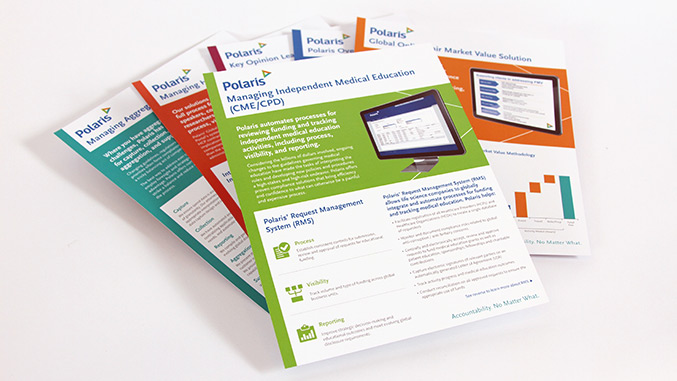
For the customer, the benefit was continuity. Information collected when an engagement was proposed could remain useful when the contract was prepared and the payment reconciled. That is the logic of connecting these steps: fewer handoffs that require somebody to reconstruct the story from scattered records. The platform still needed the company’s policies and people, but it gave their work a common route through the organization.
The people came with the platform
The software did not arrive alone. Polaris also offered consulting, implementation and managed services. Its consultants mapped processes, developed policies, trained teams and assessed risk. The distinction is practical. A company can buy a system and still struggle to decide who approves a request, which information belongs in it or how employees should use it.
Polaris’s positioning put specialist knowledge near the product. In a 2014 interview, Bender described consulting as a way to anticipate customer needs and regulatory developments. The proposition was that experience gained in one assignment could improve a tool used across many assignments. Customers bought software, but the company also helped them make it work inside an organization.
That places Polaris in a particular market: commercial compliance for life sciences. Today, overlapping choices include qordata’s compliance platform, MedPro’s transparency tools and Veeva’s event-management software. Those alternatives illustrate the buyer’s decision. A team might need reporting, event administration, consulting or several connected services. The relevant comparison is the workflow the buyer needs covered.
A useful buying question follows: who will do the work after installation? Someone still has to maintain the process, handle exceptions and train new users. Polaris’s combination offered customers several ways to answer that question within one relationship. For a manufacturer with an established internal team, software might fill a gap. For a stretched team, implementation help and ongoing services could matter just as much as the application’s features.
An office opened because customers asked
Polaris’s September 2016 Hong Kong announcement contains a useful detail. Bender said existing clients had requested an office to support their regional businesses. The expansion followed demand already visible in customer relationships. Hong Kong joined an office network that included New York, Amsterdam, Boston, Paris and San Francisco.
Top pharmaceutical companies included in Polaris’s historical customer portfolio, according to H1’s 2021 announcement about co-founder Marc Eigner.
That same announcement listed ten leading biotech and five leading medical device customers. These retrospective claims give a sense of the company’s enterprise reach. They also explain the international problem: a manufacturer working across borders needs processes that travel, while accommodating local requirements. Consistency and local detail have to occupy the same system.
The repeatable part is the lesson
QuintilesIMS acquired Polaris in 2017; the buyer is now IQVIA. Polaris’s LinkedIn page directs visitors to its parent. The combination of technology, advice and operational support remains visible in IQVIA’s commercial compliance offering, which includes fair market value, healthcare professional engagement, grants and transparency services.
For another services business, the useful lesson begins before software development. Look for the assignment that keeps returning. Identify which decisions repeat, which information must be retained and which steps can be standardized. Polaris’s history suggests that proximity to the customer’s daily work can provide the product brief.
The conditions matter. A recurring need must exist, the workflow must be reusable, and people must supply reliable information and judgment. A bespoke assignment may never justify a subscription product. Polaris found a category where the work kept coming back. Its achievement was to make more of that work reusable each time.