The most revealing object in Pitchblend’s recent portfolio is not a press release. It is a lattice. For an adidas Climacool event in New York, the agency built a three-dimensional structure that responded to audio, then wrapped it in projection mapping and real-time visual effects. As the DJ played, the room appeared to breathe. More than 150 creators attended. The shoe’s 3D-printed design had escaped the shoe and occupied the air.
This sounds like the work of an experiential studio, until you notice what the object was really doing. It gave the guests a picture to make, editors a frame for the product story and social feeds a moving image that explained innovation without a paragraph of technical copy. The installation was not decoration around a communications campaign. It was the campaign’s most legible sentence.
Pitchblend is a privately held creative brand and visual communications agency founded in 2006 by Mi-Ya Han. LinkedIn places its headquarters in Manhattan, lists a Los Angeles location and puts the company in the 11-to-50-employee range. Han herself is based in the San Francisco Bay Area. Geography, like discipline, is distributed. The public work travels through New York launches, Miami race weekends, Coachella, a basketball tour in China and the adidas campus in Germany.
“PR, reimagined for the visual age.”Pitchblend on SocialPR
01The agency with four jobs
On paper, Pitchblend sells four groups of services. Brand Communications + Amplification covers familiar agency work: campaign planning, message architecture, copy, media relations and editorial placement. SocialPR, the company’s registered label, combines editorial thinking with platform-native visual content, creator partnerships and distribution. Talent Curation + Contracting handles the unglamorous machinery of outreach, negotiation, payment and checking deliverables. Multimedia + Experience takes in 2D and 3D motion, films, XR, projection mapping, installations, live events and real-time rendered animation.
The list is broad, but the logic is narrow. Each capability fixes a handoff. A conventional PR agency may conceive a story, then wait for a production partner to make it visible. A creative studio may build a beautiful room, then discover there is no editorial reason for anyone outside it to care. A creator shop may book reach without giving those creators much worth saying. Pitchblend keeps those dependencies close enough that the message can influence the object, and the object can improve the message.
02The stunt is only as good as its exits
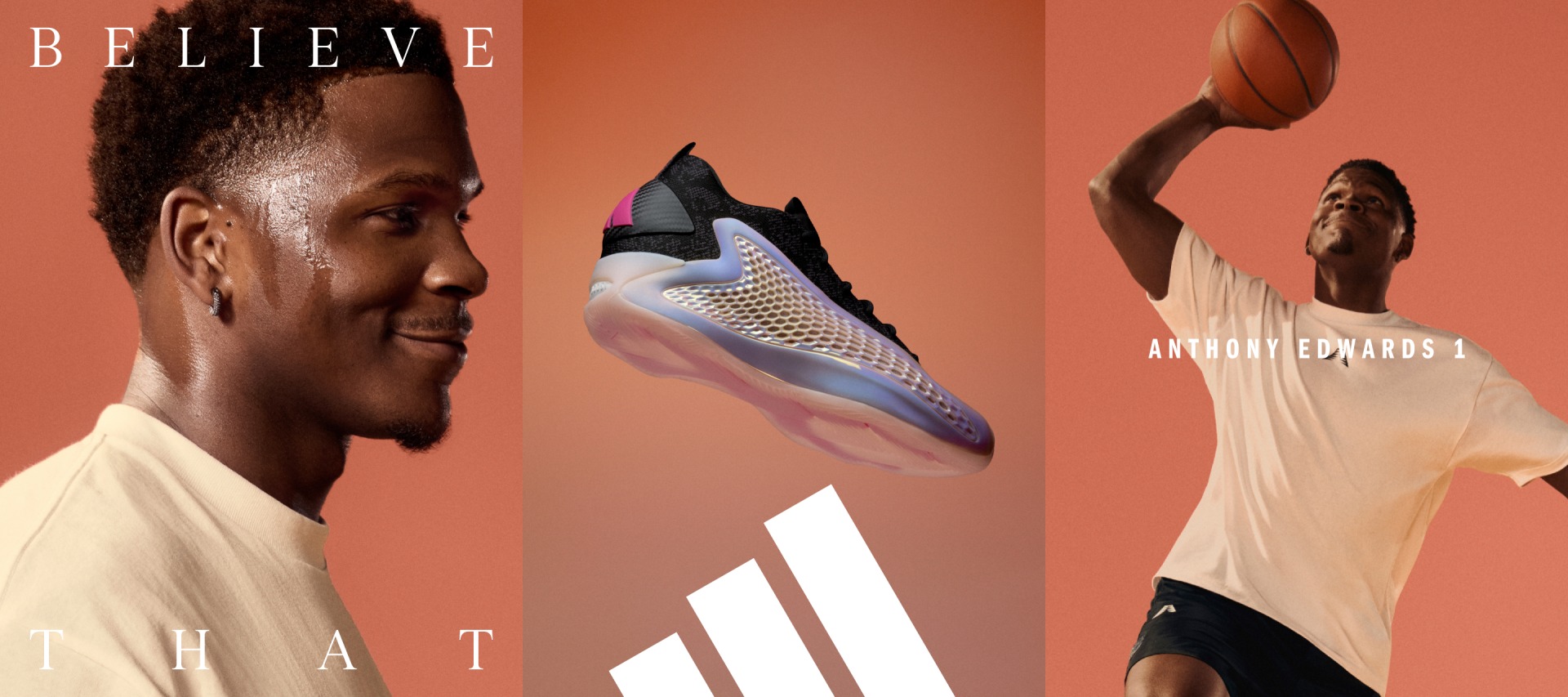
Consider the launch of the Anthony Edwards 2 basketball shoe. Pitchblend says it combined media strategy with a coordinated run of one-to-one editor interviews during Edwards’s first China tour with adidas Basketball. The result, as reported by the agency, was 103-plus earned placements and 7.3 billion impressions across sport, sneaker, fashion and culture titles. The striking detail is not merely the size of the number. It is the number of exits built into one moment. An athlete tour became an interview, a product reveal, a performance story, a sneaker story and a culture story.
Anthony Edwards 2
adidas × Bad Bunny
Formula 1 Miami
The same pattern appears in other assignments. For a 2023 adidas program around Bad Bunny and Coachella, Pitchblend reported more than 800 million impressions across 319 earned placements. Around Formula 1 Miami in 2025, media access, a Tyshawn Jones and Toto Wolff “skitching” moment, creator hosting and yacht-side interviews produced more than 150 placements, according to the agency. At HYPEBEAST’s 20th anniversary in New York, Pitchblend was hired to curate and manage the guest list. In that setting, the list was not administration. The people in the room were the editorial medium.
03Culture is a permission system
Pitchblend describes itself as “born from subculture and built for enterprise.” It is a tidy phrase for an awkward commercial problem. Large companies want the speed, taste and credibility of small scenes. Small scenes are exquisitely alert to the arrival of a large company wanting those things. The agency’s product is partly translation, but translation is not enough. It is closer to permission design: choosing the right collaborators, references, media and setting so a brand can participate without flattening the thing it came to borrow.
That is where a two-decade operating history matters. Pitchblend’s trademark filing claimed first commercial use in 2008; the company celebrated its 20th anniversary in 2026. Its public client marks include adidas, Air Company, Beyond The Streets and CCS. The work spans sport, fashion, technology, street culture and entertainment, categories in which audiences notice the difference between a fluent reference and a mood board assembled on Tuesday.
Choose the people who will carry the story before you build the thing they are meant to carry.
The useful part of this model is available even to a team that cannot commission a projection-mapped lattice. Start with one cultural tension, not a bag of messages. Decide which editors, creators and communities have permission to interpret it. Give each group access or material suited to its medium. Build a physical or digital moment that produces evidence of the idea. Then measure the paths separately: placement quality, creator response, audience behavior and the life of the assets after launch.
It works poorly when the brand has no credible reason to enter the conversation, when approvals sand every sharp edge off the idea, or when spectacle arrives without a distribution design. The method also depends on coordination. Talent payments, media windows, technical rehearsals and product logistics are not supporting details; one missed handoff can make an integrated campaign feel like four unrelated vendors standing in the same room.
04The machinery under the taste
A current Pitchblend job description is unusually instructive. Alongside drafting releases and researching journalists, a coordinator may track samples, help run events, manage guest lists, work through transport and vendors, capture performance data and support setup and breakdown. The glamour of cultural communications turns out to involve spreadsheets, shipping labels and the ability to lift 40 pounds. That mundane range explains how the agency’s ambitious menu can function.
The same combination appears in its Alpine A390 work. Pitchblend says cinematic 3D scenes were processed through a bespoke point-cloud generator built in Three.js, then composed in TouchDesigner with real-time 3D tools. “Weightless Energy,” Alpine’s theme, was expressed as a visual behavior rather than pasted on as copy. This is specialist production, but its purpose remained communicative: make a technical vehicle feel like its premise.
Pitchblend sits in a crowded market between PR consultancies, creator agencies, experiential studios and in-house communications teams. A client could buy each capability separately, and sometimes should. The case for Pitchblend is strongest when the launch depends on all of them sharing a nervous system - when the guest list affects the creative, the creative affects the pitch and the pitch affects what must happen in the room.
The company’s real product is not attention. It is continuity: the same idea surviving every surface it touches.YesPress analysis
That is a less romantic claim than “moving culture,” but a more useful one. Attention is rented by the impression. Continuity is designed. Twenty years after Pitchblend began, the press release is still alive. It simply has a DJ now, and sometimes it glows.