Phil Bartos enjoys the numbers. He has said so himself, with the faintly mischievous air of someone confessing to a hobby his employees might find difficult to understand. Growth forecasts, profit calculations, weekly reporting: he likes this part of running a business. He also thinks putting those figures on a screen is a poor way to get everyone else excited. A superhero movie, on the other hand, has possibilities.
In 2017, the founder and CEO of NarraSoft proposed a different way to talk about financial goals. Translate the target into something people can picture. Set aside some of the additional profit for a shared experience. Take the company to a film. Or, if the executives feel sufficiently adventurous, have them serve dinner to the staff. The spreadsheet could keep its job. It simply needed a more interesting social life.
That small argument opens a useful door into Bartos's career. Based in Cary, North Carolina, he leads a business with operations in the Philippines, bringing together software development, digital art, animation and business support. These are services people often describe in the language of efficiency. Bartos keeps returning to the people expected to produce it.
Before NarraSoft, a much larger map
Bartos graduated from Baylor University's Hankamer School of Business with a Bachelor of Business Administration in Management and Marketing. His working background includes Accenture, Computer Sciences Corporation, TELUS and Siemens. Before putting his own company's name on the door, he had spent years inside the consulting and outsourcing businesses that help other companies organize their work.
The geography was extensive. His experience included operations in the Philippines, India, Thailand, Russia, Mexico and Mercosur. He entered the Philippine outsourcing market in 2003, six years before launching NarraSoft in 2009. That sequence matters. The founder arrived with experience of the industry and of the country where his company's operating team would be based.
There is a particular kind of entrepreneurial story in that progression. The interesting move is from working within large organizations to taking responsibility for a smaller one. A corporate background offers familiarity with complex operations. A company of your own asks whether those habits will work when the clients, staff and decisions are yours to answer for.
The people behind the game credits
NarraSoft's work crosses a useful boundary between technical execution and visual imagination. Its services include software and web development alongside 2D and 3D art, animation, mobile applications and games. A developer and an artist may work on the same product while seeing very different problems. Running a company that employs both means making room for both kinds of attention.
Bartos's own name appears in video-game credits. Infinifactory, released in 2015, lists him under NarraSoft art; Warhammer: Doomwheel, released in 2017, includes him in its special thanks. The distinction is worth keeping. A credit connects him to the work without turning the CEO into the individual creator of everything the studio makes.
Those entries also give an otherwise abstract business a concrete setting. Outsourced work ends up inside something somebody plays. A player sees the finished world, the characters and the machinery. Behind that experience sit people whose names may pass across a credits screen long after the difficult production decisions have been made.
Trust, in installments
When Bartos wrote about offshore software development in 2019, he resisted prescribing one arrangement for every customer. A bounded project can suit an organization with intermittent needs. A dedicated team makes more sense when the work continues through the year and the requirements evolve. His argument begins with the actual pattern of work.
He gives continuity a practical value: developers accumulate knowledge of a client's culture and processes. They stay available for that client's tasks. Over time, colleagues become more familiar with one another. In his account, camaraderie helps the communication on which software work depends. The relationship becomes part of the working infrastructure.
“There is very real value and strength in human camaraderie.”
Phil Bartos, on dedicated software teams, 2019
Bartos also acknowledges the awkward question underneath the purchasing decision: can a client trust a team it has not worked with? His proposed answer is a low-risk activity and a pilot lasting 90 or 120 days. Let the two sides learn how they work together before expanding. It is a measured courtship, with rather more bug fixes.
- 01Choose one
low-risk activity - 02Work together
for 90-120 days - 03Build trust
before expanding
A budget with a better invitation
His thinking about employees has the same preference for something tangible. In the 2017 piece about financial goals, the cinema outing and executive-served banquet were suggestions, rather than a report of events already held. Their appeal lay in giving the team a reason to care about a target beyond the target itself.
The joke at the beginning of his argument was aimed at fellow executives and business-school professors, whom he asked to be patient before becoming alarmed. He knew the proposal might sound frivolous. He also knew precisely which management machinery he intended to keep. Reporting and fun could share an office without either having to surrender its desk.
His views on loyalty are more demanding. In a 2019 essay opposing counteroffers, he argued that employees should find purpose, community and career progress at work. He also put responsibility on employers to compensate and support their people before a competing offer arrived. The cinema-ticket version of Bartos is genial; the employment argument has sharper elbows.
It would be too tidy to turn all of this into a formula. A company outing cannot tell the whole story of a workplace. What his writing does show is a leader who repeatedly links the quality of the customer relationship to the experience of the people doing the work.
The anniversary came with karaoke
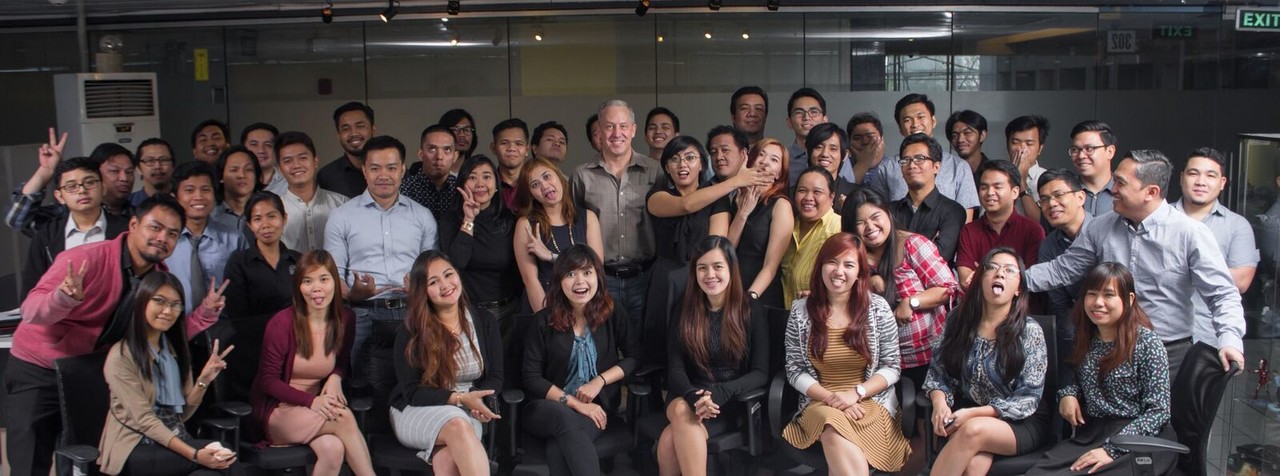
In September 2019, NarraSoft reached ten years in business. Management invited all eighty employees to a celebratory weekend at Acuaverde in Laiya, Batangas. Bartos's account includes a four-hour journey, beach games, swimming, banana-boat rides, a bonfire and karaoke. Annual-report prose rarely gets quite so close to a microphone.
He even found room for a traffic joke, comparing the drive with the time it could take to get from Manila's airport to Ortigas. The weather cooperated despite the season. In his telling, the weekend was about participating as much as watching: teams competed, colleagues played, and a business anniversary became time spent together.
This is where the earlier management proposal acquires a real setting. Two years before, he had suggested making financial achievement legible through experiences. Now the milestone had a beach attached. The detail is modest, but revealing. He chose to describe the tenth anniversary through what employees did together.
A student gets a beginning, too
The company's education initiative had another kind of time horizon. In June 2018, NarraSoft fully funded its first student through a scholarship program called Narratives. Bartos described its purpose as helping young people shape their futures through higher education. He expressed the intention to support more students as the company grew.
His involvement with learning also extended to North Carolina. From 2010 to 2021, he served on the board of the Museum of Life and Science in Durham, including its governance and development committees. It is a different institution from an outsourcing studio, but another place where organizing resources helps people learn and make discoveries.
There was an entrepreneurial version of opening a door as well. In 2018, Bartos described Bright Knight Ventures as an arrangement for people with app or game ideas and limited initial funding. The proposed exchange was development at labor cost, with initial profit forgone, in return for a negotiated share of future revenue. The invitation came with an actual business mechanism.
Still a student underwater
Bartos's own learning has a less office-bound side. His diving qualifications stretch from a PADI Open Water certification in May 1990 to freediving in 2021 and several SDI qualifications in 2022. His profile lists deep, drift and wreck diving, along with Master Diver. The sea has occupied a place on his calendar for decades.
In March 2018, he was also in the audience for Tom Chi at the Hive Entrepreneurial Summit in Scotts Valley. He came away enthusiastic about rapid prototyping and the possibility of shortening product-development testing. Even while running a business, he was spending a weekend listening to someone else's approach to making things.
Neither detail needs to become a grand theory of his character. They are enjoyable particulars: a business graduate who keeps collecting diving qualifications; an outsourcing executive interested enough in testing ideas to attend a presentation and recommend it afterward. A person has a life between the job titles.
The work after the idea
By June 2025, Bartos was explaining another part of NarraSoft to gaming clients: player support. Some clients, familiar with its art and development work, had been surprised to learn the company also handled gameplay questions, billing inquiries, account security and community management. Even an established business occasionally has to introduce itself again.
In March 2026, Raleigh-Durham Startup Co. featured him as a founder and investor in Triangle startups, with NarraSoft supporting the Strategy Track at Raleigh-Durham Startup Week. His concern was the work of executing at scale while keeping a business lean. “Strategy is where most startups fail,” he said.
It is a fitting present-day concern for someone whose career has moved between corporate operations, a company of his own, and the everyday business of bringing distant colleagues into the same effort. The idea gets people interested. Then come the team, the testing and the trust. If things go well, Bartos has already offered a suggestion for the celebration. Someone should check what is playing at the cinema.