A missing sock is a modest commercial opportunity. Most clothing companies would suggest buying another pair. At Coolmate, the Vietnamese apparel business co-founded by Pham Chi Nhu, replacing the missing half has been part of the service. Somewhere between the washing machine and the wardrobe, an everyday nuisance becomes a chance to be remembered. The gesture is small enough to sound silly. That is part of its charm.
Nhu has larger ambitions, including a Vietnamese brand with customers beyond Vietnam. He has raised venture capital, expanded into women’s activewear and opened a physical shop after years of building online. Yet the spare sock gets close to the question underneath those developments: what would persuade someone to choose this company again, when the internet contains a practically inexhaustible supply of T-shirts?
For Nhu, the answer has involved ownership of the whole experience, including its least glamorous parts. An advertisement can make a garment desirable. A refund can make its seller believable. His career has become an extended attempt to get both sides of that bargain working at once.
Before the sock, a false start
Born in 1991 in Que Vo, Bac Ninh, Nhu studied finance and banking at Hanoi’s Foreign Trade University. His early career included financial control work at Deloitte Vietnam. He wanted a business of his own, particularly one connected to Vietnamese production. The ambition preceded the successful company; the operating knowledge took longer.
In 2017 he started Basic Wear 4Men, selling men’s clothing largely through online marketplaces. He worked without a co-founder. The venture lasted about two years and failed. Watching the American edition of Shark Tank had helped kindle his enthusiasm; Mark Cuban was a particular favourite. Television supplied encouragement. Running a business supplied the less agreeable education.
What mattered about the failure was how specifically he described it afterward. The operation lacked the financial organisation, independent sales channel and broader team he later wanted to build. He had encountered a promising market without yet assembling a company equipped to serve it. His next attempt would require other people, clearer responsibilities and something more durable than a seller account.
Three founders and a very small warehouse
Coolmate began in March 2019 with Nhu as CEO, Nguyen Van Hiep as CTO and Nguyen Hoai Xuan Lan as CMO. Their starting equipment included a basic website and a warehouse of about 20 square metres. The products were similarly unceremonious: T-shirts, socks and underwear. A wardrobe’s supporting cast had been given its own company.
The division of labour mattered. Nhu’s previous attempt had concentrated too much in one person. Here, technology and marketing had fellow founders attached to them. The proposition was also narrower than a department store’s: make everyday clothing easy to buy, with enough attention to product and service to give customers a reason to remember the name.
Those early limitations are useful to keep in view as the company grows. A website gives a young brand a place of its own, but no automatic audience. A warehouse provides somewhere to put stock, but no guarantee it will leave. The founders were taking on the unromantic work of earning each transaction before they could worry about becoming an international name.
Sixty days to change your mind
Coolmate’s returns policy grew from an observation about online shopping: buyers were being asked to take too much on faith. A photograph could promise one thing and the parcel deliver another. Returning a disappointing purchase could become its own chore. Nhu’s response was to make the promise unusually easy to test, extending an initial 45-day return window to 60 days.
That offer included clothes customers had already worn. The obvious objection almost writes itself: what happens when someone returns a shirt on day 59? Nhu has acknowledged that some customers repeatedly exchange items. His approach has been to watch the level of misuse while preserving the benefit for the larger group. Trust has a cost; he treats it as something a business can measure.
This makes the spare sock easier to understand. A replacement or a straightforward return gives the customer a story to tell about a company whose products otherwise look familiar. Plenty of businesses can photograph a plain shirt attractively. The interesting competition begins when something goes wrong and a person asks for help.
A return window that gives the buyer time to test the promise.
The label is the easy part
Nhu’s international ambition begins with an observation close to home. Vietnam makes clothing for familiar foreign brands. He wants Vietnamese businesses to capture more of the work around manufacturing: research, design, a recognisable name and a lasting relationship with the buyer. Printing an origin label is a much smaller undertaking than building those capabilities.
Coolmate’s production model connects local suppliers rather than assuming that one factory can solve every problem. Nhu has described the difficulty of coordinating the materials for even a single jacket. The apparent simplicity of a finished garment conceals negotiations over fabric, trims, construction and consistency. Customers are entitled to ignore all of that. The company cannot.
In 2024, he described his intended customers in disarmingly ordinary terms: “Essentially, our customers are people like me.” They wanted functional clothing with restrained designs at accessible prices. That self-recognition gives the business a starting point. Continuing to understand people whose wardrobes differ from his own is part of the next job.
“Essentially, our customers are people like me.”Pham Chi Nhu · 2024
When a bestseller is still an experiment
Outside investment has widened the room for that work. Coolmate announced a $6 million financing in 2024. In November 2025 it announced a Series C led by Vertex Growth, with Cool Japan Fund and YoungOne CVC among the participants. Cool Japan Fund separately disclosed a $10 million investment decision. That figure describes its participation, rather than the size of the entire round.
The expansion programme had three practical directions: women, international markets and physical retail. Women’s activewear launched in March 2025. Sports socks became an early product on Amazon in the United States. Neither move could be judged simply by how confidently it was announced; both would need repeat purchases and workable economics.
By his 2026 Vietnam Innovators conversation, Nhu was discussing that distinction quite plainly. Success in a small Amazon category did not automatically produce profit. After more than a year of trying different approaches, the US operation had only gradually moved closer to breaking even. The distance between a favourable sales badge and a sustainable business is large enough to swallow a promotional campaign.
His response to the problem of stock is equally practical. Smaller production tests, customer surveys and pre-orders help the company learn before committing to bigger runs. For a founder, that means accepting a less theatrical form of progress: making fewer expensive guesses. The unsold shirt occupies real space regardless of how persuasive its launch presentation was.
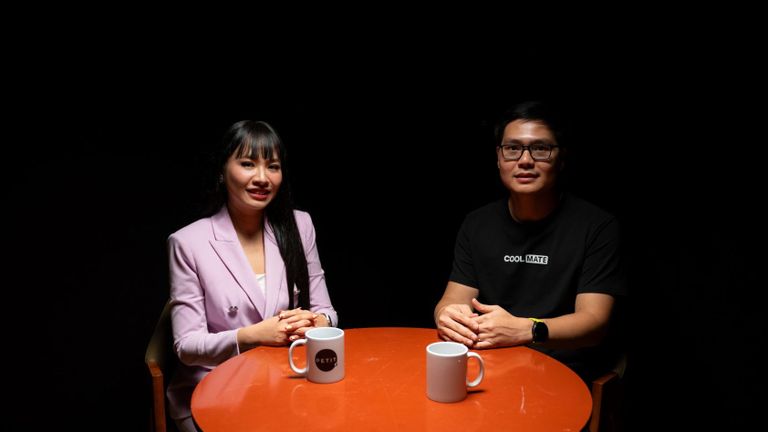
Opening the door, then answering for the work
In March 2026, Coolmate opened its first store at Hanoi Centre. Nhu described the undertaking as another round of first attempts: creating a retail space, developing a store concept with Vietnamese design partner SIS and introducing RFID into store operations. He said the technology had been deployed in 30 days by a Vietnamese partner. The shop gave an online business a new set of physical particulars to master.
There is a pleasing complication here. Earlier discipline had meant keeping the business focused online. Expansion now meant learning when to revise that choice. Customers could touch the fabric and try the clothes, but the company also had a room to operate and a different kind of service to get right. A shop puts the promise within reach of a hand.
Growth has also exposed failures that require more than a generous returns policy. In June 2026, Coolmate acknowledged that it had used Tao Creative Studio’s Happy Uncles artwork on a commercial T-shirt without permission. The company apologised and suspended sales of remaining stock from a production run of 1,138 items. Its internal review placed responsibility for the mistake with Coolmate.
For a company asking buyers to value the work behind a Vietnamese brand, that admission matters. Original design and responsible production have obligations attached. The apology belongs in the same story as the service gestures and expansion plans: the credibility Nhu wants has to survive scrutiny of how the products are made, including whose creative work appears on them.
A company that can think without him
Away from the expansion announcements, Nhu describes a fairly ordered start to the day: take his three children to school, have breakfast and reach the office before 8:30. He also plays table tennis or pickleball with colleagues and friends. These are ordinary details, but they give the founder a life beyond the succession of funding rounds that can otherwise flatten a business biography.
His account of leadership has changed as well. He now spends more time on direction, recruiting and helping the leadership team remove important obstacles, with less attention to routine daily operations. The desired result is an organisation capable of making good decisions when he is absent. Anyone who began by doing almost everything has reason to appreciate that ambition.
The next markets will test how much of Coolmate travels. A familiar service promise in Hanoi may need different explanations elsewhere. A product that wins an initial order still has to earn its place in the next shopping basket. Nhu’s international plans ask a larger audience to judge the proposition he first tested with everyday basics.
The missing sock remains a useful place to end up. It is specific, comprehensible and just inconvenient enough for a customer to appreciate the solution. Across stores and borders, the business will accumulate far more complicated decisions. Nhu’s task is to build a company that can keep making them with the same attention to the person opening the parcel.