Peter Orszag went to Princeton intending to study public policy. Then an introductory economics assignment gave him something more useful than a tidy career plan: a professor who noticed how he thought. Asked to dissect a newspaper editorial, he spotted a leap in the argument. Alan Blinder marked his paper approvingly. Years later, Blinder helped bring him into the Clinton administration. A close reading had become an introduction.
There is a pleasing economy to that beginning. Orszag would spend much of his working life examining the distance between a confident proposition and the evidence supporting it. Government budgets, retirement policy, corporate strategy: each offers plenty of opportunities for an assumption to put on a good suit and pass itself off as a fact.
Today he runs Lazard, the financial advisory and asset management firm founded in 1848. His job involves advising people who must commit money before the future has had the courtesy to explain itself. The economist who studied uncertainty now has employees, clients, and shareholders waiting to see what he does with it.
The education of an uncertain economist
Born in Boston in 1968, Orszag grew up in a household shaped by his father Steven's mathematical work. Public affairs caught his attention early. As a school student, he read the newspaper and listened to Boston talk radio. Government was already an absorbing subject before it became an employer.
His academic route looks exceptionally orderly on paper: Phillips Exeter, Princeton, a Marshall Scholarship, the London School of Economics. Princeton awarded him an economics degree in 1991, summa cum laude. At LSE he earned a master's in 1992 and a doctorate in 1997. Such a list can make a life resemble a railway timetable. The subjects he chose reveal more than the stops.
His undergraduate thesis concerned congressional oversight of the Federal Reserve. His doctoral thesis examined regime changes under uncertainty, with applications to hyperinflation and privatization. Even the titles contain the outline of a continuing preoccupation: what happens when economic calculations collide with public institutions and decisions that cannot easily be undone?
The dissertation considered why policymakers might delay acting despite the apparent costs of waiting. One chapter examined stabilization during hyperinflation; another explored a proposed privatization involving the U.S. Enrichment Corporation. Efficiency mattered, but so did incomplete information and nuclear nonproliferation. A price could be calculated. A decision still required judgment.
“Everything’s relative in life”
Peter Orszag, reflecting on his mathematical upbringing
That dry observation is a useful corrective to the polished résumé. He could recognize his own mathematical ability while recognizing that his father's existed on another plane. The comment has a little of the economist's instinct to ask: relative to which comparison?
Two offices, two different obligations
Orszag's early government career included the Council of Economic Advisers under Bill Clinton and service as special assistant to the president for economic policy. These jobs placed economic analysis inside an institution where a technically elegant answer has to survive competing priorities, timing, and persuasion.
He also built a life in policy research. At Brookings, his work ranged across taxes, pensions, and the federal budget. He co-founded and directed the Hamilton Project. With Peter Diamond, he wrote Saving Social Security: A Balanced Approach, first published in 2004. The book offered a detailed reform plan rather than treating retirement finance as a contest in ominous adjectives.
The authors examined how to preserve the program while addressing its projected financing problems. Their updated edition engaged with individual-account proposals and changes to benefit calculations. This was the patient business of showing how a proposal works, who it affects, and where its arithmetic leads. Whatever one's preferred answer, the exercise requires more than a stirring speech about future generations.
In 2007, Orszag became director of the Congressional Budget Office. In January 2009, he moved to the Office of Management and Budget under Barack Obama. The similar names conceal an important change in responsibility. CBO supplies nonpartisan analysis to Congress. OMB serves the president and helps turn an administration's priorities into a budget.
The move also put him inside the executive branch during the financial crisis and its aftermath. Economic recovery and federal finances had to be considered together. The attraction of a model is that one can isolate a variable. The inconvenience of governing is that the other variables keep arriving at the door.
He left OMB in 2010. His subsequent career would carry him from evaluating public choices to advising private institutions, but the questions traveled well: what is the evidence, what could change, and how much room does a decision leave for being wrong?
Wall Street acquires a policy vocabulary
At Citigroup, Orszag became vice chairman of corporate and investment banking and chairman of its Financial Strategy and Solutions Group. He joined Lazard in May 2016 as a vice chairman of investment banking. By 2018 he was leading North American mergers and acquisitions; in 2019 he became CEO of Financial Advisory.
Those intermediate roles matter. His appointment to lead the whole firm followed years inside its advisory business. He became Lazard's CEO on October 1, 2023, succeeding Kenneth Jacobs. The chairmanship followed on January 1, 2025. The two titles arrived separately, despite their tendency to travel together in a biography.
In his 2024 conversation with David Rubenstein, the subjects included his government background, the merger environment, advising presidents and chief executives, and the qualities Lazard looks for in employees. The range itself explains something about his position. A corporate transaction can depend on a regulator's decision or a government's next move as surely as on the spreadsheet everyone has brought to the meeting.
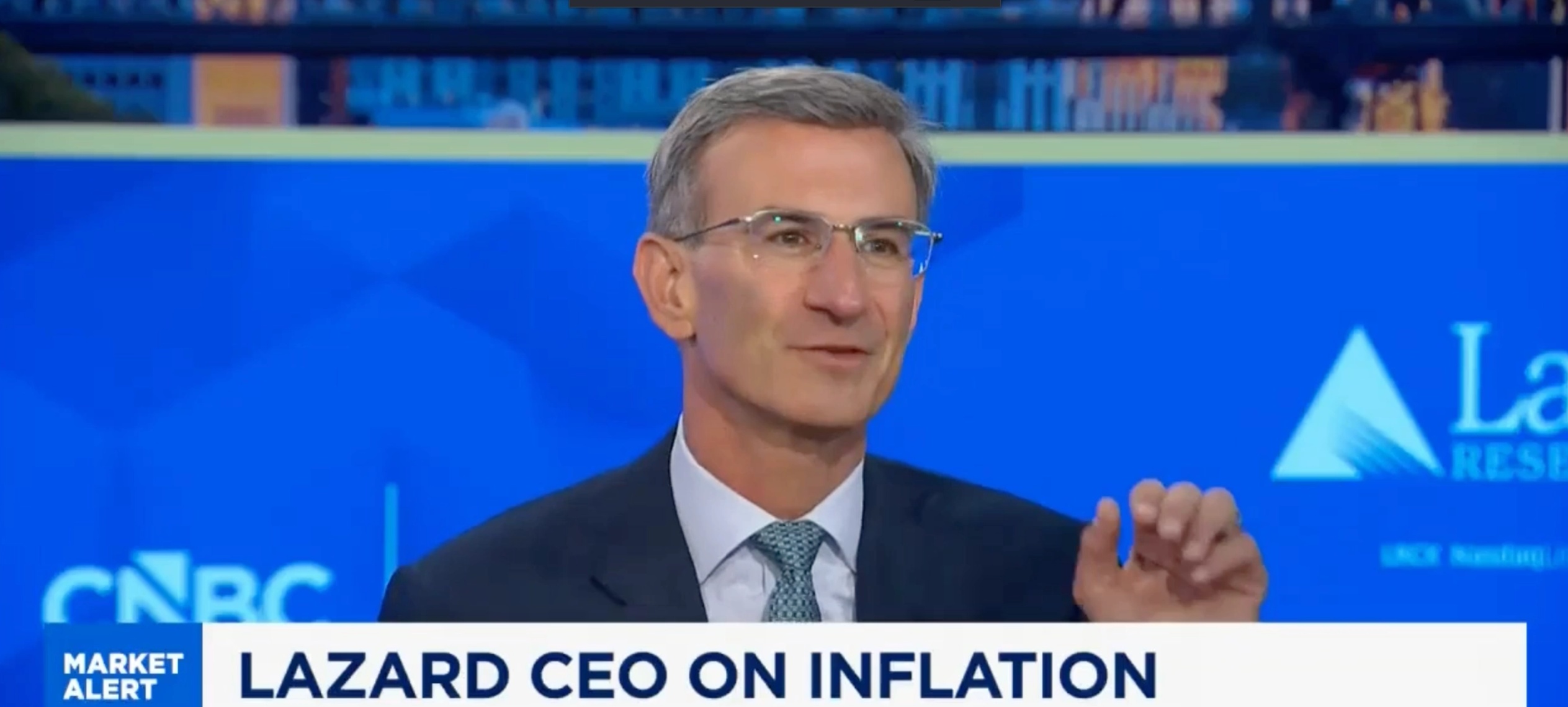
His term for connecting business questions with the wider setting is “contextual alpha.” It gives a compact name to a demanding proposition: an adviser should understand forces outside the immediate transaction. An apparently attractive deal may look different once geopolitical relationships, financing conditions, or public policy enter the calculation.
There is a commercial test attached to that idea. A client must find the additional perspective useful enough to act on and pay for. Having worked in government supplies experience. Turning that experience into sound corporate advice is a separate piece of work, repeated with each new assignment.
An economist volunteers to be measured
Before taking over as CEO, Orszag circulated a September 2023 memorandum outlining Lazard 2030. It proposed three measures: relevance, revenue, and returns. Relevance meant greater influence on client outcomes and participation in consequential assignments. Revenue was to double by 2030. Total shareholder return was targeted to average 10 to 15 percent annually through that year.
versus 2023
shareholder return
Management objectives, not achieved results or guarantees.
Publishing numerical ambitions has a certain bracing quality. The numbers do not become less specific when business becomes more awkward. They also make the next questions clearer: which businesses will grow, what investment comes first, and how will the organization behave differently?
His answer has included expanding Lazard's capabilities in restructuring, capital solutions, and private capital advisory. That broadens the reasons a client might call. Companies need help raising and reorganizing capital as well as buying one another. A firm's relevance can therefore extend beyond the moment when a merger is ready to announce.
The latest report puts some figures beside that argument. On October 22, 2026, Lazard reported third-quarter GAAP net revenue of $814 million and adjusted net revenue of $805 million. Adjusted net revenue rose 11 percent from a year earlier. The distinction between the two measures belongs in the sentence; numbers become less helpful when their labels disappear.
Orszag said the strategy was progressing as planned and pointed to record third-quarter Financial Advisory revenue. He also said Lazard CL, its new private capital advisory business, would launch in early November. That remained an upcoming step at publication. A business plan earns its dates one at a time.
The next variable is already in the room
Artificial intelligence now sits squarely within his plans. In his 2025 shareholder letter, published in April 2026, Orszag described bankers using AI for meeting preparation, information analysis, and scenario testing. He also argued that machine-scale evidence can improve judgment itself, alongside human experience.
For an advisory firm, that is a consequential claim. If analytical work becomes faster, the organization must decide what people do with the time and how they develop expertise. Orszag's letter paired AI adoption with changes to apprenticeship and collaboration. The organizational question accompanies the technical one.
His public interests continue beyond Lazard. In March 2026, the Citizens Budget Commission awarded him its Medal for High Civic Service, presented by Lazard's Raymond McGuire. In May he joined the Institute for Advanced Study's board of trustees. He also serves on the Peterson Institute for International Economics board and is a member of the Council on Foreign Relations and the Aspen Economic Strategy Group.
He lives in New York and is married to CNN journalist Bianna Golodryga. The public outline is that of someone whose working interests still cross the boundaries between markets, scholarship, and government. Those institutions ask different things of him, even when they share an appetite for economic explanations.
The Princeton paper offered a small, satisfying outcome: find the faulty step, explain it, receive the mark. Running Lazard supplies a less accommodating examination. The argument is public, the timetable runs to 2030, and the evidence keeps changing. Orszag has spent a career studying decisions under uncertainty. He has now given everyone else a date for checking his own.