A banker can spend years preparing a company for a difficult question. In 2014, Wassim Al-Khatib found himself answering one about his own department. Sarah Al-Suhaimi, the incoming chief executive of NCB Capital, wanted his view on closing its investment banking division. There are easier subjects to discuss over coffee.
He had researched her record before their meeting and travelled to Riyadh when she invited him. He argued that the division had a future. She agreed. What stayed with him was the ease of the conversation and her willingness to ask. “Right away, I was impressed by her humility,” he recalled.
Al-Khatib stayed. Years later, the two would work together again at Lazard, with Al-Suhaimi chairing its Middle East and North Africa financial advisory business and Al-Khatib running it. Their professional connection gives an otherwise orderly sequence of banking appointments a more interesting beginning: a division had to make its case before it could help other businesses make theirs.
A career with an engineering degree at its beginning
Al-Khatib’s academic starting point was computer engineering at Pennsylvania State University. He later completed Harvard Business School’s General Management Program. The qualifications are distinct: an undergraduate engineering degree and an executive education certificate. Neither needs to be dressed up to make the combination interesting.
His work came to centre on institutional clients, corporate transactions and the machinery of raising money. At NCB Capital, he led the financial advisory franchise from 2015 to 2021. Across his earlier career, transactions he originated and executed totalled more than $80 billion, spanning mergers and acquisitions, capital markets and advisory.
Combined value of transactions he originated and executed across M&A, capital markets and advisory before Lazard.
That figure describes transaction value. It is a measure of the financial decisions passing through the work: companies changing ownership, shareholders selling stakes, institutions arranging capital. The number is large; the individual decisions inside it are what give an advisory career its substance.
The name in the offering documents
One way into Al-Khatib’s working life is through the small print. When BinDawood Holding began trading on Tadawul on 21 October 2020, its announcement named him as NCB Capital’s contact for the lead manager and bookrunner roles. These are the parts of a flotation that rarely become the photograph.
The grocery retailer sold 20 percent of its shares. Its offer price was SAR 96, and its market value at listing was approximately SAR 10.97 billion. The offering was around 50 times oversubscribed. Those were figures attached to a particular transaction at a particular moment, rather than a promise about what its shares would do next.
A supermarket flotation also makes the breadth of capital markets tangible. Investors were buying exposure to a business built around everyday shopping. For the bankers involved, translating that business into an offering meant coordinating the work between a company and the people being asked to own part of it. The groceries were familiar. The change in ownership required considerably more paperwork than the weekly shop.
Then came the responsibility for the whole operation
In May 2021, Citi announced Al-Khatib’s appointment as its Saudi Arabia chief executive, subject to regulatory approval. He arrived after fifteen years at National Commercial Bank and NCB Capital. The move put him in charge of Citi’s regulated Saudi business and of coordinating what the bank delivered to clients in the country.
His reporting lines ran to Linos Lekkas, who led corporate and investment banking across Central and Eastern Europe, the Middle East and Africa, and Carmen Haddad, Citi’s Middle East vice chairperson and Saudi country officer. The arrangement placed a national operation inside a wider international banking organisation.
Citi had received its Saudi investment banking licence in 2017. Its permitted activities included investment banking, debt and equity capital markets, and securities research for institutional clients. Al-Khatib’s remit therefore extended beyond the next transaction to the delivery of a regulated business. A deal has a closing date. Running the operation means being responsible for the following morning as well.
By 2022, he was also taking part in the Saudi Capital Market Forum. On its panel, he discussed how international investors perceived the Saudi market, the development of investor relations and the growth of ESG in the kingdom. The conversation had moved from getting a transaction done to how a market communicates with the people it wants to attract.
Riyadh becomes the regional base
Lazard announced Al-Khatib’s appointment on 23 January 2023. He would lead Financial Advisory in MENA and serve as CEO of Lazard Saudi Arabia, with the Saudi appointment subject to regulatory approval. Riyadh would be the regional investment banking hub. Geography was part of the announcement’s substance.
The appointment brought him back alongside Al-Suhaimi. Peter Orszag, then chief executive of Lazard’s Financial Advisory business, described the two working together to expand engagement with regional clients. Al-Khatib’s own statement set out a two-way task: supporting local clients and international companies seeking to expand into the Middle East and North Africa.
That is a useful way to understand the role. An adviser based in Riyadh has to understand the companies already there and the companies arriving with questions about it. The work sits between different owners, expectations and markets. A regional hub is a place from which those conversations can be organised.
What happens after the bell?
When Al-Khatib appeared on IPO Stories in February 2024, he made a point that can spoil a perfectly good celebration. He described a listing as a checkpoint in a company’s longer relationship with funding. The occasion deserved a longer view than the day’s ceremony.
His discussion covered preparation, the choice of listing venue and the obligations that follow admission to a market. A company needs to consider which investors understand its business, as well as the liquidity a venue offers. Preparation matters because a favourable execution window is useful only when the company is ready to use it.
“Completing an IPO is not the end journey.”
Wassim Al-Khatib · IPO Stories, 2024
The point puts the ceremonial moment in proportion. Before a listing comes the work of readiness. Afterwards come governance, disclosure and an ongoing relationship with investors. A bell can announce the transition. It cannot perform the next quarter’s responsibilities.
He also discussed the opening of GCC markets to foreign investment and the region’s effort to broaden its listed businesses beyond energy and chemicals. Saudi Arabia’s Vision 2030 formed part of that discussion. In this account, capital markets matter because they connect companies with funding for growth and give investors a wider range of businesses to consider.
A board seat on the other side of the table
BinDawood Holding now lists Al-Khatib as an independent non-executive director. The name that appeared in the retailer’s flotation documents is also on its board. The two roles belong to different stages of a company’s public life.
A transaction team helps organise a defined event. A board oversees a business across time. The distinction makes his connection to BinDawood an unusually concrete companion to his argument about life after an IPO. The company continues operating, reporting and making decisions after the offering is complete.
There is something pleasingly practical about the pairing. The language of capital formation can drift far from the businesses it serves. A grocery retailer brings it back to shelves, customers and daily operations. Corporate governance has to remain useful when the flotation presentation has long since been filed away.
The distinction is useful for reading his career, too. Executive appointments describe where responsibility sits inside a bank. An independent non-executive directorship describes a different relationship to a company, outside its daily management. Both involve financial judgment, but the titles should retain their separate meanings. His work can be followed more clearly by keeping those responsibilities in view.
A second address, the same regional assignment
In April 2025, Lazard announced its planned Abu Dhabi financial advisory office, subject to regulatory approval, and appointed Hussain Altajir to lead its UAE advisory business. Altajir would work with Al-Suhaimi and Al-Khatib. The regional effort was acquiring another local base.
By September, Jean-Louis Girodolle was sharing photographs of the new office’s opening. His account placed Al-Khatib alongside Orszag, Altajir and sovereign wealth fund coverage head Ali Syed during client meetings. The group photograph is the sort of corporate picture in which everyone has sensibly agreed to stand still. Behind it is the practical business of getting colleagues and clients into the same city.
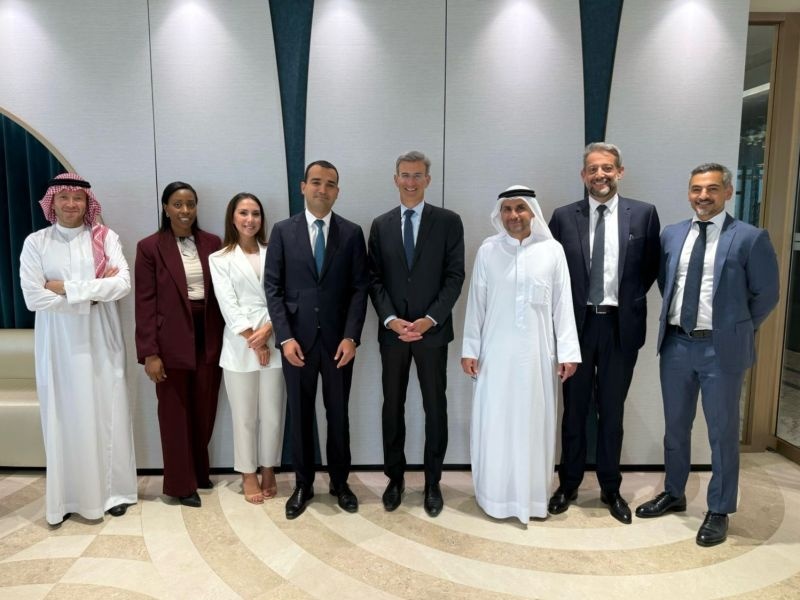
Later that month’s public account of Lazard’s regional strategy described Riyadh and Abu Dhabi as complementary bases. Al-Khatib and Orszag had discussed the expansion in Abu Dhabi as part of Lazard’s wider growth plans. For a MENA advisory business, having people on the ground was becoming a visible part of the plan.
The photograph offers a fitting place to leave him: among colleagues, at an office opening, with more conversations ahead. The career began taking shape around a decision to stay in a department whose future was being questioned. It has since involved helping companies prepare for decisions of their own. The interesting work starts when someone sits down and asks what should happen next.