A car, a cloud server and a ship engine make an unlikely collection of career souvenirs. For Mohammed Aldekmary, they belong on the same page. His advisory assignments reach from the Lucid Saudi Arabia project to cloud computing and heavy manufacturing, following the business arrangements that bring international technology into Saudi enterprises. The products differ considerably. The recurring form is a partnership.
That makes the joint venture a useful place to begin his story. An adviser working across these projects encounters companies with different expertise and public institutions with long investment horizons. The task concerns the arrangement between them: how a proposed business takes shape, who participates, and what each side brings. It is a career viewed through agreements whose consequences eventually leave the meeting room.
Aldekmary now leads Evercore Saudi Arabia. He arrived at the firm in May 2025, ahead of its December announcement of a Saudi arranging license and a Riyadh office. His route there included consumer products, London banking and advising the Saudi minister of investment. Reading that route alongside his projects reveals a working life spent across several institutional worlds.
A career transaction total, rather than a measure of personal wealth.
The campus before the capital
There is a smaller institution in this story, with a much smaller budget. At Clark University, Aldekmary served as president of the Finance Association from January 2008 to March 2009. His account of that period describes arranging speakers, expanding membership and running a trading competition. Half of the program participated in the competition; the association’s budget quadrupled and its membership tripled.
These are the details that give an education some texture. A degree tells us what someone studied. A student association also supplies deadlines, attendance figures and the occasional need to persuade somebody to show up. Aldekmary’s account includes negotiations with the CFA Institute over a university partnership and recruiting professional speakers for events. The organizing had a practical audience beyond the classroom.
He earned an MBA and a master’s degree in finance at Clark and is also a London Business School alumnus. His later banking experience included senior roles at Standard Chartered and RBS in London, and The Saudi Investment Bank in Riyadh. Government advisory added another perspective. The combination placed commercial finance and national investment policy within the same career.
Two ways to build a car industry
The automotive assignments make that combination tangible. Lucid’s Saudi Arabia project concerned an international manufacturer establishing production in the kingdom. Ceer concerned the formation of a Saudi electric vehicle business through a partnership. Both appear in Aldekmary’s advisory record. They offer two distinct answers to the industrial question of how to develop a local automotive operation.
Lucid opened its AMP-2 plant in King Abdullah Economic City in September 2023. The initial operation assembled vehicles from kits manufactured in Arizona, with annual assembly capacity of 5,000 cars. The company described a longer-term plan for a complete manufacturing operation with total annual capacity of 155,000. Those figures refer to different stages: the initial assembly operation and the proposed larger facility.
For an industrial investment, that distinction matters. The first operating phase and the eventual ambition occupy different places on a calendar and require different capabilities. The project connects a manufacturer’s existing production system with a new location, local support and a developing supply chain. It helps explain why a factory belongs in the biography of a financial adviser as well as an engineer.
Ceer brought another structure. Announced in November 2022, it combined Saudi Arabia’s Public Investment Fund with Foxconn, with component technology licensed from BMW. Foxconn’s responsibilities included the vehicles’ electrical architecture. A domestic automotive brand was being assembled from several kinds of expertise, rather as a vehicle itself is assembled from parts that must work together.
The partnership names tell their own industrial story: an investment institution, an electronics manufacturer and licensed automotive technology. Aldekmary’s connection is his advisory assignment on the venture. The wider significance lies in the structure of the project, which brings separate capabilities into a business intended to design and manufacture vehicles in Saudi Arabia.
Where the cloud meets the foundry
His project list then makes an abrupt turn, from cars to computing. In December 2020, Saudi Aramco Development Company announced an agreement with Google Cloud covering cloud services for enterprise customers in Saudi Arabia. Google Cloud would establish and operate a local cloud region, while a new company would supply solutions and services following regulatory clearances.
Here, the infrastructure is digital, but the arrangement still has a geography. A cloud region sits somewhere. Customers need services they can buy and use locally. The agreement linked a global technology platform with a Saudi business structure. Alongside the automotive assignments, it gives a sense of the range covered by Aldekmary’s advisory work.
Tuwaiq Casting & Forging takes the story back to weight, heat and machinery. The venture connects Dussur, Aramco and Doosan. In January 2022, the partners signed an amendment to their shareholders’ agreement in Riyadh. Doosan’s planned contribution included technology, technical support and operating services. The machinery would follow a commercial structure that defined how the participants worked together.
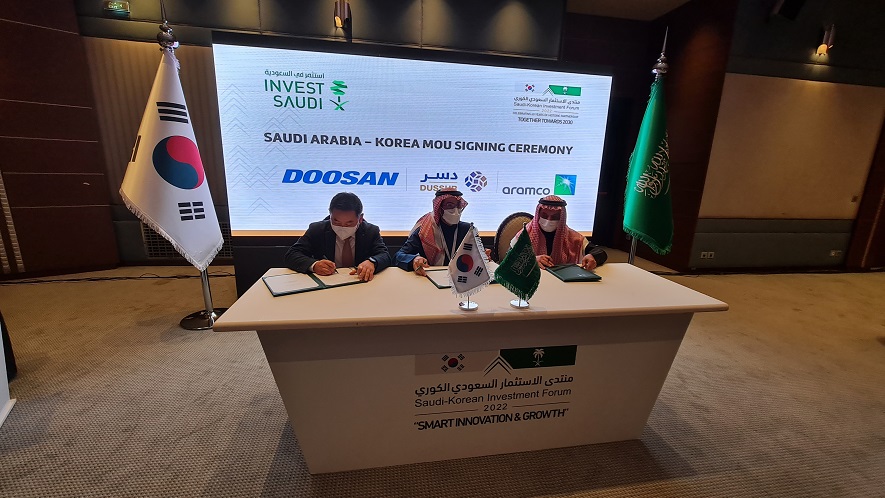
The facility’s intended products make the investment less abstract: valve bodies, pump housings, drilling equipment parts, engine components and marine parts. Its targeted annual capacity is 60,000 tons. Dussur’s 2024 account also records an international training program for 80 Saudi engineers. Alongside the production equipment, the project involves developing people who can use it.
Another assignment involved the engine venture between Aramco, Hyundai Heavy Industries and Dussur. The agreement announced in June 2019 specified ownership of 55 percent, 30 percent and 15 percent respectively, and an engine manufacturing and aftersales facility. Even a ship engine needs a company around it: an ownership structure, an operating purpose and partners with defined stakes.
An aircraft part has a long itinerary
The aerospace assignment adds a French connection. In December 2021, SAMI, Figeac Aéro and Dussur announced a venture to manufacture aerostructure components in Saudi Arabia. Initial products were to include aluminum and titanium parts. The venture’s aims included training Saudi engineers and technicians, developing manufacturing capabilities and supporting local participation in aerospace supply chains.
The announcement followed a memorandum signed at the Paris Air Show in 2019. Establishing the venture involved Saudi competition clearance and approvals in five other regions, including the European Union. That itinerary offers a useful corrective to the tidy image of a deal as a handshake. A partnership can travel through several jurisdictions before its factory makes a part.
Across these assignments, Aldekmary’s record spans companies producing very different things. Cloud services require a different operating model from a foundry; aircraft components have their own manufacturing demands. The connecting thread is the advisory work around bringing partners into a workable enterprise. The variety is visible in the projects themselves, without needing to turn it into a personality theory.
The Riyadh assignment
At Evercore, those earlier experiences meet a new institutional task. After joining in May 2025, Aldekmary spent time in the firm’s Dubai office as part of its Middle East coverage team. That office had opened in 2017. In December 2025, the Saudi license and Riyadh office announcement put him at the head of a local operation, as CEO and Head of Arranging.
“The opportunity to expand our presence in the Kingdom of Saudi Arabia is both a privilege and a challenge I look forward to embracing.”Mohammed Aldekmary · December 2025
The office also gives the career a different center of gravity. A named advisory assignment concerns a particular transaction or project; an office serves clients across a continuing business. Aldekmary’s new role brings a title with responsibility for that Saudi operation, alongside his place in the broader firm. The progression is visible in the dates: joining the regional team in May, then leading the announced Riyadh presence in December. The earlier projects remain part of his experience as the focus turns toward building the local practice.
The paired words, privilege and challenge, suit an office opening. There is an existing firm behind him and a local practice to develop. Evercore’s stated purpose for the Riyadh office is independent advice for clients in the kingdom. Aldekmary’s experience supplies a point of contact between that global advisory business and the Saudi institutions and projects that have occupied his career.
The path began well before the new office: a consumer products job, graduate study, a campus association, banks in London and Riyadh, government advisory, industrial partnerships. Now the assignment is to build an advisory presence in the city where he is based. After years of working on the arrangements that connect other institutions, Aldekmary has an institution of his own to help establish locally.