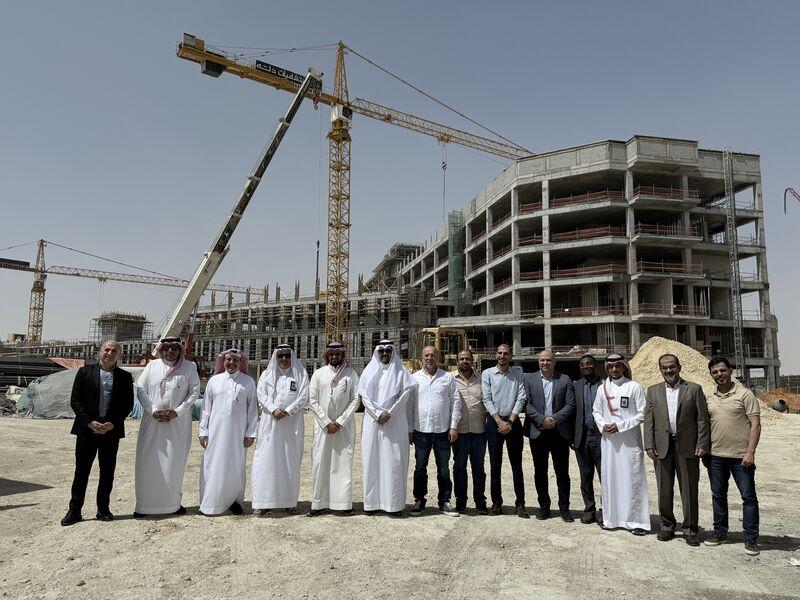
In the photograph, the building is still a skeleton. Concrete floors stand open to the air. Cranes cross the sky. A line of colleagues has assembled on the ground in front, dressed for a mixture of office work and construction work. Muteab Al-Tukeas shared the picture in June 2025, marking the completion of the structural frame at Dallah’s Al-Arid project. It is a useful place to begin a story about a chief executive: before the title, beside something unfinished.
His accompanying message thanked the team. He named Dallah’s engineers, the contractor YMCO, the supervision consultant KFO Khalid Alfagih and the project manager Takamul PMC. The roll call gives the celebration its character. A corporate milestone often arrives wrapped in a slogan. This one came with a list of people who had to make the pieces fit.
Sixteen months later, Al-Tukeas has a different title. He became Dallah Health’s chief executive on September 30, 2026, following an acting appointment that began on September 1. His route there runs through civil engineering, water infrastructure, project management and corporate strategy. Look along that route and the construction photograph becomes more than an agreeable souvenir. It supplies the central question of his career: how does a plan become something that stands up?
A profession that checks the working
Al-Tukeas studied civil engineering at King Saud University in Riyadh, then earned a master’s degree in project management at Heriot-Watt University in Edinburgh. The pairing is practical. One discipline concerns the physical structure; the other concerns the work required to deliver it. A design can satisfy an equation and still have an awkward relationship with a calendar. Project management inhabits that awkwardness.
His early experience includes work as a civil engineer at DynCorp International. At National Water Company, he held project management and asset responsibilities. Those positions place the beginnings of his executive career among tangible assets and the arrangements needed to build and manage them. Before the language of corporate strategy came the language of projects.
There is a temptation, when writing about someone who becomes a CEO, to make every earlier job sound like an audition. That would flatten this sequence. Civil engineering is a profession in its own right. Managing projects and assets involves its own expertise. What makes the progression interesting is the way these different responsibilities eventually sit together in one career.
By the time Dallah chose him for its executive leadership in 2026, his professional and leadership experience exceeded 15 years. The appointment description covered strategy, project management and mergers and acquisitions. Each adds a different question to the work: what should be built, how should it be delivered, and when should an organization buy rather than build?
An editorial reading of the disciplines in Al-Tukeas’s career, rather than a ranking or performance score.
The two university cities also give the education a geographical shape: Riyadh for his engineering degree, Edinburgh for his postgraduate qualification. The subjects remain closely connected despite the distance between them. Engineering and project management both appear again in the responsibilities that followed. His later business education would add finance and acquisitions, expanding the range of decisions covered by that original technical foundation.
Five years between strategy and delivery
From 2017 to 2022, Al-Tukeas served as Dallah’s general manager of strategy and its project management office. The combination matters. Strategy can become abstract when it travels too far from delivery. A project management office brings it back to named work, dependencies and progress. His remit placed those two activities beside each other.
A project office is rarely the glamorous part of a company’s story. It is where an ambition acquires a sequence and where that sequence meets other people’s commitments. Even its abbreviation, PMO, sounds designed to discourage a dinner-party conversation. Yet the function sits close to a business’s ability to carry out what it has decided.
That is the business context for his five years in the role. The dates establish something more useful than a vague claim about long experience: a sustained period in which strategy and project oversight were connected in the same appointment. In 2022, he became chief strategy officer, moving into the position he held before taking on the CEO’s responsibilities.
The progression also changes how to read the September 2026 appointment. Dallah selected an executive who had already worked on the company’s direction and project oversight for years. An internal successor brings familiarity with earlier choices. He also inherits the task of making those choices work from a different position of responsibility.
- 2017–2022General manager, strategy and project management office
- 2022Chief strategy officer
- September 1, 2026Acting chief executive
- September 30, 2026Chief executive
The thank-you beneath the cranes
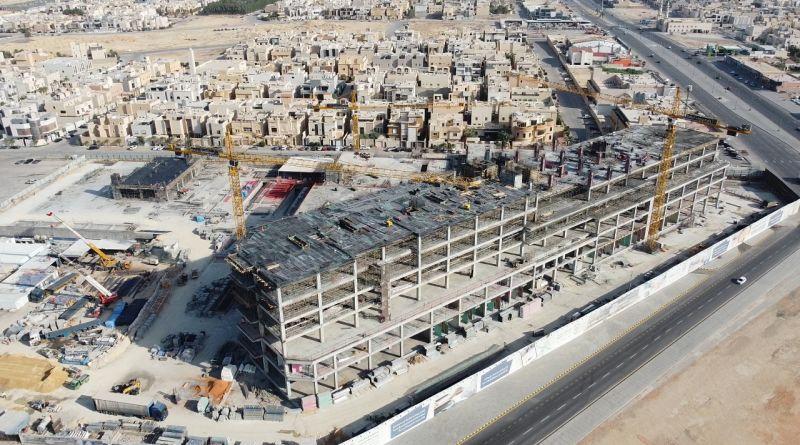
Return to the Al-Arid photograph. The structural frame is complete, but the building is visibly a work in progress. Al-Tukeas’s June 3, 2025 message celebrated a defined stage of construction. It also gave an expected completion window of the first quarter of 2027. The distinction between a milestone and a finished project is built into the announcement itself.
That makes the post more revealing than a general statement about execution. A frame is a specific achievement. It can be photographed. It gives a team a reason to gather while leaving the remaining work plainly visible. There is something pleasingly candid about a celebration whose backdrop still contains so much to do.
“Thank you to the team.”
Muteab Al-Tukeas, June 3, 2025
Translated from his Arabic construction-milestone post
The names in his acknowledgment trace the organization of the project: internal engineers, a contractor, a supervision consultant and a project manager. These are separate participants with different jobs. Recognizing each makes the work legible. The achievement belongs to a coordinated effort, and his description preserves that division of labor.
It would be too much to turn one public message into a complete theory of his personality. But the choice of emphasis is there to read. He could have left the announcement at the milestone. Instead, he attached thanks to named contributors. For a career built around projects, that is a concrete and fitting detail.
Learning the financial language of building
His later education broadens the picture beyond engineering. Al-Tukeas completed executive development and project finance programs at London Business School, along with a mergers and acquisitions strategies program at Harvard Business School. These were professional and executive programs, adding business subjects to his degrees in engineering and project management.
The subjects have a clear relationship to his responsibilities. Project finance concerns how a proposed development is funded. Mergers and acquisitions concern another route to expansion. Executive development addresses the wider demands of managing an organization. Together, the subjects describe a move from individual projects toward decisions about a portfolio of activities.
His outside appointments extend that perspective. He chairs the board of Palm Oasis Real Estate Fund and serves on the board of Care Shield Holding Company. The fund chairmanship adds a real estate dimension to a career already concerned with physical development. The board roles add governance to the mix of operational and strategic responsibilities.
These appointments are useful details because they explain the breadth of the professional setting around him. He has worked with assets, projects, strategy and investment, and also with boards. The progression is easier to understand through those actual responsibilities than through a string of flattering adjectives. His career contains enough job descriptions already.
There is also a useful distinction between his fund chairmanship and his executive position at Dallah. A chairmanship belongs to the board’s oversight of an organization; a chief executive position belongs to its management. His published appointments therefore describe different forms of responsibility. Reading the titles carefully preserves that difference and gives a more precise picture of the professional roles he holds.
September changes the brief
The succession happened in stages. Dallah announced the acting appointment in August, effective September 1, 2026. Al-Tukeas also joined its investment and financing committee. The board then decided on September 29 to appoint him CEO, with the appointment taking effect the following day. The distinction matters: September 1 began the acting assignment; September 30 began the confirmed role.
He succeeded Ahmad Saleh Babaeer. For Al-Tukeas, the move brought years spent on strategy into the broader responsibilities of chief executive. There is an evident continuity in that transition, although continuity is only the beginning of the story. The title places decisions made across the organization under a different degree of personal accountability.
The September appointment is still recent. Seen from October 2026, its significance lies in the career that preceded it and the responsibilities it now brings. The completed frame at Al-Arid offers a suitable closing image. It marks visible progress without confusing progress with completion. There are colleagues in front, a structure behind them and more work ahead. Al-Tukeas’s next chapter begins with all three.