A better barricade was cause for celebration on West 103rd Street. In April 2021, neighborhood volunteers welcomed metal barriers with orange signs to their Open Street. Peter Frishauf recorded the improvement, then recorded a taxi driving through too fast. The two videos made a compact argument: changing a street requires more than announcing that it has changed. Somebody has to see whether the arrangement actually works.
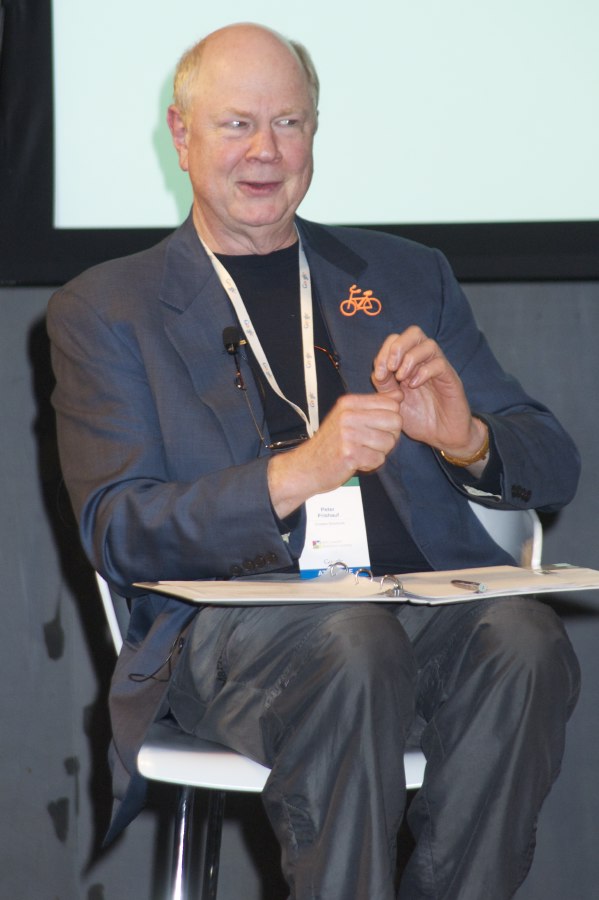
Frishauf had reason to appreciate both the promise and the awkward implementation. He founded Medscape in 1995 and served as its first CEO, after years spent experimenting with how publishing offices could work together. His later civic work puts him among volunteers, planters, performers, and the stubborn particulars of a Manhattan block. The distance between a website and a street is considerable. His interest in making shared spaces usable supplies a connection.
“They just can’t trust motorist behavior,” he said of the people reluctant to use the newly designated space. A city's invitation to walk in the road comes with a rather demanding footnote if drivers have not read the invitation. Frishauf was pleased by the new barriers. He was also watching the taxi. Both reactions belong in the picture.
The copy boy studies the machinery
In 1968, Frishauf worked as a copy boy at the New York Daily News. From the bottom of the newsroom hierarchy, he could watch the whole operation. Stories moved through an engineered sequence, carried along by people using equipment that was already slow. Yet the paper came out quickly. The contrast interested him: the machines were cumbersome, but the organization knew how to move.
He later recalled wondering whether computers could take over the copy boys’ work. It is an unusually practical ambition for someone holding the job in question. Plenty of young employees hope to escape the bottom rung. Frishauf was considering whether the rung needed to exist.
“I kept having this notion that you could replace copy boys with computers.”
Peter Frishauf · recalling the Daily News
At New York University, he changed course toward journalism and edited the Washington Square Journal. He was covering student protests for United Press International in 1968 and for The New York Times in 1969 and 1970. These were years when the campus newspaper could hardly complain that nothing was happening. Journalism gave him work close to the argument, with deadlines attached.
His connection to that period lasted. In a piece published in February 2025, he revisited October 15, 1969, when a nationwide campus strike took place. He remembered being the Journal's editor and producing a special poster edition in support. The artifact was both reporting and participation: a student publication finding a form suited to an event larger than its usual pages.
A terminal for the receptionist, too
He graduated from Columbia's journalism school in 1972. By 1975 he and a partner had founded F&F Publications, borrowed money, and bought a magazine. F&F was sold in 1977. The sequence gave him experience on both sides of the publisher's desk: making a publication and making an enterprise that could keep producing it.
In the early 1980s, he started SCP Communications. Here the old copy boy's thought acquired hardware. The company assembled a minicomputer system from parts, and terminals reached across the staff, including the receptionist. People in different functions could work with a shared set of information. The office itself was open, too.
Remembering it in 2021, Frishauf compared the arrangement with collaborating in Google Docs. That comparison helps recover what was unusual. The novelty lay in who could see and use the same material while work was happening. A computer in a corner would have been a purchase. A common working environment required a decision about the organization.
The receptionist's terminal is the detail that stays with you. It suggests an experiment extending beyond the people whose job titles made access seem obvious. Today, shared documents can feel about as exciting as fluorescent lighting. At SCP, working electronically across the office was something the team had to build for itself.
information
The office had a cat policy
The system also had room for less predictable occupants. In 1991, SCP staff rescued a mother cat and three kittens abandoned in the building's stairwell. The mother became Chelsea. In Frishauf's recollection, the cats were admired by some colleagues and thoroughly unwelcome to others. An office community had acquired a constituency with claws.
A forum on the company's computer bulletin board addressed the resulting logistics. There were suggestions for keeping fur off chairs, alongside information about areas where cats were excluded. Shared computing had met a problem of considerable practical importance to anyone wearing dark trousers.
Frishauf jokingly expanded CEO as “Cat Empathetic Officer.” The joke acknowledged that the arrangement had a sponsor. A boss's fondness for cats does not automatically make the whole staff fond of them, and his account made space for the dissenters. Chelsea and Boots eventually moved into his home. The office experiment had become part of the family.
A website learns to stand on its own
Medscape went live on May 22, 1995. It came out of SCP, an existing publishing operation willing to put people and resources behind an experiment. Frishauf's account of its beginnings describes a small team working without a formal dedicated budget. The web project grew inside an organization that already knew how to produce material electronically.
That history matters because founding stories tend to give the launch date all the credit. The years before a launch are less photogenic. They contain decisions about workflow, colleagues learning how to collaborate, and equipment assembled to solve yesterday's problem. At SCP, those accumulated habits gave the next project somewhere to begin.
The roles changed as the company developed. Frishauf stepped down as CEO in February 1998 and became chairman of the executive committee. Paul Sheils, who had worked on The Wall Street Journal's online business, took over as CEO. A founder who had helped create a publication was now helping it proceed under someone else's management.
Medscape went through its public offering and a merger with MedicaLogic in 2000. WebMD acquired the site in December 2001; Frishauf's formal relationship ended in 2002. Those dates give a useful boundary to the familiar founder label. He remains part of the company's origin, while the organization has had a long life beyond his executive tenure.
Medscape launches
CEO handover
relationship ends
The introduction that keeps travelling
His work after Medscape included investing and advising. At Crossix, he helped Asaf Evenhaim raise financing and served as board chairman. The company was acquired by Veeva Systems in 2019. The role extended his involvement with people he had met through earlier work, taking a professional connection into another venture.
There is a similar thread in Osmosis. When investor Alan Patricof discussed his introduction to that company in 2018, he credited Frishauf, with whom he had worked at Medscape. Introductions can disappear from a company's official chronology even when they change who gets into the room. Here the investor remembered who had made the connection.
Shiv Gaglani, an Osmosis cofounder, also describes Frishauf as a mentor and a skiing companion. His public recommendation dwells on curiosity, tinkering, and a willingness to connect people. Skiing adds a useful dimension to the relationship: advice does not always arrive across a conference table, and a long professional association can make room for ordinary friendship.
Other affiliations put him in rooms organized around quite different purposes. His StreetsPAC biography lists service with NYC H2O and Alumni & Friends of LaGuardia High School, alongside his role in Park to Park 103. Education, the arts, environmental work, and streets all need people prepared to do organizational work. A board seat can sound remote until someone has to make the next event happen.
The long route between two parks
Frishauf and his spouse, KC, moved to West 103rd Street with their daughter in 1982. In 2009, they worked with the block association on a temporary parklet near the Marseilles. The demonstration and accompanying survey tested interest in a street that gave pedestrians greater priority between Riverside Park and Central Park.
The idea returned with the West 103rd Street Open Street in 2020. Frishauf became a volunteer coordinator for Park to Park 103 and joined the block association's board in April 2022. A neighborhood proposal had taken years to find another opening. The interval gives the word persistence some local geography.
By summer 2024, Park to Park 103 had arranged fiscal sponsorship with the Columbus-Amsterdam Business Improvement District. The agreement brought administrative and financial support to programming on the shared street. It also made it easier to coordinate performers and draw on the BID's experience with cleaning and tree care. There is a lot of paperwork behind a pleasant afternoon.
The programming gives that paperwork a purpose. Spring 2024 plans included planting, dancing, music, chess, and backgammon instruction from world champion Antoinette Marie-Williams. For the June 2025 Make Music New York celebration, Park to Park and the BID organized five neighborhood sites, three of them on West 103rd Street. Singer-songwriter Lizzie Blazquez served as curator and performer. Frishauf photographed the occasion.
His Winter 2025 neighborhood writing also turned to the street's 40 planters and the work needed to maintain them. The block association collected 500 signatures on thank-you cards for the city transportation department and the Horticultural Society of New York. The gesture made routine maintenance visible, giving neighbors a way to acknowledge work they might otherwise pass without noticing.
There is something pleasing about a publishing founder turning his attention to thank-you cards. He has spent years thinking about how information reaches people. Here the message was simple, the audience was nearby, and the paper was large enough for hundreds of names. Between the two parks, making room for people still requires someone willing to organize the details.
Keeping a shared street welcoming means watering, refreshing, and caring for what grows there.
Keep following the thread
His writing, conversations, and neighborhood work.