Peter Frischmann’s office had a small instrument for discouraging digression. At the start of a 2020 interview, he turned over a white cube-shaped timer and gave the conversation thirty minutes. “I fiercely defend my time,” he said. For a founder selling into the battery industry, this was an admirable ambition. The industry, unfortunately, had brought its own calendar.
That little cube is a useful place to begin with Frischmann, the chemist who co-founded Sepion Technologies. He wanted research to become useful sooner. He had to learn how to make a company fit the requirements of people who already had factories, equipment, and customers of their own. Later, he would describe another education: learning how to listen when the difficult feedback concerned his leadership.
“The biggest concern for me is speed.”
Peter Frischmann, 2020
A chemist before he was a founder
Frischmann earned his chemistry degree at Idaho State University in 2005. His recollection of the place is refreshingly specific. He credited professors Rene Rodriguez and Joshua Pak with being patient and supportive, and remembered getting access to research during his freshman year. A laboratory was something he could enter and work in early, rather than a distant reward for surviving enough lectures.
By 2010, he had completed a chemistry PhD at the University of British Columbia. His research background encompassed organic, inorganic, and supramolecular synthesis: work concerned with making molecules and understanding the structures they form together. That last field rewards an interest in relationships at a very small scale. Arrangement matters; the ingredients alone do not tell the whole story.
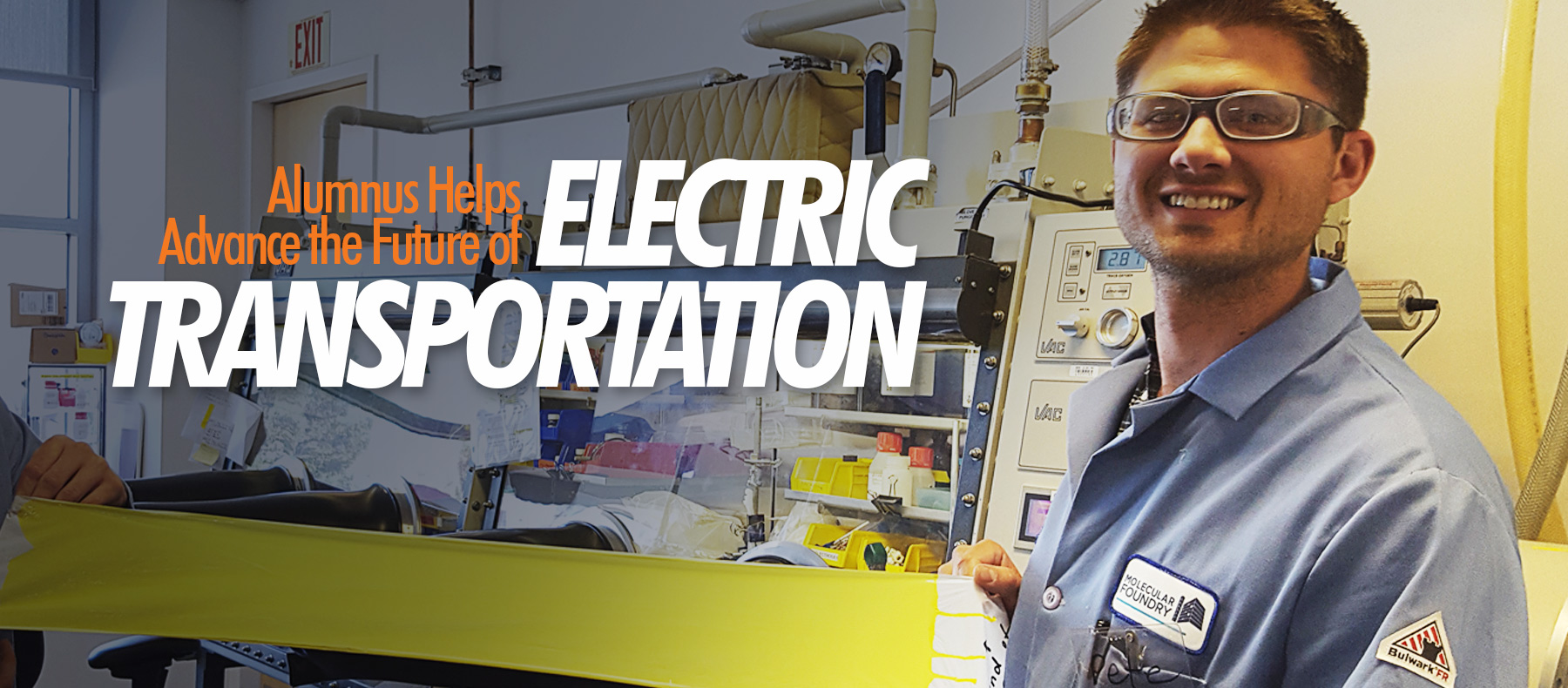
A Humboldt fellowship then took him to Würzburg, Germany, where his host was chemist Frank Würthner. The fellowship began in 2011. His publications from that period include studies of self-assembled molecular structures and light-harvesting dye assemblies. This was a career built around the behavior of materials, with energy-related questions already running through it.
One project, with Valentin Kunz, Kingsuk Mahata, and Würthner, assembled tetrahedral structures using dye molecules and metal ions. Kunz won a poster prize for work on these systems in 2014. They could hold other molecules inside them and had optical properties of interest for photocatalysis. Long before customer qualification became part of Frischmann’s working vocabulary, he was studying what molecular architecture could make possible.
The customer gets a vote
At Berkeley Lab, Frischmann worked on energy-storage materials, first as a postdoctoral researcher and later as a project scientist. There he and staff scientist Brett Helms developed the work that became Sepion. Their polymer membranes offered a way to control movement inside a battery: let useful charged particles through while restricting troublesome species.
Their early commercial idea involved lithium-sulfur batteries. In 2015, Frischmann, Helms, and battery-program manager Michel Fouré joined the I-Corps entrepreneurship program and put the idea in front of potential customers. Manufacturers were reluctant to replace their infrastructure for lithium-sulfur chemistry. The team shifted toward lithium-metal batteries. Frischmann and Helms founded Sepion that year; he joined the Cyclotron Road incubation program in 2016.
By 2022, another choice followed. Building a battery company would require more capital than the team wanted its business model to depend on. Sepion concentrated on supplying membrane materials: polymer for separator manufacturers, or coated separators for cell makers. The scientific contribution could remain inside a battery assembled by somebody else. There is a certain commercial maturity in accepting that your invention need not have your name on the outside.
Customers question the infrastructure switch
The membrane finds a different application
Sell polymers and coated separators
The intellectual move is easy to underappreciate. A scientist has to decide which variables to hold constant. Here, the customer was asking to keep a factory’s basic process in place. That requirement became a boundary within which Sepion could work. Frischmann’s training had prepared him to change materials. Entrepreneurship required him to accept that the buyer could define part of the experiment.
The factory has its own clock
In September 2023, Sepion opened a 25,000-square-foot facility in Alameda. The company described a thousandfold increase in separator-coating capacity and a hundredfold increase in polymer-synthesis scale. The building also supported pouch-cell production, allowing materials to be evaluated in working battery formats. For Frischmann, the route toward commercialization now included machinery, production processes, and enough material for customers to test.
These are less photogenic developments than a gleaming vehicle. They are also closer to the daily obligations of a supplier. A promising coating has to be made again. Then it has to be made in a larger quantity. Each repetition asks whether the useful behavior survives the process that produced it.
A 2024 project report co-authored by Frischmann and Jessica Golden puts numbers around that work. Within the reported project, Sepion expanded polymer synthesis tenfold and roll-to-roll coating capability two hundredfold. Process quality controls helped lift yield from below 50 percent to 95 percent. Those project-specific figures describe a different comparison from the facility-opening announcement, and a particularly consequential one: how much of the output can actually be used.
Process yield
The same project trained 26 California employees, most recruited from adjacent industries without prior battery-materials experience. That detail belongs in a founder’s story. Growing production involves teaching people a process as well as developing the process itself. The company’s knowledge has to become something colleagues can use, repeat, and improve together.
Money has arrived in several forms. Sepion raised a $16 million Series A in 2021. In October 2024, it announced a $17.5 million grant supporting a planned West Sacramento separator-manufacturing facility. These amounts describe company financing and project support. They also suggest why a founder’s calendar fills with conversations beyond the laboratory: production ambitions need partners willing to sustain a long development effort.
The difficult conversation
Frischmann’s later public reflections make the personal cost of that transition more visible. After a decade building Sepion, he described learning to deliver candid feedback with care, receive criticism without letting ego take over, and face uncomfortable conversations. He also emphasized staying calm when the stakes were high and listening to people whose perspective differed from his own.
He discussed those experiences with Danielle Applestone in a conversation titled To the RIF and back: A hardtech founder’s honest experience. The subjects included product changes, the transition from research to manufacturing, company culture, and reductions in force. A founder responsible for people’s jobs has decisions that no materials characterization instrument can settle.
His account gives the office timer a more interesting companion. Protecting attention is relatively straightforward when the task is ending a meeting. Receiving feedback requires leaving room for something you did not plan to hear. The leader who wants a company to learn has to tolerate being part of what needs changing.
This is where the person becomes more visible than the title. Frischmann’s public emphasis is on conduct: how to give feedback, how to receive it, how to remain in a conversation that has become uncomfortable. Those are modest verbs for consequential work. They also offer a more useful picture of leadership than the customary photograph of a founder looking thoughtfully at equipment.
A narrower product, a wider horizon
On March 26, 2026, Sepion announced a $10 million Series B led by Fine Structure Ventures, with strategic participation from W. L. Gore & Associates and Syensqo Ventures. The stated priorities were practical: expand U.S. polymer production, fulfill commercial purchase orders, develop the Power and Shield product lines, and strengthen quality and operations.
The company said coated separators were being made on commercial production lines for late-stage customer qualification. Frischmann described separators as a critical battery component with relatively little innovation. His commercial proposition now centers on improving that component while working with existing manufacturing lines. After years of changing direction, the appeal to a customer is the amount of change the customer can avoid.
Sepion’s current manufacturing approach uses toll and partner manufacturers, allowing production to expand through an existing network. It describes meter-wide coating and line speeds above 100 meters per minute. The vocabulary has traveled some distance from self-assembled molecular structures. The underlying question remains whether an arrangement will do useful work under the conditions required of it.
His colleagues bring experience from different parts of that journey. Helms remains Sepion’s scientific co-founder; chief technology officer Brian Sisk has worked at Rivian and A123 Systems. The company’s advisers include MIT materials scientist Yet-Ming Chiang. Frischmann’s role sits among those specialties, connecting the scientific premise to the people who must manufacture, evaluate, and buy the result. It is a practical setting for his stated interest in listening: useful expertise arrives from several directions, and each direction brings its own questions.
For Frischmann, those conditions now include a buyer’s timetable, a colleague’s judgment, and the demands of a production run. The cube timer remains a fine accessory for a desk. Beyond it, the work asks for a more complicated discipline: move quickly enough to matter, and listen carefully enough to choose where to go.
Keep the conversation going
- Sepion Technologies
- Peter on LinkedIn
- The early Idaho State profile
- Berkeley Lab’s commercialization account
- The 2020 office interview
- Pilot-production report (PDF)
- March 2026 financing announcement
- Current manufacturing approach
- Watch: conversation with Danielle Applestone
- Watch: University of Colombo interview
- Watch: 2025 TechBlick presentation excerpt