A liver biopsy asks a strangely literal question of the body: could we have a little piece of you? The sample goes to a laboratory. A specialist examines it. A judgment follows. Perspectum began with a different proposition. Perhaps some of the information could be gathered while the liver stayed exactly where its owner preferred it.
The Oxford company makes software that converts MRI data into measurements of tissue. Its flagship, LiverMultiScan, reports disease activity, fat and iron. The attraction is obvious enough: information without a needle collecting tissue. The complication arrives later. Healthcare does not purchase information merely because it is interesting. Someone has to decide what to do differently after receiving it.
- The product: quantitative imaging software for existing MRI infrastructure.
- The buyers: clinical providers and pharmaceutical research teams.
- The distinction: repeatable biomarkers, including iron-corrected T1, rather than pictures alone.
- The test: whether those numbers improve decisions enough to earn their cost.
Three numbers, one stubborn organ
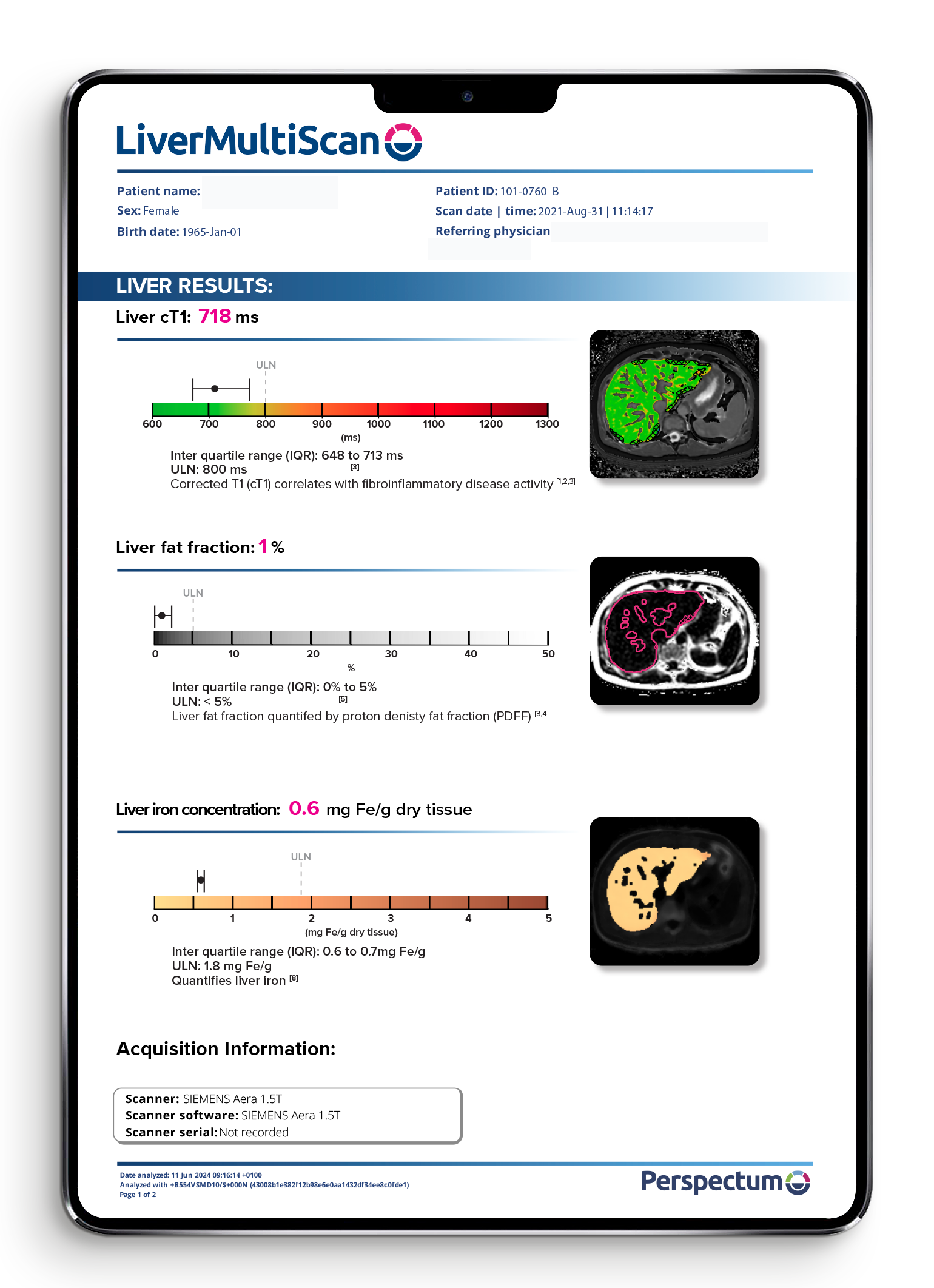
There is a pleasingly unglamorous detail inside LiverMultiScan: the letter “c”. It stands for corrected. T1 is an MRI measurement related to how tissue responds after magnetic excitation. Iron can alter it. Correcting for iron makes cT1 more useful as a marker associated with liver fibro-inflammation. A small letter carries a substantial scientific obligation.
The other measurements answer different questions. Proton density fat fraction, or PDFF, estimates liver fat. Iron measurements describe iron content. They belong together because liver disease is not one substance accumulating in one predictable fashion. A useful report needs to distinguish what it can measure, rather than compress everything into a cheerful traffic light.
Perspectum’s clinical proposition is that these measurements can help clinicians assess disease and follow its course. A repeat visit supplies another set of numbers. That gives the physician something to compare. Interpretation still belongs within the patient’s broader clinical picture; a color map is not a medical history.
The upgrade travels through software
Perspectum grew from University of Oxford research in 2012. Its founding group included physician Rajarshi Banerjee, image-analysis scientist Michael Brady, MRI specialist Matthew Robson and academic clinician Stefan Neubauer. The combination matters. A medical question, a physical measurement and an analysis pipeline are different jobs, however fashionable it becomes to put them all under “AI”.
Brady’s background includes helping establish MIT’s Robotics Laboratory. Here, the object of analysis became rather less cooperative than a robot: human tissue. Perspectum’s expertise sits at the meeting point of imaging physics, biomedical science, clinical practice and software engineering.
The company does not ask a hospital to replace its MRI machine with a Perspectum machine. LiverMultiScan works with specified Siemens, GE and Philips systems at 1.5 and 3 Tesla. A suitable acquisition sequence must be configured. Images move into the analysis service using established medical-imaging infrastructure. The current product page describes an acquisition of approximately five minutes, which can be added to other protocols before contrast is administered.
This is an attractive way to distribute a product: improve the use of equipment already installed. It also creates work that a glossy demonstration can conceal. A measurement needs to remain meaningful across scanner manufacturers, sites and repeat visits. Consistency is part of the product people buy.
- 01 Acquire
Compatible MRI protocol - 02 Analyze
Cloud-based processing - 03 Compare
Quantitative report - 04 Decide
Clinical interpretation
The customer with hundreds of scans
A clinician wants to understand a patient. A pharmaceutical sponsor may need to understand what happened across a trial: who changed, by how much, and whether the apparent difference could simply be measurement noise. The same technology therefore has two commercial lives.
Perspectum sells clinical imaging-analysis services and cloud-based software, alongside contracted services for drug development. Its pharmaceutical offerings span liver disease, body composition, cardiometabolic conditions, autoimmune disease and oncology. The company reports a network exceeding 1,200 locations and more than 40,000 processed trial datasets. Those are company-reported network and processing figures, not counts of paying hospitals or unique patients.
For sponsors, standardized biomarkers can support patient characterization and the assessment of treatment response. The less visible value is operational: managing imaging across many locations so that a number means something comparable when it reaches the trial team. Software is one component of that service; scientific and delivery expertise are others.
Clinical purchasers have alternatives. Blood tests, ultrasound-based transient elastography such as FibroScan, magnetic resonance elastography and biopsy all occupy parts of the liver-assessment pathway. They ask overlapping questions, but measure different things. Perspectum’s case rests on the additional information its biomarkers provide and where that information is useful.
The awkward question on the invoice
In January 2023, NICE found insufficient evidence to recommend LiverMultiScan or magnetic resonance elastography for a defined group with fatty liver disease: people whose previous fibrosis tests were inconclusive or discordant, or for whom certain ultrasound-based tests were unsuitable or unsuccessful. This was an assessment of a particular use, not a verdict on every application of quantitative MRI.
The committee wanted evidence about accuracy and the effect on care. Would a result alter a biopsy decision? Would it change management? The distinction is uncomfortable for a diagnostics company. A test can supply more information while leaving the next clinical action much the same.
A 2025 publication of the 802-participant RADIcAL-1 trial supplied further evidence. It reported final diagnoses in 57% of the imaging arm and 48% of standard care. Short-term per-patient healthcare expenditure was higher with imaging: approximately €1,300 versus €830. The authors concluded the approach was cost-effective in their analysis; several authors had Perspectum affiliations.
More diagnoses. More upfront spending.
Participants receiving a final diagnosis by trial end. Total short-term healthcare expenditure: approximately €1,300 vs €830 per patient. These are not scan prices.
The newer publication does not itself overturn NICE’s guidance. It does make the commercial debate more concrete. More diagnoses and fewer appointments may have value, while an additional scan still costs money. Cost-effectiveness requires a fuller accounting than a promise that avoiding needles must save cash.
The buyer’s question is beautifully blunt: what changes on Monday morning because this number exists?Editorial analysis
When one organ stopped being enough
The liver was the starting point, not the boundary. CoverScan extends quantitative MRI into multi-organ assessment. Its pandemic-era development and use followed interest in the effects of COVID beyond a single organ. An Oxford oral-history interview with Banerjee describes that shift and the company’s work on long COVID.
CoverScan is a cloud-delivered software service that uses existing MRI infrastructure. Its US clearance dates to May 2022, with specific supported scanner configurations. In August 2026, Perspectum and Singapore Institute of Advanced Medicine Holdings announced a program through Advanced Medicine Imaging to offer the assessment in Singapore. Reports would be reviewed alongside physicians.
The wider product family keeps returning to a clinical question. MRCP+ measures and visualizes the biliary system, including duct narrowing and dilation. Hepatica combines liver tissue metrics with segment volumes to support surgical planning. For a surgeon considering a resection, the health of the liver left behind matters as well as its size.
Research has its own milestones. A $245,356 FDA grant announced in November 2024 supports Perspectum’s work with CALiD on a potential monitoring biomarker for primary sclerosing cholangitis. Collaborator Christopher Bowlus described the research aim as exploring “the potential of quantitative MRCP as a monitoring biomarker” in PSC. The phrasing is appropriately conditional: research funding and device clearance do not amount to completed biomarker qualification.
A number still needs a next step
Building this business has required capital. Perspectum announced a $36 million financing in 2020. Its Series C reached $55 million in March 2023, including a $19 million second close; the company then put cumulative funding at approximately $140 million. Counting that second close again would make the finances look livelier than they were.
The leadership has changed, too. Banerjee’s departure was announced in January 2026, followed by interim leadership from Rexford Newbould. Warren Cresswell became CEO on September 15. His background spans diagnostics, pharmaceuticals and laboratory services. The public announcements establish the transition; they do not explain private motives.
For another technology business, the useful lesson is specific: identify the decision your measurement will improve, then validate it in the workflow where the buyer operates. Perspectum’s approach depends on compatible MRI acquisition, patients able to undergo scanning, interpretable data and a clinical or research question worth answering. MRI access, suitability and price can all narrow that opportunity.
There is room here for an elegant ambition and a plain commercial discipline. Leave the organ in the patient. Take the measurement seriously. Then show why somebody should act on it.