A casino payment has an awkward last few feet. The money may already be sitting in a bank account. The player may already be sitting at a machine. Between them sit permissions, payment networks, hardware, and sometimes a walk across the floor. Pavilion Payments has built a business around that distance. Its most interesting product is the connection between things a casino once bought separately.
- Bank transfers, kiosks, mobile funding, and cash advances for gaming operators.
- A $415 million carve-out gave the business its Pavilion identity in 2023.
- CasinoSoft and DiTRONICS extend its reach into compliance and floor automation.
01 / The walk is the problem
Start with VIP Preferred, Pavilion’s eCheck and ACH network. A patron enrolls once and can use participating physical casinos and online gaming sites without starting again at every property. Pavilion advertises more than three million registered users and availability at more than 350 North American casinos and iGaming sites. Those are company-reported network figures, rather than a count of people actively gambling today.
The distinction matters because Pavilion sells to operators while serving their guests. Its expertise sits in authorizations, bank-account funding, risk management, and the practical business of keeping transactions moving. A casino wants less congestion at the cage. An online operator wants fewer abandoned deposits. The shared problem is an interruption between deciding to play and getting funds into place.
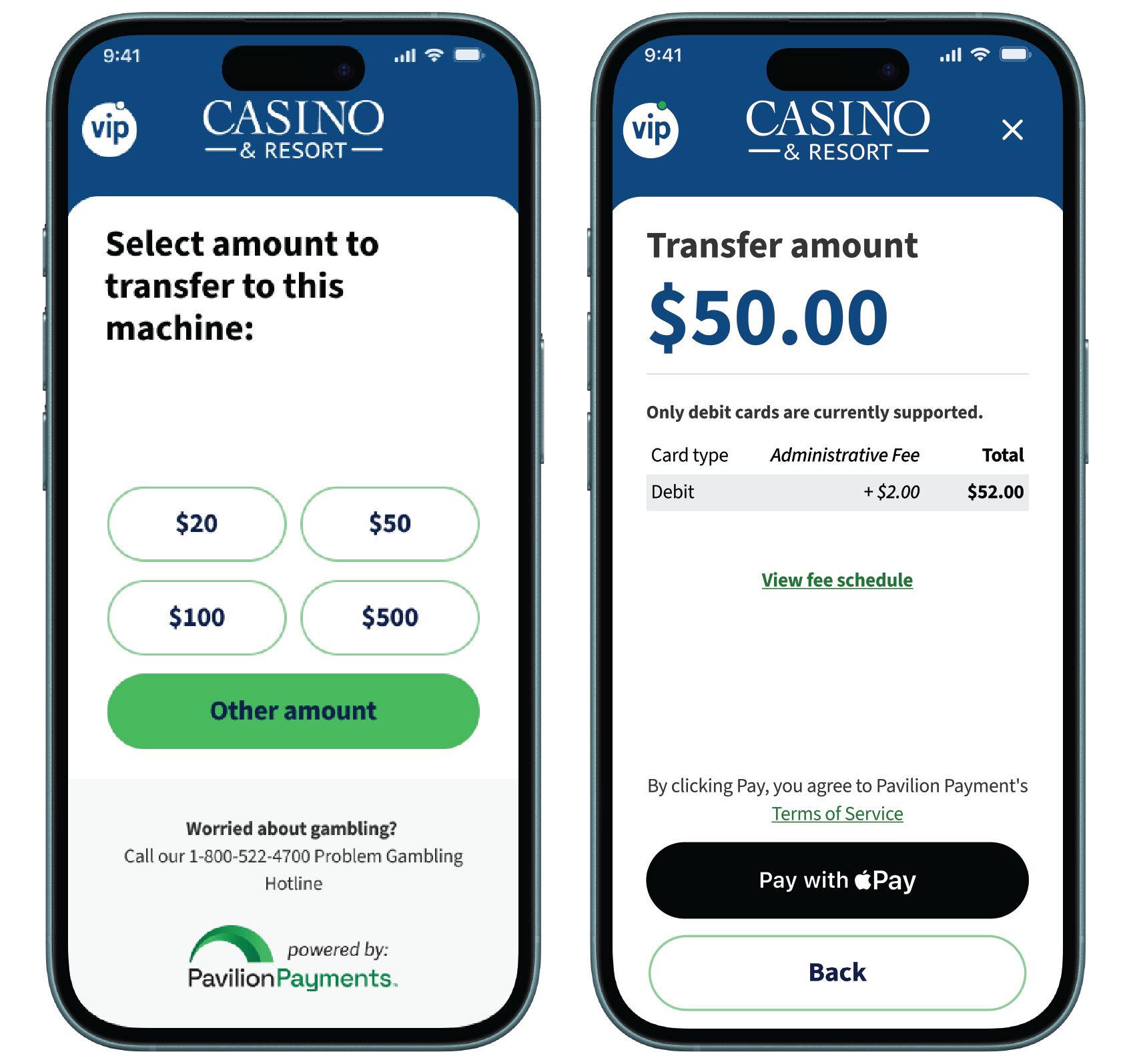
Tap2Play makes the proposition easy to see. Pavilion describes scanning a machine’s QR code, choosing an amount, and paying through Apple Pay. Its product artwork shows a $50 transfer with a $2 administrative fee. That little line is useful: convenience can carry a price. The illustration is an example, and an operator’s actual commercial terms are a separate question.
02 / A new name cost $415 million
Pavilion’s LinkedIn profile dates the business to 1995. Its independent identity arrived much later. In 2023, private equity firm Parthenon Capital bought Global Payments’ gaming division in a $415 million transaction. The business became Pavilion Payments, with Christopher Justice leading it as CEO. Global Payments remained a payment acceptance partner.
2023 sale of Global Payments’ gaming business to Parthenon Capital.
Why separate it? Global Payments described a shift toward its corporate clients and away from consumer-centric businesses. The buyer saw room for a gaming specialist. Justice argued that independence would allow greater reinvestment in products and people. This was a change in ownership and investment priorities, rather than a newly invented payment network.
Payments Dive reported that the unit contributed about $100 million in 2022 revenue and processed roughly $10 billion in payments that year. Those figures describe two different things: money earned by the business and money passing through its systems. Keeping the dates attached prevents a large historical processing number from masquerading as today’s sales.
The business model follows that division of labor. Pavilion supplies payment processing, risk services, software, and equipment to gaming organizations; patrons encounter those services while funding or cashing out. Its developer portal offers a React-based component for embedding deposits and withdrawals into an operator’s application. That gives online customers a different entry point from a casino purchasing floor hardware, while keeping both within Pavilion’s payment network. The operational promise is consistent across channels: fewer separate steps for the guest and the people serving them.
03 / The box and the money inside it
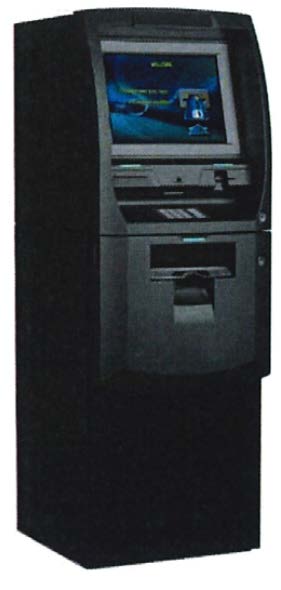
There is a physical side to this story. Pavilion’s LightSpeed kiosks combine functions including ticket redemption, bill breaking, ATM access, eCheck, cash advances, and jackpot processing. Pavilion says casino kiosks historically could contain services supplied by companies other than the manufacturer. Its answer is to bring the machine and the transaction services together.
 Tickets.
Cash.
Payments.
That integration has limits. Cashless funding still meets the installed equipment and approvals of a particular property. In March 2024, JCM announced GLI certification for FUZION 2.1 working with Pavilion’s VIP Mobility in California, Oklahoma, and Michigan. The described route used JCM iVIZION validators with FUZION added. A phone interface does not make those equipment requirements disappear.
“Casinos want to be able to offer their guests a choice of paying for their play”
Dave Kubajak, JCM Global, March 2024
Everi and NRT were competitors named by Justice in 2023. Pavilion’s proposition is the breadth of the connection: bank funding, mobile play, physical cash access, and operator workflows. It is an enterprise payments and technology supplier, with consumer-facing tools attached. Buying it means choosing infrastructure and service relationships as well as a screen.
04 / Follow the payment into the paperwork
The next move was behind the scenes. Pavilion acquired CasinoSoft in July 2025, adding anti-money-laundering and Title 31 compliance, tax forms, jackpot handling, and regulatory reporting software. This extended the company from helping move money to helping operators manage the records surrounding it. Payment speed and administrative speed became parts of the same sales pitch.
- 01FundBank, card, mobile
- 02PlayFloor or online
- 03RecordOperator workflows
Conceptual workflow. Available integrations vary by property and product.
In February 2026, Pavilion announced an agreement for certain DiTRONICS contracts and technology assets. Its current integration page now confirms the acquisition and promises continuity for existing customers. In August, Happy Valley Casino selected Pavilion for cash access and compliance, including check services, ATMs, kiosks, and AML automation. The bundle had a named customer and a concrete deployment.
05 / The lesson hiding behind the QR code
For another business, the useful idea is to follow the customer’s task across departmental boundaries. Pavilion’s acquisitions connect transactions with the work those transactions create. A prettier deposit screen alone would leave that work untouched. The opportunity lies in understanding who handles the next step, and what they need to finish it.
There is also a boundary to removing friction. Pavilion offers self-exclusion and self-directed funding limits, and describes research with UNLV on cashless wagering. These tools matter in a business whose stated mission includes maximizing guest spend. Faster funding needs controls as well as convenience; neither a QR code nor a payment guarantee answers every question about appropriate use.
On October 8, 2026, Pavilion named Mary Beth Higgins CEO and promoted Alyssa Beaver to chief revenue officer. The next test is operational: making an expanding portfolio work together for customers. The most persuasive version of Pavilion’s story will be measured in completed transactions, manageable records, and fewer handoffs. The machine can keep the flashing lights.