Paul McCarthy had plenty of ways to hear that something needed fixing. A tenant could phone. A contractor could send a message. There were emails, voicemails and little adhesive squares of obligation. Between them, these channels could carry almost any instruction. Keeping track of the work was another matter. McCarthy, who had spent more than 25 years in software development while also managing buildings through a family business, found himself wanting something almost embarrassingly modest: a photograph he could follow through to a finished job.
That irritation became Snapfix. Its central proposition fits into three colours: red for a new task, yellow for work under way, green for completion. A picture shows the problem; the colour shows where things stand. The idea borrows a piece of street furniture that most people already understand. There is a pleasing economy to a software founder finding his organising principle at a junction.
Twelve children, then a world of computers
McCarthy grew up as one of 12 children on a farm in County Cork. His account of that childhood connects it with teamwork, simple arrangements and making limited resources go further. The setting gives his later preoccupation with wasted time some texture. Long before there was an app to design, there was a family in which cooperation had practical consequences.
He studied computer science at University College Cork, then spent 15 years working abroad, including in New York, Britain, Australia and Germany. His career took in ICL, National Terminals in Australia, Fusion Systems, Vision Consulting and the Irish electronic purchasing business Marrakech. It was a working education in the systems companies use to organise themselves, acquired across several countries rather than one office.
He returned to Ireland to raise a family and lived in Dún Laoghaire, working in property management and development through the family business. Software and buildings gave him two views of the same daily problem. He knew what computers could coordinate, and he knew how much coordination still depended on someone remembering to pass on a message. That overlap supplied him with a problem worth keeping.
The photograph that saved a paragraph
One detail in Snapfix’s early history is particularly domestic. McCarthy’s son sent him a photograph rather than writing instructions for a game. The image made its point. McCarthy saw an approach he could carry into reporting problems in buildings. The expensive thinking behind a software company can begin with a child choosing the quicker way to explain something.
He had already looked for a tool he could use himself. What he found felt too complicated, too dependent on forms, too inflexible or too expensive. Other businesses recognised his frustration when he spoke with them. The task became designing something with the ease of familiar messaging applications, while giving work a visible beginning, middle and end.
In conversation with Ryan Staley, McCarthy put his impatience rather neatly: “We’ve declared war on forms.” The line is funny because the enemy is so unglamorous. A form rarely announces itself as an obstacle. It merely asks for another field, another description, another minute. McCarthy’s complaint starts with the person standing in front of the thing that needs attention.
“We’ve declared war on forms.”
Paul McCarthy
Three states. Written labels keep the meaning clear alongside the colours.
A hotel makes a demanding classroom
McCarthy and co-founder Cathal Greaney chose hotels as a concentrated test of the idea. A hotel runs around the clock. Its staff may speak different first languages. Its guests expect a room to work properly without considering the departmental negotiations required to make that happen. These were useful conditions for discovering whether a simple communication system actually helped.
The choice was deliberate. McCarthy has explained that an investor told him insights would differentiate the business. A demanding environment could produce those insights faster. There would be less room for a pleasant demonstration to conceal a troublesome daily experience. A hotel could put the app through many small examinations in a single shift.
One early moment stayed with him: feedback from a hotel employee who could communicate effectively despite English being a second language. The photograph gave that person a more direct route into the conversation. In McCarthy’s telling, this was one of the discoveries that confirmed the design. A useful interface could change who found it easy to participate.
He also saw a larger technical possibility. By 2023 he was discussing a future in which the information gathered through everyday tasks could support analysis, with connections to customers’ existing systems. The ambition went well beyond sending pictures. Yet the person reporting a problem still needed a quick, comprehensible way to begin. That tension runs through the business: plenty happening behind the screen, relatively little demanded of the person holding it.
A trophy before the long sales pitch
McCarthy worked on the idea before Snapfix’s formal September 2019 launch. Greaney, who had worked at Apple in Cork, joined as chief technology officer that year. The early development period and the later company launch explain why the story has both a 2016 beginning and a 2019 milestone. Building the thing and starting its funded life were separate stages.
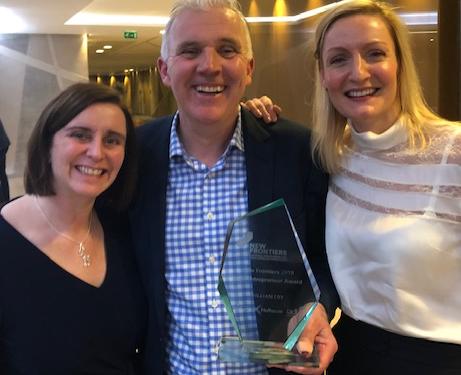
In January 2020, McCarthy won the New Frontiers Lead Entrepreneur Award after participating in the Enterprise Ireland-backed programme run through IADT and TU Dublin. IADT’s account singled out his direct approach during questions and answers. The accompanying photograph catches him holding the award, smiling broadly. For once, there was a completed task with something more substantial than a green dot to show for it.
By September 2021, he was describing a company with more than 100 customers across four continents and a team of 26. Snapfix had closed a €1.5 million seed round the previous year. The question had shifted from whether he could build a tool for his own buildings to how he would introduce it to many more people. Development and distribution had become parallel jobs.
Then, in January 2022, Snapfix announced €1.75 million in funding backed by the American investment group Sator Grove Holdings. McCarthy said the money would support technical development, partnerships and international sales. Ireland, Britain and the United States were the focus. The ambition had acquired a budget, although the ordinary work of finding customers still lay ahead.
- 2016-18Early development and testing
- Sep 2019Formal launch
- Jan 2020New Frontiers award
- Jan 2022€1.75m funding announced
- Jun 2024Brett Robbins becomes CEO
- Jun 2026McCarthy steps back; stays on board
Patience, reluctantly practised
The route to that investment included an introduction to Sator Grove’s Paul Buser and a meeting in London. McCarthy’s description of fundraising included the familiar awkwardness of being too early for some investors and too late for others. The conversation that worked led to a decision relatively quickly. A company organised around removing delays still had to navigate other people’s calendars.
By the fifth anniversary, McCarthy was emphasising the accumulation of customer suggestions and successive refinements. He also celebrated the original team remaining together. Those details matter in a story so easily reduced to a flash of inspiration. The initial idea had to survive years of requests, adjustments and decisions about what would make daily work easier.
He has called his preferred job title “Chief Impatience Officer.” Yet the search for a leader to help scale Snapfix required patience. Brett Robbins became CEO in June 2024. By February 2025, McCarthy was welcoming him to Dublin to mark the company’s move to new headquarters. Robbins was based in New York, bringing experience in real estate, retail and hospitality to the role.
The founder’s impatience has a quieter counterpoint outside work. McCarthy lives near the sea and enjoys an occasional swim. He has been careful to explain that these are brief dips. It is a small, rather endearing qualification from someone whose working conversation is so often about the possibilities of scale.
His ambitions have also reached beyond the company’s immediate business. In 2025 he described a vision shared with his family: build a billion-dollar company serving more than 100 million buildings, then give it away to help address a global problem. Those were aspirations, rather than a valuation or a count of customers. They offer a different measure of what he hoped the business could eventually make possible. Even his long-range plans returned to buildings, the everyday objects through which the original idea had become useful to him.
Leaving the desk, keeping the question
On 1 June 2026, McCarthy announced he was stepping back from daily activities. He reported customers in more than 60 countries and said he would continue focusing on long-term strategy from his seat on Snapfix’s board. After a decade associated with the idea, he was making space before choosing another problem to tackle.
The change put a clear date on a less visible transition. McCarthy had already made room for a new chief executive two years earlier. Now he was changing his own daily relationship with the business as well. Remaining on the board gave him a way to keep contributing to its direction while leaving the routine of running it behind.
His invitation to people building something new, or looking to simplify an existing product, suggested where his attention might go. The fascination remains the same: how much can be removed before a tool becomes easier to use? The next application was still open. The preference was already clear.
McCarthy’s story has travelled from a large Cork family through international software work to the everyday business of keeping buildings in order. Its recurring object is wonderfully modest. A photo passes between people; a light changes colour. For a founder with considerable ambitions, he has spent a striking amount of time making the first step smaller.
Follow the conversation
Interviews, company updates and more from McCarthy.