Paul J. Taubman had a perfectly serviceable reason to keep an unfashionable telephone. In 2015, while running an investment bank with his initials on the door, he was still using a Samsung flip phone he had owned for more than a decade. He liked the sound. He liked the battery life. In an industry devoted to the next transaction, here was a small vote for something that already worked.
The preference was practical, and rather revealing. His business depended on conversations in which the person at the other end needed to hear every word. A better screen could wait. Taubman had spent much of his working life learning what clients needed from a banker, then left a large institution to test how much of that relationship could travel with him.
Quite a lot, as it turned out. His second career began after nearly 30 years at Morgan Stanley. It would eventually require him to do something harder than win an assignment: build an organisation that could earn those calls without every conversation passing through its founder.
A retirement with unfinished business
On November 5, 2012, Morgan Stanley announced that Taubman would retire at year-end. He was co-president of Institutional Securities, overseeing businesses that included investment banking, capital markets, sales and trading. Colm Kelleher, his fellow co-president, would become the division’s president in January. The announcement put a full stop at the end of a substantial institutional career.
It also recorded something more consequential than a change of titles. James Gorman credited Taubman with helping secure Mitsubishi UFJ Financial Group’s investment in Morgan Stanley in 2008 and overseeing the relationship from its beginning. During the financial crisis, the bank itself had needed a transaction. Taubman’s work had helped bring in the Japanese partner.
That experience gives his later independence a particular texture. He had worked inside the machinery of a large bank and helped protect it at a moment of danger. When he left, he carried an understanding of both its capabilities and the demands placed on its leadership. Starting again would draw on that education.
In 2013, Verizon turned to him as an independent adviser on its $130 billion purchase of Vodafone’s 45 percent interest in Verizon Wireless. The transaction was announced that September. Taubman had been among the bankers advising Verizon when an earlier attempt came close in 2004. Years had passed, employers had changed, and the relationship had survived.
For a banker working outside a large firm, it was a striking assignment. For the client, there was a plainer explanation: the people already understood the problem. Investment banking can look like a contest between imposing names on office towers. Here, continuity of judgement mattered across a change of stationery.
Thirty years before the start-up
Taubman graduated from Wharton in 1982 and earned his MBA at Stanford in 1986. His training joined economics with management, before the succession of senior responsibilities at Morgan Stanley. Today, he remains connected to Stanford through its Graduate School of Business advisory council. The student became a practitioner, then someone asked to help think about the institution itself.
The public image of a dealmaker often comes with an imaginary soundtrack: raised voices, slammed doors, somebody demanding a helicopter. Taubman’s reported manner is quieter. People who knew him described an introvert who listened well. There was also an autographed Roger Maris photograph in his office, a fitting possession for a Yankees enthusiast with an interest in consequential performances.
After leaving Morgan Stanley, he had initially imagined a pause. Clients kept calling. “Then a bunch of clients started phoning me up,” he recalled in 2016. It is an excellent complication to a retirement plan, although a poor way to reduce the number of meetings in one’s diary.
“Then a bunch of clients started phoning me up.”
Paul J. Taubman, recalling life after Morgan Stanley
His move also coincided with changing expectations of banks. In a 2022 conversation with Colbert Cannon, Taubman discussed how the aftermath of the financial crisis had made clients more willing to consider advisers beyond the traditional large banking institutions. The opportunity had a personal side and an industry side. A familiar adviser was available just as companies were reconsidering where to seek advice.
One founder, several inheritances
The dates tell an important part of the story. PJT Capital, his predecessor advisory business, dates to 2013. PJT’s own biography places the firm’s founding in 2014. The publicly traded PJT Partners took shape in October 2015, when that independent business combined with Blackstone’s financial and strategic advisory, restructuring and reorganisation advisory, and Park Hill fund advisory operations.
A founder’s story usually offers the comfort of one beginning. Taubman’s involves several, each answering a different question: when he began advising independently, when he assembled a firm, and when the combined public company emerged. The result joined a new enterprise to established teams and capabilities. It brought experience from more than one institutional family into the same business.
The predecessor business
PJT’s founding year
The public company begins
That combination matters to understanding Taubman’s achievement. The solo adviser’s reputation could bring in work. A lasting firm needed a broader range of expertise and people able to work together. Restructuring, strategic advice and fund advisory created different reasons for clients to pick up the telephone, including when the business environment became less hospitable to acquisitions.
Consider the work of restructuring. PJT advises on liability management, specialised financing, distressed asset sales and court proceedings. A company facing financial pressure needs people who can negotiate across competing claims and understand what the available choices actually permit. That work gives the organisation a purpose during difficult markets as well as buoyant ones. The founder’s job includes making those capabilities part of a coherent whole.
The word after the initials
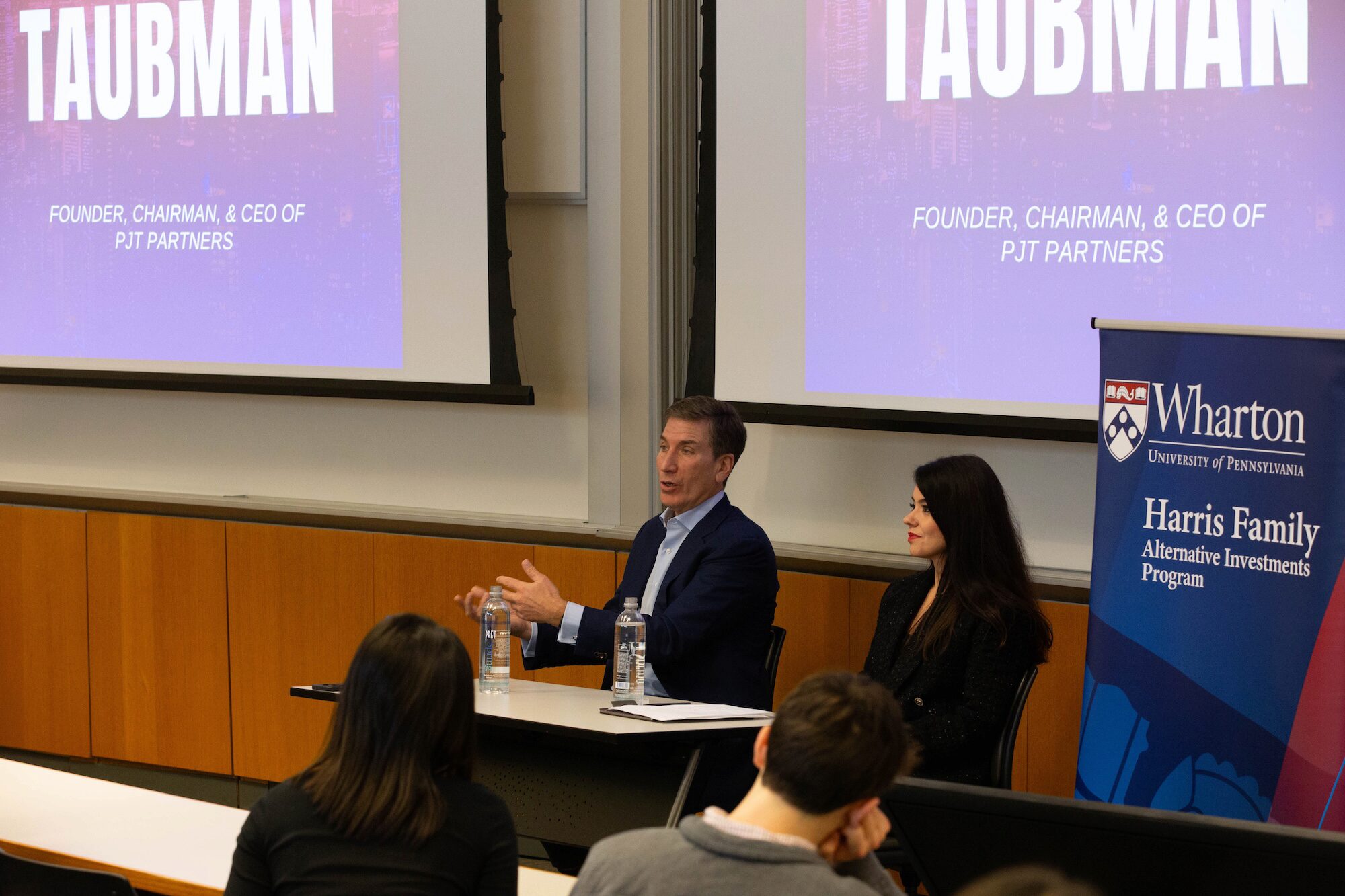
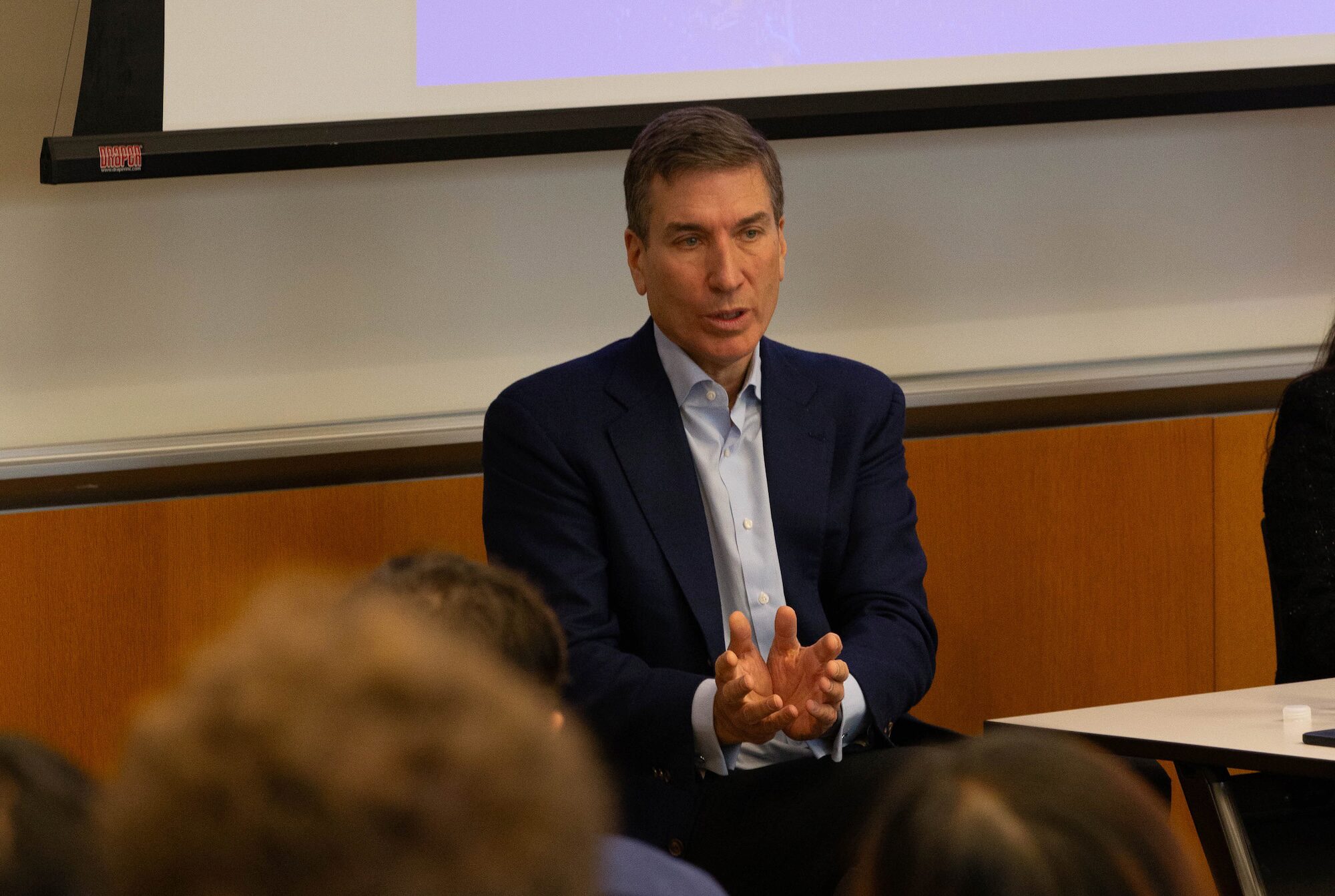
In December 2025, Taubman returned to Wharton for a conversation moderated by Burcu Esmer. He described a business that began with two people and grew beyond 1,000. His discussion of recruitment emphasised drive and intellectual curiosity. The name had been chosen deliberately, too: “Partners” signalled that the organisation would be defined by its people.
There is a useful tension in that name. The initials identify the founder; the next word makes room for everyone else. For someone whose independent career had demonstrated the value of a personal reputation, distributing that reputation across a firm became a central task. A client needs confidence in the person answering the next call, too.
The expanding map provides one measure of that work. PJT acquired CamberView in 2018. It passed $1 billion in annual revenue in 2020. In 2024, it opened in Tokyo and Munich and acquired deNovo Partners, bringing offices in Dubai and Riyadh. Stockholm and Milan followed in 2026, taking its footprint to 17 offices in 10 countries.
Those additions carry a management problem inside the geography. Each new location has to contribute knowledge and relationships while belonging to the same firm. An office sign can be installed quite quickly. Creating reasons for colleagues in different cities to call one another takes longer. Taubman’s emphasis on recruitment makes sense against that expanding map.
An education in paying it forward
There is another classroom in Taubman’s story. During a visit to Prep for Prep, he watched an 11-year-old speak complete sentences in Mandarin after only weeks of study. He was impressed by the students’ commitment and the programme’s academic intensity. The detail is more telling than a general declaration in favour of education: he noticed what a child had learned to do.
By the time Prep honoured him at its 2019 Lilac Ball, he had supported the organisation for more than two decades. Prep helps promising New York City students of colour access independent schools and supports their educational and leadership development. His involvement sat alongside his role as board president of New York Cares and other civic commitments.
At the ball, he spoke about his father growing up in a household where English was seldom spoken. He connected his own family’s earlier challenges with those faced by the students being celebrated. The point brought a financier’s polished present into contact with a less comfortable family past.
He also wanted his son to leave with an understanding of mutual responsibility. The evening raised more than $3.8 million for Prep’s programmes. Yet the lesson he described was personal: remember the help that allows people to advance, and make it available to someone else. In a career built on relationships, that obligation extends beyond the client list.
The next call
By 2025, PJT generated $1.714 billion in annual revenue, up 15 percent from 2024. Advisory fees accounted for $1.500 billion and placement fees for $181.6 million. The figures describe a business whose scale now exceeds the early image of an independent banker with a telephone and a few enduring clients.
The first half of 2026 brought revenue of $904.5 million, a 24 percent increase over the comparable period. In announcing those results, Taubman linked the firm’s progress to sustained investment in its capabilities, footprint and brand. The ambition remained institutional: keep building the organisation that makes future assignments possible.
On October 22, PJT scheduled its next results for November 3, 2026. Public-company life supplies its own calendar, quite independent of a founder’s preferences. Quarterly numbers arrive; clients make decisions; new colleagues join. Taubman’s second act has become a continuing exercise in making personal judgement work at organisational scale. The telephone remains a useful place to begin.