At nineteen, Patrick Sigrist spent three months cycling more than 3,000 kilometres through Patagonia. It is an appealing detail in the biography of someone who would later help start a company called Nomad. The name fits the journey almost too neatly. But a bicycle also supplies a useful way to think about his working life: movement depends on a surprisingly large number of small things agreeing to cooperate.
In his businesses, those small things have included restaurant menus, telephone orders, international transfers and the machinery of private credit. Sigrist has helped build iFood, cofounded Nomad and, in 2025, introduced IORQ. The industries change. Read together, the ventures suggest a recurring interest in the awkward space between wanting something and actually getting it.
This is a career easier to understand through its inconveniences than through its valuations. Dinner should arrive. A Brazilian should be able to open a dollar account. A company should be able to arrange financing without assembling an entire financial operation from scratch. Each sounds modest when put that way. Modest requests can conceal very complicated plumbing.
A dinner order with a long backstory
The story behind iFood reaches back to Disk Cook, the delivery business established in 1997. Its world included printed restaurant menus and orders placed by telephone. Customers could choose their dinner from a guide, then call a central operation. Before the familiar app, there was the less glamorous business of making an order travel from a hungry person to a restaurant.
By January 2002, Sigrist was explaining a difficult stretch at Disk Cook. The company had been operating at a loss until the previous year. Help from Endeavor had brought partnerships and operational changes. The business broadened its delivery offering to include convenience products, toys and books, while concentrating its Rio operations in São Paulo. It then had 35 employees and 160,000 registered customers.
Those figures belong to that moment, not to the later iFood empire. They make the early business more tangible: a staff, a customer list, and a need to make the economics work. A printed menu could promise a delightful evening. The delivery operation still had to pay for the promise. Entrepreneurship has always had a talent for making a romantic idea sit down with an accountant.
The eventual change depended on other people arriving with different experience. Eduardo Baer had worked with Sigrist at Disk Cook. Guilherme Bonifácio, Felipe Fioravante and Renato Motta came from a circle formed at the University of São Paulo’s business school and its junior enterprise. Bonifácio later recalled that they wanted a business they could help turn around.
In 2008, they accepted the challenge of digitising Disk Cook and building iFood. Their management training met an operating business with actual customers. That pairing is more interesting than a solitary flash of inspiration. It brings together a person who knows the troublesome details and people eager to reorganise them. The telephone business supplied problems a presentation could only describe.
The app was a team sport
iFood was founded in 2011 by Sigrist, Baer, Bonifácio and Fioravante. Movile invested in 2013. Those milestones would become part of a much larger technology story, but the beginning remains recognisable: connect restaurants and customers, then improve how the connection works. A digital interface shortened the distance between browsing a menu and placing an order.
Sigrist’s own account of the period makes room for company. When he announced his new Nomad journey, he named colleagues and investors who had helped him along the way. His list included Simone Carvalho, Baer, Fioravante, Bonifácio, Renato Motta, Ulisses Baldini and Gabriel Pinto. He also acknowledged investors including Fabricio Bloisi and David Buttress. The roll call matters. Businesses accumulate relationships as well as customers.
He wrote that his early vocabulary had not included startup and venture capital. There is something refreshing about a founder admitting that the jargon arrived after the work. The important discovery had been a market to serve; the fashionable labels could catch up later. He also described colleagues becoming close friends, a warmer measure of time spent building than a funding announcement can provide.
His background adds another unexpected turn. Sigrist trained in forest engineering at the University of São Paulo, completed a master’s at Purdue University and an MBA at Fundação Instituto de Administração. His master’s work concerned spatial data analysis. Forestry, dinner delivery and financial technology make an unconventional curriculum. They also offer plenty of practice at understanding systems whose parts do not behave independently.
At Yellow Ventures, his biography describes work leading iFood’s acquisitions and a subsequent role as an investor and adviser. That experience adds a second perspective to the founder’s job: beyond persuading someone to try a product, there is the question of how businesses combine, grow and survive. It is a useful education to carry into another attempt.
An expensive trip becomes a dollar account
After leaving iFood’s operations, Sigrist went to Silicon Valley in 2015. A later account of Nomad’s origins places him and Eduardo Haber in the United States in 2016, noticing how expensive it could be for Brazilians to use international credit cards there. It was a customer problem they could understand personally. Crossing the border did not make the financial border disappear.
A trip can be wonderfully straightforward until the bill arrives. Currency conversion makes even a familiar purchase a small calculation. For an entrepreneur looking for an everyday source of friction, that is fertile ground. The opportunity lay in giving Brazilians a simpler way into a financial life denominated in dollars.
Nomad was founded in 2019 and began operating in November 2020. Its service allowed Brazilians to open US dollar accounts digitally. By July 2021, it had more than 50,000 accounts opened. International remittances, transactions and investments formed the early offering. The customer could approach an American account from Brazil, rather than organise a whole journey around obtaining one.
Nomad brought together five cofounders: Lucas Vargas, Gabriel Pinto, Sigrist, Eduardo Haber and Marcos Nader. Vargas is its CEO. Calling Sigrist its founder describes a real role, but leaves out the ensemble. The company joined experience in technology, operations and finance around a problem that crossed national boundaries. Here again, his career shows the value of assembling people who know different parts of the job.
“Mais do que sócios, se tornaram melhores amigos.”
Patrick Sigrist, recalling his early collaborators
“More than partners, they became best friends.” Translation.
In May 2022, Nomad raised US$32 million in a round led by Stripes. Sigrist was then described as founder and executive chairman of its board. The planned uses included expanding investment products, attracting customers and developing technology. The work was extending beyond the original account into more reasons for customers to return.
The company’s later milestones show that widening ambition. Nomad acquired international transfer business Husky in 2022. A US$61 million round followed in 2023. By 2025, its investment services business had obtained a FINRA brokerage licence in the United States, and Nomad Wealth had launched in Brazil. These are company developments; their significance for Sigrist’s story is the growing scope of the institution he helped begin.
When the money stops being friendly
Sigrist’s public comments also contain a colder assessment of startup life. In March 2023, after Silicon Valley Bank collapsed, he warned that businesses which had burned through money could struggle. He described a market becoming less willing to pay for distant promises, particularly in later-stage companies. The investor’s outlook had become more demanding about what the business could sustain.
It is an instructive companion to the account of Disk Cook’s early losses. The practical problem survives changes in fashion: revenue, costs and available capital still have to meet. A successful previous venture may open a door. It cannot make the next company’s arithmetic disappear. In September 2023, he also joined a public discussion about founder-investor relationships, including difficult conversations and choosing investment partners.
There is a dry sense of humour in his reaction to the SVB rescue. He observed that people who disliked state intervention in other settings had welcomed it here. His short closing verdict was, in translation, “That’s curious.” It is the sort of remark that punctures a room full of principles without needing to raise its voice.
The next queue is for credit
By 2025, Sigrist was pursuing IORQ, a private-credit platform. Its starting point was different from an early delivery operation: the acquisition of Quatá Investimentos brought an established credit business into the project. Beatriz Degani became CEO, with Bernardo Mergár among the partners. A R$35 million funding round backed the launch. Sigrist’s role is executive chairman.
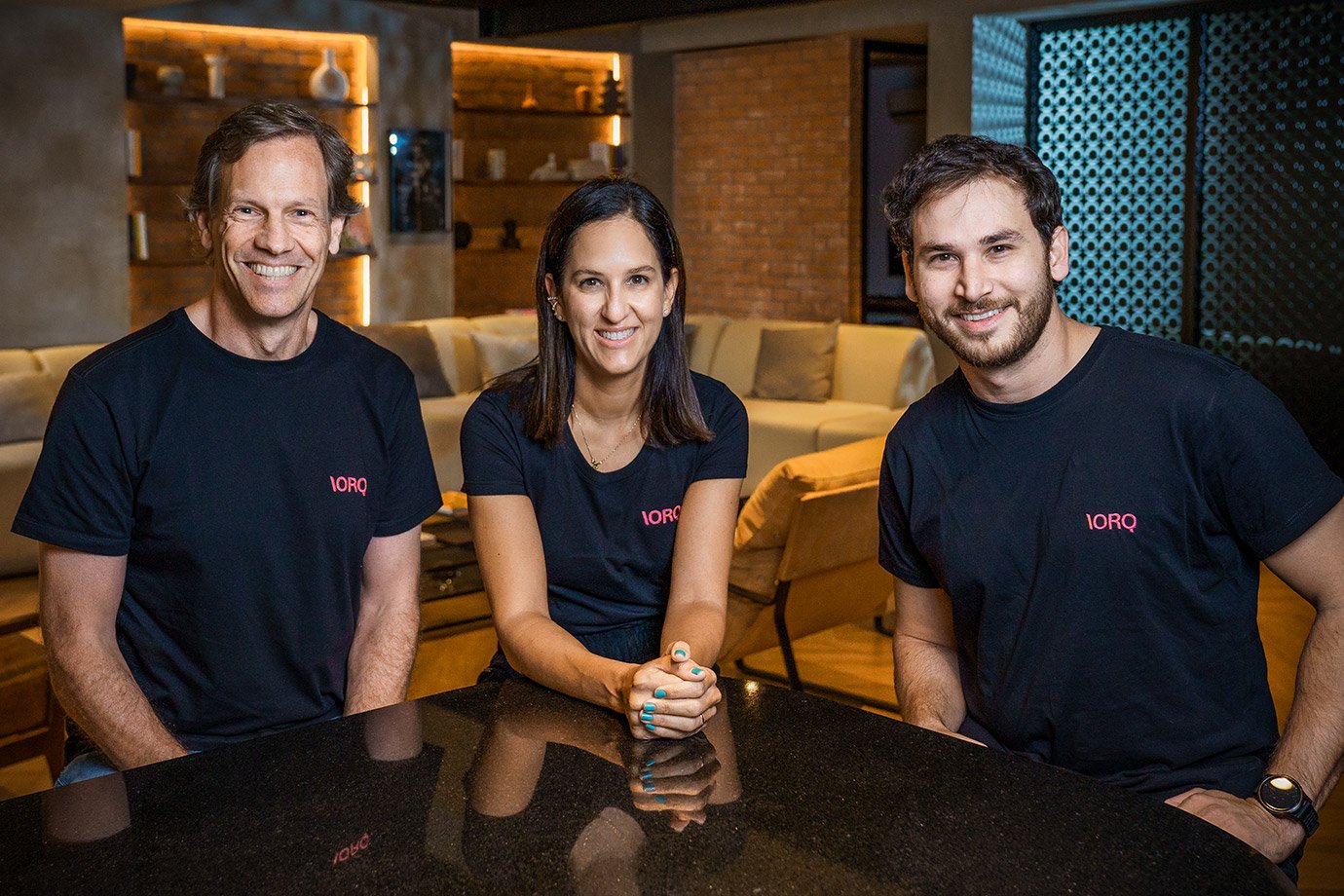
The proposition lets businesses use credit infrastructure for their own relationships with customers and suppliers. IORQ describes direct corporate credit and technology that structures and monitors credit operations. Think of the work as connecting the money to the machinery required to manage it. Lending is only one part of that arrangement; someone must also keep track of the transaction afterward.
The numbers require dates. IORQ entered the market in 2025 with R$2.5 billion under management inherited from Quatá. Its website, checked in October 2026, reports R$3.1 billion under management and more than R$15 billion originated. These figures describe the business and its operating history. They give the new venture an established base from which to attempt change.
Assets under management reported on its website, October 2026.
R$2.5bn reported at the August 2025 launch. Different dates, same measure.Sigrist has said IORQ could become his company “para a vida” - for life. That is an intriguing aspiration from someone whose biography keeps acquiring another beginning. Perhaps the appeal is a problem large enough to keep occupying him. Perhaps it is simply what founders say when a new project gives them a reason to start the day. The ambition is his; the outcome remains open.
The bicycle in Patagonia, the telephone at Disk Cook, the dollar account and the credit platform belong to very different worlds. Together they make a career with a recognisable direction. Sigrist keeps returning to transactions that ought to be easier, and to partners who might help make them so. There is no shortage of either. Even after the app is downloaded and the account is opened, somebody still has to make the next thing move.