In 2012, Marcelo Sampaio was trying to persuade his friend Bruno Caratori to take Bitcoin seriously. Caratori thought the idea was absurd. Years later, he could still remember his reaction: “What are you doing?” It is an excellent question to put to a friend who appears to have discovered the future in something most people cannot explain. It is also a question whose answer, in this case, took fourteen years to become fully visible.
On March 5, 2026, Sampaio handed the chief executive’s job at Hashdex to Caratori. The former skeptic would run the company they had founded together in 2018. Sampaio became executive chairman, remaining at the firm full time. Their early disagreement had produced a partnership durable enough for a change of command. If you wanted a tidy advertisement for agreeing with your friends, this would be an inconvenient story.
The useful thread in Sampaio’s career is his interest in making unfamiliar technology accessible. Before crypto funds, there were inexpensive computers. Before either business, there were years selling technology at Microsoft and Oracle. Again and again, the work involved bringing an invention closer to people who had reasons to hesitate. Enthusiasm was part of the job. So were distribution, familiar packaging and a considerable amount of explaining.
A computer shaped like an argument
Sampaio studied production engineering at PUC-Rio and later completed executive programs at Harvard Business School and INSEAD. His early career took him through Microsoft and Oracle, where he became the company’s youngest sales director globally. He also worked at Rio Negócios, Rio de Janeiro’s investment promotion agency. These were useful places to learn how organizations decide to buy something, and how many conversations stand between a good idea and a signed agreement.
In 2012, he co-founded Endless with Matt Dalio in San Francisco. Sampaio served as chief growth officer. The company set out to bring affordable computers to consumers in emerging markets. Its early field research included Rocinha in Rio de Janeiro and Guatemala. That detail matters: the prospective customer was someone whose circumstances had to shape the product, rather than someone expected to rearrange a household budget around Silicon Valley’s preferences.
The computer itself was hard to mistake for office equipment. A rounded, unusual object, it had the sort of shape that invited comparisons with an egg. In 2015, a model priced at $169 came with around 150 installed programs, including education, entertainment and business tools. The proposition was practical. A person buying a first computer should be able to do something with it when it arrived.
Sampaio had to defend that proposition during the rise of cheaper smartphones. His explanation was straightforward: phones were useful for communication, while writing and other productive work still called for a computer. At Computex in 2015, he also discussed the cost of processors and operating systems. By building its own operating system and using an integrated processor, Endless could lower the price. The aspiring futurist was discussing the bill of materials.
Distribution followed the same logic. Endless began selling through its own kiosks and Claro stores in Guatemala, with an América Móvil agreement helping it reach customers. Access required a route to the buyer as well as an affordable machine. This earlier venture gives his later career a useful continuity. The question of how a technology reaches ordinary users had occupied him well before a cryptocurrency ticker entered the picture.
The price of an Endless computer described in December 2015, with roughly 150 programs already installed.
The friend who needed convincing
Sampaio had begun investing in digital assets by 2012. Caratori’s skepticism would eventually give way when Ethereum helped him see a broader technological possibility. Their histories gave the partnership different points of reference: Sampaio came from technology and entrepreneurship; Caratori had worked in risk at Gávea Investimentos and in product at the education platform Edmodo. Both had spent time thinking about systems people would actually use.
They founded Hashdex in 2018. Sampaio’s interest extended beyond selecting a favorite coin. A growing collection of blockchain projects suggested an investable market, but participation still demanded decisions many investors were poorly equipped to make. Which assets belonged in a portfolio? How should they be held? How could someone gain exposure through the financial arrangements they already understood?
The name supplied the outline of an answer: hash plus index. Hashdex would build products around a basket of digital assets. In his account of the company’s origins, Sampaio has described the missing pieces as structure, a product and a way to explain crypto inside the existing financial system. A founder could believe strongly in the technology while recognizing that conviction alone made a rather incomplete investment vehicle.
There is a pleasing modesty in the index idea. It gives up the performance of knowing tomorrow’s winner. Instead, it establishes rules for what belongs in the basket and allows that basket to change as the market develops. Sampaio’s bet was that people would want exposure to an emerging field without also taking on the occupation of full-time coin selector.
- 2012Digital-asset investing
Endless co-founded - 2018Hashdex founded
with Bruno Caratori - 2021Crypto index ETF in Bermuda
HASH11 on Brazil’s B3 - 2025NCIQ begins trading
on Nasdaq - 2026Sampaio becomes
executive chairman
First, give the future some rules
The Nasdaq relationship turned that proposition into a benchmark. Together, Hashdex and Nasdaq developed the Nasdaq Crypto Index, using eligibility criteria and periodic rebalancing to describe an investable part of the market. That was less theatrical than choosing a coin mascot. It was also work an institutional investor could examine, discuss and put through a committee.
In February 2021, the Hashdex Nasdaq Crypto Index ETF launched on the Bermuda Stock Exchange for accredited non-US investors. On April 26, HASH11 began trading on Brazil’s B3, becoming the country’s first ETF referenced to a cryptocurrency index. Those are separate milestones in separate markets. The Brazilian product started with an initial unit value of approximately 50 reais and used the trading arrangements already familiar to local brokerage customers.
The smallness of that transaction was part of its significance. The underlying technology might require pages of explanation; the act of buying exposure could fit into an existing brokerage account. A crypto index fund still carried the risks of its assets. What changed was the route into them. Sampaio’s business was building that route, with exchanges and other financial institutions taking defined roles along the way.
His connections grew through patient contact. Eduardo Vasconcellos of Valor Capital Group first met Sampaio and Caratori at the Brazil at Silicon Valley conference in 2019. They stayed in touch before Valor led Hashdex’s 2021 investment round, joined by investors including SoftBank and Coinbase Ventures. The story has an ordinary interval at its center: a meeting, continued conversations, then capital. Even futuristic finance occasionally proceeds at the speed of getting to know someone.
Many assets. Different technologies. Uneven liquidity.
A defined basket, reviewed and rebalanced.
Exposure through a familiar brokerage transaction.
A bell, and a preference for conversation
In March 2023, Sampaio was at the New York Stock Exchange celebrating six months of trading for Hashdex’s US bitcoin futures ETF. The opening bell supplied the ceremony. His comments supplied the method: cooperation with regulators and an incremental approach as the industry pursued a US spot bitcoin product.
“We work with regulators, we don’t sue them.”
Marcelo Sampaio, March 2023
He expected a spot bitcoin ETF eventually, while acknowledging uncertainty about its timing and circumstances. That combination is characteristic of his public argument: confidence about a direction, with the implementation left to negotiations and technical work. The regulatory details were consequential. They determined which version of a product could be offered, where, and to whom.
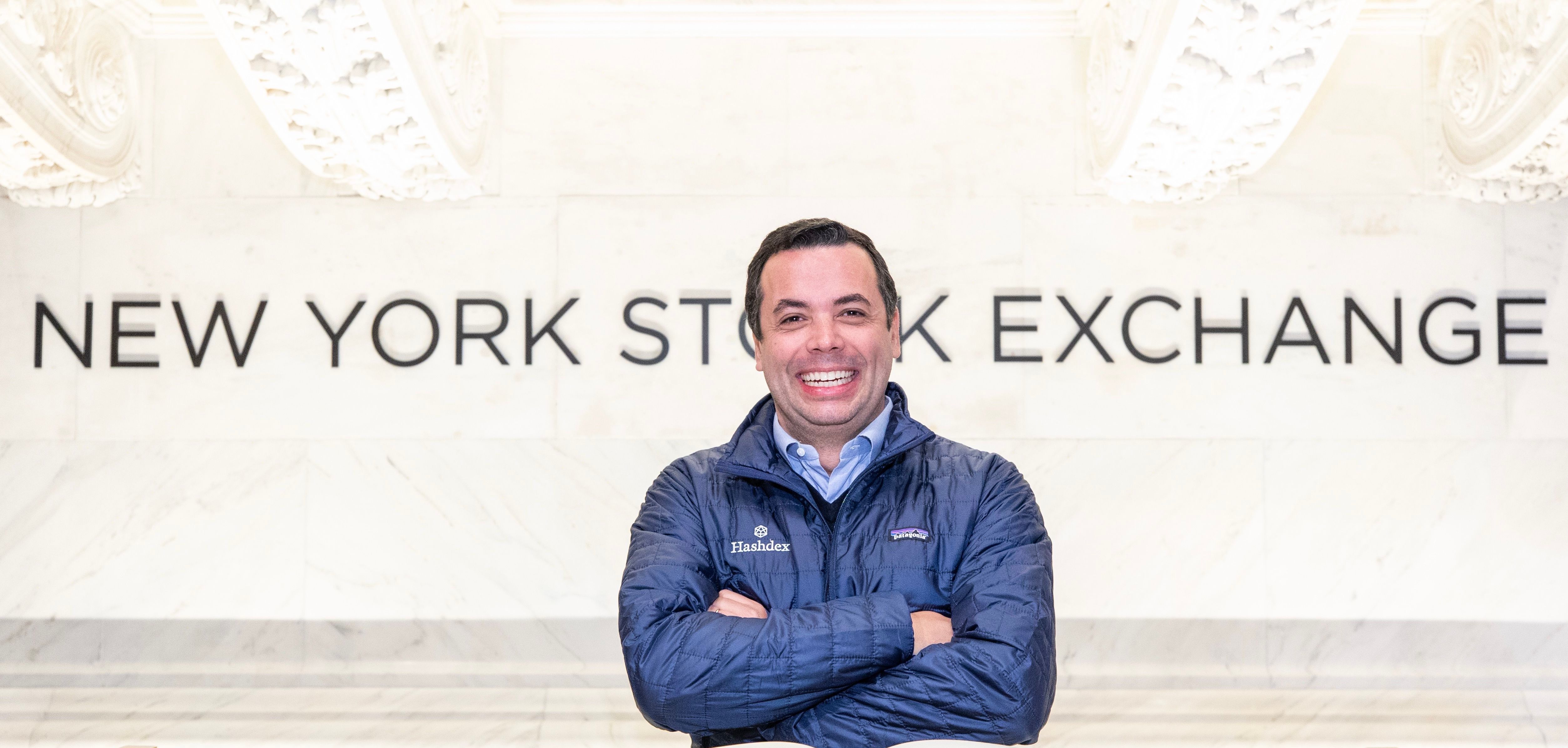
By January 2024, after the SEC’s approval of US spot bitcoin ETF listings, Sampaio was comparing the American and Brazilian processes. He described the US regulator’s concerns about market manipulation and regulated markets, and argued that Brazil had been ahead on this issue. His vantage point was unusual: a Brazilian founder carrying experience from an earlier local launch into a much larger American market.
The basket thesis reached another milestone on February 14, 2025, when NCIQ began trading on Nasdaq with exposure to bitcoin and ether. Its launch brought a multi-asset spot crypto product to US investors. The initial two-asset portfolio was a starting configuration. The broader idea, visible since Hashdex’s name was chosen, was a product capable of evolving with the investable market.
The chairman makes room to think
The March 2026 leadership change followed eight years of building Hashdex. Caratori became global CEO, and Mick McLaughlin became US CEO. Sampaio kept responsibility for the board, long-term strategy, capital allocation, major initiatives and senior relationships. Daily leadership moved to his co-founder. The distinction made room for a founder’s attention to go elsewhere without taking him out of the business.
Sampaio’s own explanation emphasized the United States as the company’s next center of gravity. Caratori was already US-based. Index investing remained the mission, while Sampaio wanted room to explore what Hashdex might become beyond it. He described the new arrangement as giving him “time and space to think and explore.” After years as chief executive, thinking had become something worth making a formal appointment with.
There are other interests in that space. Sampaio plays guitar, sings and enjoys listening to music away from work. He is also an angel investor. His account of leadership favors direct conversations and giving people real responsibility. The public picture is of someone interested in both a company’s organizing idea and the individuals expected to carry it forward.
Back to the classroom
In August 2026, Sampaio wrote about spending six weeks at Stanford’s business school. A class with Rob Reich had stayed with him, particularly the distinction between automating human work and augmenting human capability. He considered whether AI could help people do more, and what would happen to the early career tasks through which inexperienced workers learn. The investor in new technology was asking who would get to develop alongside it.
That question sits comfortably beside the earlier computer venture and the index business. Across very different products, Sampaio keeps returning to the practical relationship between a technology and its user. A computer needs a price and useful software. An emerging asset market needs a benchmark and a workable transaction. AI raises questions about the opportunities people retain when machines can perform more tasks.
His next venture is still an open question. The pattern already has some shape: find a technology with wider possibilities, then work on the arrangements that let other people encounter it. Caratori’s old question remains a good one. Sampaio has spent much of his career making the answer easier to understand.