The first time Mick McLaughlin talked to financial advisors about crypto, the room did not erupt. It nodded politely. A few faces suggested that their guest had wandered in from a more excitable conference. The curiosity was real, but so was the practical objection: how, exactly, does a responsible advisor buy this stuff for a client?
Nearly a decade later, McLaughlin’s answer comes with a ticker symbol, a prospectus, a benchmark, and a management fee. This is progress in the language of finance: the strange becomes a line item. As U.S. CEO and Global Head of Distribution at Hashdex, he is responsible for making regulated crypto products legible to financial advisors and institutions. He is not asking them to memorize the personalities of seven blockchain founders before breakfast. His argument is much less theatrical. Buy a diversified slice, let an index set the rules, and rebalance.
It is an almost comically conventional proposal for an industry that once advertised its contempt for convention. Yet convention is McLaughlin’s craft. His career has followed the ETF from early adoption to ubiquity, through flash crashes, fee wars, currency hedging, smart beta, and now digital assets. He has spent more than 25 years standing at the seam between a product maker’s clever machinery and a buyer’s perfectly reasonable suspicion.
A résumé shaped like the ETF industry
McLaughlin studied government at California State University, Sacramento, graduating in 1993. The degree is a useful detail. Markets may run on numbers, but distribution runs on institutions, incentives, language, and trust. His professional education began at Russell Investments, where he was an early ETF sales hire, and continued at Barclays Global Investors and BlackRock as iShares grew from clever financial invention into portfolio furniture.
By 2013, he was Managing Director and Head of ETF Distribution for the Americas at Deutsche Bank. The X-trackers franchise entered 2015 as an also-ran and finished the year with more than $16 billion in net flows, lifting Deutsche into the top tier of U.S. ETF providers. Currency-hedged funds had the wind behind them, but plenty of competitors could read the same weather. McLaughlin credited his team and the way it helped clients recognize and use the opportunity.
The episode supplied a tidy lesson about distribution. A timely product matters; a sales force able to explain why, when, and where it belongs matters too. In 2016, McLaughlin observed that about 70 percent of ETF flows still went into the top 100 funds. His response was focus: align the firm’s expertise and activity with the right opportunities. Distribution, in this telling, is not confetti. It is concentration applied to relationships.
The access business, one market at a time
After shorter turns at 55 Capital and Hartford Funds, he joined Bitwise in September 2018 as Head of Sales. Crypto was then easier to speculate about than to allocate to. Bitwise built research, funds, and a field organization for professional investors; McLaughlin became Chief Distribution Officer in 2022. One company presentation distilled his earlier record into a blunt line: he had helped build a $20 billion ETF franchise from zero. The next zero was more literal - the crypto allocation in most advised portfolios.
The middle is where the market lives
McLaughlin divides advisors into three broad groups. Some already own crypto for clients. Some want nothing to do with it. Between them sits the interesting crowd: advisors who see that clients are buying digital assets on their own but have not found an approach they can defend inside a holistic plan. Hashdex is built for that middle.
The goal, as he puts it, is to move advisors off zero. That phrase could sound like a salesman’s impatience, but the method is deliberately measured. Crypto remains a risk asset. It responds to liquidity, geopolitics, sentiment, and institutional flows. A regulated wrapper does not abolish volatility; it makes ownership, tax reporting, and custody more familiar. An index does not promise that every constituent will prosper; it removes the need to identify the eventual winners in advance.
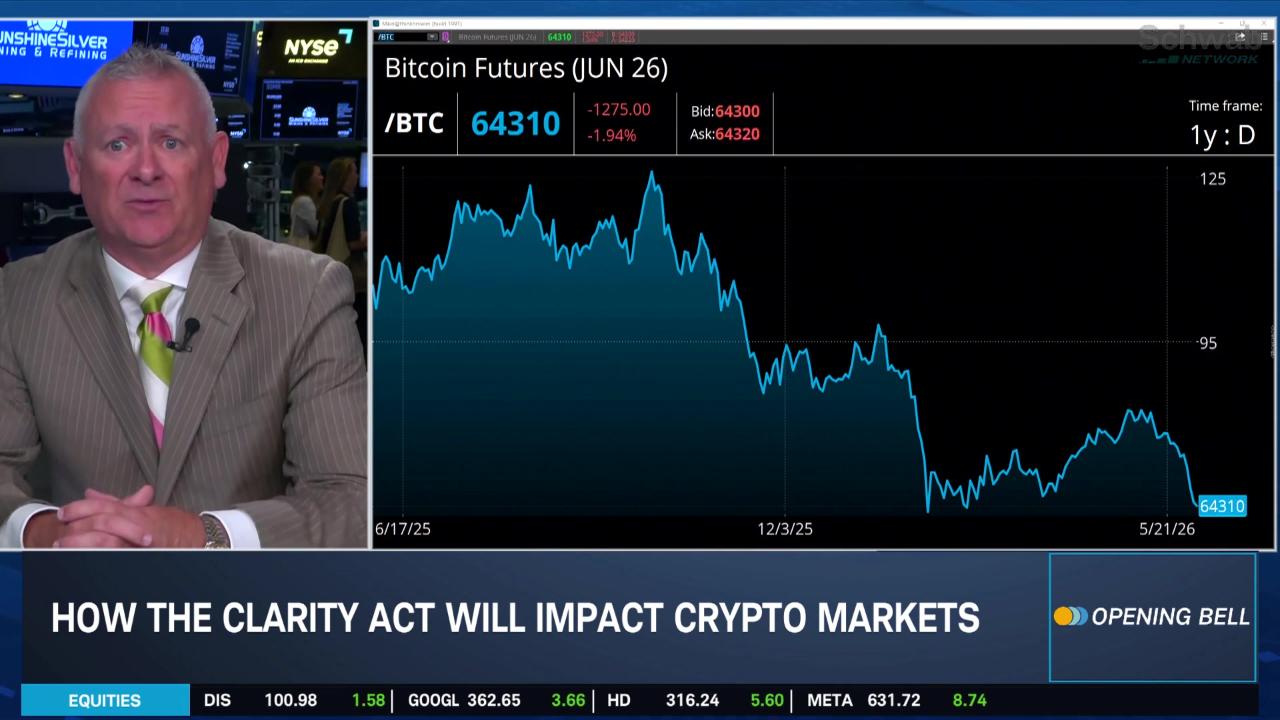
During a June television appearance from the New York Stock Exchange, he addressed a rough patch rather than pretending it away. Institutional selling, outflows from Bitcoin ETFs, and geopolitical tension had all pressured prices. The market infrastructure, he argued, was still present. It was a revealing choice of frame: identify the forces, separate price action from plumbing, then return to the long-term process.
This is the intellectual center of McLaughlin’s current work. Indexing is a behavioral device disguised as a product feature. It replaces a stream of individual predictions with a methodology. When an asset rises, the portfolio can trim it at rebalance. When it falls, the system can add. The investor remains exposed to the category while surrendering some of the urge to chase whichever token has recently acquired a louder fan club.
A promotion, and a larger translation job
McLaughlin joined Hashdex in 2024 as U.S. Head of Distribution. The firm had started in 2018 and built crypto index products across Latin America, Europe, and the United States. Its partnership with Nasdaq gave the emerging asset class a familiar piece of market infrastructure: a benchmark. In February 2025, Hashdex launched NCIQ, a multi-asset spot crypto exchange-traded product in the United States. The fund was designed to evolve as eligible assets and regulation changed, rather than freeze today’s leaderboard forever.
He set about expanding field coverage. Hashdex added specialists for U.S. regions in 2025 and more senior distribution hires in 2026. The organizational diagram tells the strategy: national ambition delivered through people who know local advisors, broker-dealers, institutions, and the texture of a client question. A global index may be rules-based. Trust remains stubbornly hand-delivered.
On March 5, 2026, Hashdex appointed McLaughlin U.S. CEO while keeping him in charge of global distribution. Co-founder Bruno Caratori became Global CEO; Marcelo Sampaio moved to Executive Chairman. McLaughlin described the mandate in verbs that would not disturb a risk committee: strengthen, deepen, expand, scale thoughtfully. He thanked both founders and emphasized alignment between marketing and distribution. The aspiration was clear without becoming operatic - make the U.S. business larger, make advisor relationships better, and keep one institutional story consistent across borders.
Eleven days after the promotion announcement, McLaughlin published an argument for permanently reducing NCIQ’s management fee to 0.25 percent. The point was not simply to be cheap. A temporary waiver asks buyers to calculate the future; a permanent fee lets them evaluate a long-term holding with fewer footnotes. He called the decision a question of investor alignment and said the products should be ones the firm would want to own.
The useful limits of boring
There is a temptation to describe this project as making crypto safe. McLaughlin does not. Product documents are explicit that investors can lose some or all of their capital. Index methodology can diversify asset-specific risk, but it cannot repeal the volatility of the category. Regulation can improve the rails without deciding the destination. Boring, here, means comprehensible enough to evaluate - not harmless.
That distinction explains why his career is useful beyond crypto. Every new market eventually meets people who are paid to be cautious. They do not need another prophecy. They need custody they recognize, fees they can compare, rules they can explain, and a human who will answer the phone after a difficult month. Innovation enters ordinary life through an accumulation of unglamorous permissions.
McLaughlin’s role in that process is neither inventor nor token oracle. He is the operator who translates novelty into portfolio grammar. At Russell and iShares, that meant teaching investors what an ETF could do. At Deutsche, it meant matching product momentum with a focused team. At Bitwise and Hashdex, it means carrying old lessons into a young asset class that sometimes behaves as if history began with its latest block.
The wager underneath his work is modest and consequential: professional investors do not need to fall in love with crypto. They need a disciplined way to decide whether it belongs, how much belongs, and what to do next. After all the slogans, that may be the bridge from curiosity to capital - one index, one rebalance, and one less heroic guess at a time.
Keep reading
- Official Hashdex profile
- Mick McLaughlin on LinkedIn
- His essay on crypto access
- Watch the Schwab Network interview
- Buy the Market, Not the Noise
- The 2016 ETF profile
This profile is editorial information, not investment advice. Crypto assets are speculative and can involve substantial loss.